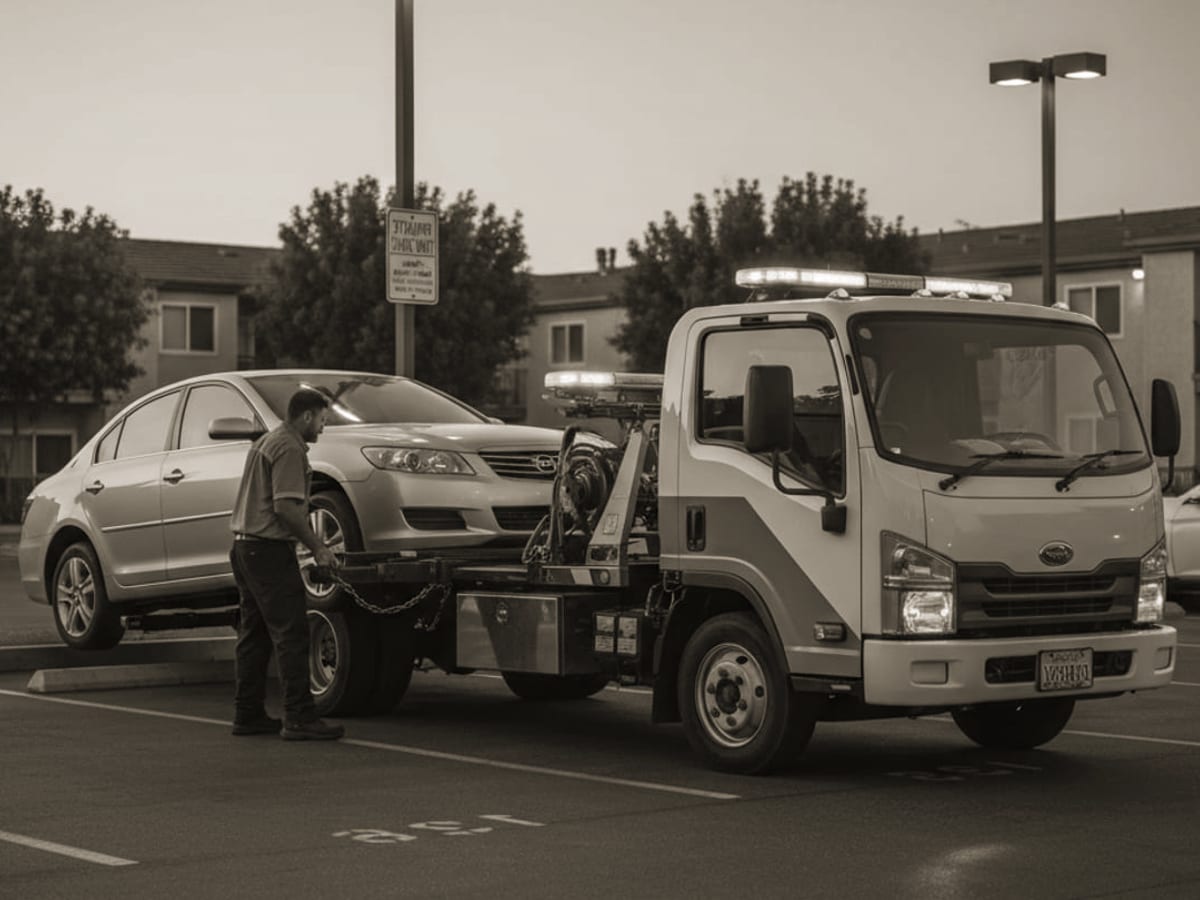
If your car was towed in Texas, you have rights at every stage: during the hook-up, at the storage yard, on the bill, and after you pay. The most important ones: you pay nothing if the car isn’t fully hooked up, you can get your belongings free, and you can request a hearing, with the written request reaching the court before the 14th day after the car was placed in storage or booted, not counting Saturdays, Sundays and legal holidays. Knowing the order things happen makes the whole mess easier to handle.
Quick Tow EP is a referral service. We connect drivers with independent local tow operators. The driver hires and pays the operator directly, and the operator quotes the price. Quick Tow EP does no towing, roadside work or storage itself.
First, figure out what actually happened
Before you assume the worst, confirm the car is really gone. Check whether a friend moved it, whether your lender repossessed it, or whether it was relocated within the same lot.
Then work out who ordered the tow. There are three main possibilities:
- Police ordered it. EPPD lists reasons it may tow a vehicle: parked illegally or appeared abandoned, involved in an accident or unsafe to drive, driver arrested or has no driver’s license, or registration was expired. Call the police non-emergency line to check.
- A property owner ordered it. This happens at apartments, shopping centers and private lots.
- The city handled it through its storage contract. The City of El Paso partners with UR Vehicle Management Solutions, which operates the City of El Paso Municipal Vehicle Storage Facility at 11615 Railroad Drive, El Paso, Texas 79934, phone (915) 212-0205, open 24 hours.
If you’re still standing where you parked, do this before you leave: note the exact spot, the signage, and the time. Photograph entrances, signs, curb markings and any removal tag. Those photos matter later if you challenge the tow. For a fuller walkthrough, see our guide to looking up a towed car in El Paso.
How to find which lot has your car
Call (915) 212-0205 or search the URVMS online vehicle database, which lists all vehicles currently stored at the city facility and their charges. For private-property tows, call the number on the lot signage. Confirm the vehicle is there before you drive across town, and ask whether a hold, lien or investigation blocks release. URVMS advises calling before visiting because some vehicles have a hold and cannot be released.
During the hook-up: the rules most people don’t know
This is where money gets saved, and it’s all about timing.
- If you get back while the car is being hooked up and it is not fully hooked up and ready for towing, you can keep it without paying any charge and without proving ownership.
- If it is fully hooked up but has not left the lot, you can keep it but must pay a drop fee. TDLR’s statewide maximum drop fee is $135 for a vehicle 10,000 lbs or less, $190 for over 10,000 but under 25,000 lbs, and $244 over 25,000 lbs. A city or county rule can set it lower, never higher. The driver must accept cash, credit cards and debit cards for the drop fee.
- Inside El Paso city limits the local rule is lower than TDLR’s. Under City Code Section 12.54.020(D), a vehicle hooked up but not yet towed from the scene is released for one-half the regular tow fee, and there is no charge if it is not yet hooked up.
- You do not have the right to get your car back after it has left the parking facility but before it is placed in a storage facility.
Outside city limits, in places like Socorro, Horizon City, Canutillo, Anthony TX, Fabens, Clint, San Elizario, Vinton or Tornillo, the El Paso code doesn’t apply. There the TDLR statewide maximums govern unless a local rule sets lower ones.
At the yard: ID, ownership and your belongings
To get a car out of a Texas vehicle storage facility (VSF) you must show photo ID, prove you are the owner or authorized user, and pay the towing and storage fees.
Accepted photo ID includes any state driver’s license or ID card, any federal photo ID, or a photo ID from a foreign government such as a Mexico driver’s license or a matricula consular. Proof of ownership is any one of these:
- A driver’s license whose name matches the registration record
- An insurance card naming you
- The title
- A notarized power of attorney signed by the owner
- A tax collector’s receipt plus registration renewal card
- A current lease or rental agreement
- TDLR’s Personal Vehicle Owner Removal and Inspection form, which the VSF must have available
A VSF may not refuse release just because your valid photo ID shows a different address than the title and registration records. If the papers proving identity or ownership are in the glove box or console, the VSF must let you get to them.
To get a car released you must show photo ID and prove you are the owner or authorized user, using one of the documents listed above. Non-owners should call the lot for extra document requirements. If someone else is collecting it, read our post on having someone else pick up a car from an El Paso impound.
Getting your stuff out without paying
At the storage facility you may access your car to get ownership documents and to recover personal property, and you do not have to pay a fee to do this. You do not have the right to remove or dismantle any part attached to the car while it is at the VSF. A VSF must make reasonable efforts to secure a stored car, and that is included in the storage fee.
Access windows depend on the facility. A VSF that takes cars 24 hours a day must let you claim or access your car within one hour at any time. One that does not must do so within one hour between 8 a.m. and midnight Monday to Saturday and 8 a.m. to 5 p.m. Sunday, except national holidays. More detail lives in our post on getting belongings from a Texas tow yard.
On the bill: what can legally be charged
TDLR’s caps cover nonconsent tows, meaning private property tows and similar tows without the owner’s consent. A tow you call for yourself is priced by the operator you hire, and no TDLR maximum table applies to it.
For a nonconsent tow, TDLR’s statewide maximum is $272 for a vehicle up to 10,000 lbs, $380 for more than 10,000 but less than 25,000 lbs, and $489 per unit for vehicles over 25,000 lbs with a $978 total maximum. Lower rates may be set locally. In El Paso, City Code Section 12.54.020 caps the maximum for a nonconsent tow, including debris cleanup, at $100.00 for a light duty tow, $350.00 for a medium duty tow (more than 10,000 but less than 25,000 lbs), and $450.00 for a heavy duty tow (more than 25,000 lbs).
A few more El Paso specifics from Section 12.54.020: an additional fee of no more than $25 may be charged for dollies or go-jacks, and for a vehicle over 10,000 lbs, if the tow takes longer than two hours, up to $55 per hour for each hour over two hours. Section 12.54.030 requires the tow company to remove all wreckage and debris as part of the tow fee. Section 12.54.060 adds a $20 fee collected for the police department when a police-ordered tow is released from storage, and a $20 impoundment fee before release from a city-owned facility.
Texas Occupations Code Section 2308.2065 bars a licensed tower from charging more for a nonconsent tow than the fee set by state rule or by the city or county, and from charging for a service that is not on those fee lists. TDLR can order refunds of overcharges.
Ask for the paperwork
For each nonconsent tow the tow company must issue a tow ticket. It must itemize each charge and show the company’s licensed name, public phone number, certificate of registration number and the operator’s TDLR license number. Tow companies must give their nonconsent fee schedule to every VSF they deliver to, and the schedule must be shown to the public on request. Ask for an itemized invoice and the total in writing before you pay. Our post on Texas towing fee limits breaks down the numbers further.
After the tow: hearings, deadlines and complaints
If a car is never claimed, a VSF must mail or publish at least two notices and wait at least 30 days after the second notice before acting. It may then sell the car at public sale, with proceeds paying towing and storage and any remainder possibly paid to the owner. A car over 10 years old fit only for junking needs only one notice before sale 30 days later. URVMS and the City of El Paso hold public online auto auctions of unclaimed vehicles on the second Tuesday of every month.
After a tow or boot without consent, the owner or operator is entitled to a hearing on whether there was probable cause. Here’s how to request one:
- Write your request. It must include your name, address and phone; where and when the car was removed or booted; who authorized it; the storage facility’s and tow company’s names, addresses and phones; copies of receipts or notices; and photos of any parking sign or a statement that no sign was posted.
- File it in any justice court in the county the car was towed from. For a boot, file in the county where the parking facility is.
- Make sure the written request reaches the court before the 14th day after the car was placed in storage or booted, not counting Saturdays, Sundays and legal holidays. If the required notice was never given, the deadline does not apply, and the 14 days do not start until the tow company or VSF gives you the information needed to fill out the request. Missing the deadline waives the hearing.
TDLR notes the court may charge a $20 filing fee, and the hearing must be held before the 21st calendar day after the court receives the request. At the hearing the burden of proof is on the person who asked for it, and the issues are probable cause and whether the charge exceeded the allowed amount. If the court finds no probable cause, the tow company, VSF, parking facility owner or agency that authorized the tow must pay or reimburse the towing and storage costs. Even with probable cause, an overcharge must be refunded. The court may also award court costs and attorney’s fees to the prevailing party.
Complaints and damage
Complaints about a tow company, tow operator, storage facility or booting company can be filed online with TDLR. Filing a TDLR complaint is not a substitute for requesting a tow hearing, but you may do both. TDLR towing customer service is (800) 803-9202 (in state only) and (512) 463-6599. You can also check any operator on the TDLR License Search by name, license number, city, county or ZIP.
If the car is damaged, photograph the condition before you leave the lot and keep every notice, envelope, receipt and invoice. It is also worth checking with your lender about the car’s status. If the car is held, call the agency or lot that has it and ask what documents and appointments are needed before you go. For a city tow, URVMS says to call (915) 212-0205 before visiting to make sure the vehicle is released for pickup, because some vehicles have a hold and cannot be released. For a Sheriff-towed vehicle, recovery requires an appointment with the EPCSO Evidence and Abandoned Motor Vehicle Section, and the county lists the plate number or VIN, the incident date and case number if given, title, current registration or bill of sale, proof of insurance, and a valid driver’s license as the documents needed.
El Paso’s 2026 anti-solicitation rule at crash scenes
City of El Paso Ordinance 019867, adopted April 28, 2026 and effective June 1, 2026, added Section 12.54.070. It is an offense to show up at a traffic accident or incident scene to do a nonconsent or incident management tow without first being contacted by the police department, vehicle owner, driver or the vehicle’s insurer, or to solicit towing or related business on public streets, property or sidewalks. The presence of a tow company vehicle, employee, dolly, equipment, business card or flyer at a scene that was not dispatched by police or requested by the owner, driver or insurer is prima facie evidence of solicitation. Violations are punishable by a fine not to exceed $500 under Section 12.54.040. If a truck shows up uninvited after a crash on I-10 or Loop 375, read what to do when a tow truck shows up at a crash.
Frequently asked questions
My car is gone from where I parked it. What do I do first?
Confirm it wasn’t moved or repossessed, then call the police non-emergency line to check whether police ordered the tow. Photograph the spot, signage and curb markings before you leave. After that, call the likely lot or search the URVMS database at (915) 212-0205.
How do I find out if it was towed or stolen?
Call the police non-emergency line at (915) 212-4000 and ask whether it was towed and by which agency. If it was a city tow, the URVMS database lists vehicles currently stored at the Railroad Drive facility and their charges.
What paperwork do I need to pick up my car?
Bring valid photo ID and one proof of ownership: a matching driver’s license, an insurance card naming you, the title, a notarized power of attorney, a tax receipt plus renewal card, a lease, or TDLR’s removal and inspection form. URVMS also asks for registration, title or insurance plus the balance owed. Non-owners should call (915) 212-0205 for extra document requirements.
How long do I have before storage fees or auction?
TDLR sets daily storage maximums of $22.85 per day or part of a day for a vehicle 25 feet or less and $39.99 for longer than 25 feet, per the 2023 adjustment. A day begins and ends at midnight, and a VSF may not charge more than one day of storage if the vehicle is there less than 12 hours. A VSF may also collect fees that must be paid to a law enforcement agency or government entity, and may not charge any other storage-related fees. On the auction side, a VSF must send or publish at least two notices and wait at least 30 days after the second before selling. For a hearing, your written request must reach the court before the 14th day after the car was placed in storage or booted, not counting Saturdays, Sundays and legal holidays.
Can I get my stuff out of the car without paying?
Yes. At the storage facility you may access your car to recover personal property and ownership documents without paying a fee. You cannot remove or dismantle any part attached to the car. Ask about the facility’s access window, since a 24-hour VSF must let you in within one hour at any time.
Can I dispute the charges or the tow itself?
Yes, through a justice court tow hearing filed in the county the car was towed from. The court decides probable cause and whether the charge exceeded the allowed amount, and an overcharge must be refunded even if the tow was valid. You can file a TDLR complaint too, but it does not replace the hearing.
When to call for a tow
If your car won’t start, won’t move, or can’t be driven safely after a breakdown or crash, you need a tow operator rather than a rights fight. Call (915) 320-5573 and Quick Tow EP will connect you with an independent local tow operator.