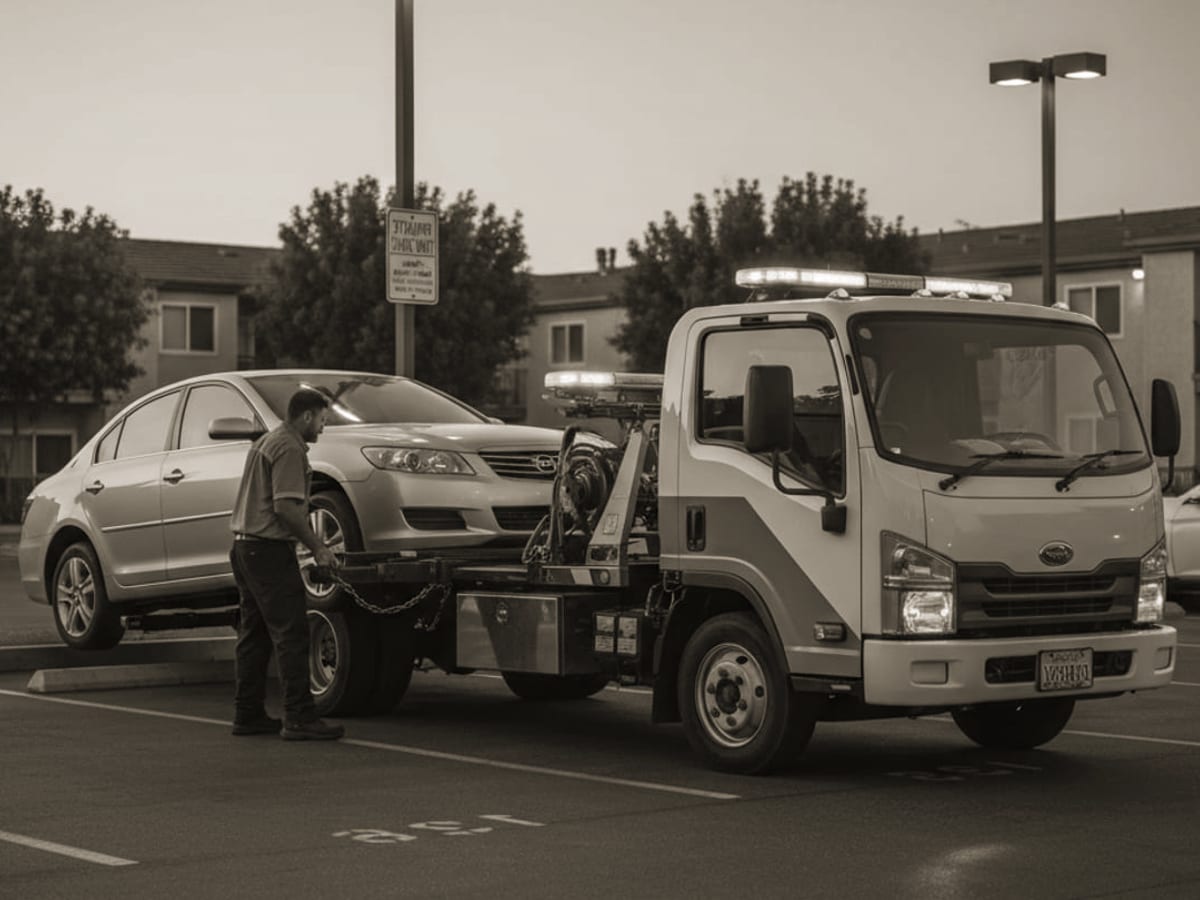
No. In Texas, a storage facility must let you into your car to get ownership documents and personal property, and it may not charge you a fee for that access. The car can be held for the tow and storage bill, but your loose belongings and your paperwork are a separate matter. The right is to reach the items, not to strip the vehicle.
Quick Tow EP is a referral service. We connect drivers with independent local tow operators. The driver hires and pays the operator directly, and the operator quotes the price. Quick Tow EP does no towing, roadside work or storage itself.
First, find out who actually has the car
Before you argue about a backpack or a folder of documents, confirm where the vehicle sits. In El Paso that could be a private lot, the city facility or a county lot.
- City of El Paso tows: the city partners with UR Vehicle Management Solutions (URVMS), which runs the City of El Paso Municipal Vehicle Storage Facility at 11615 Railroad Drive, El Paso, Texas 79934, phone (915) 212-0205, open 24 hours. Call that number or search the URVMS online vehicle database to see whether your car is there and what the charges are, per EPPD.
- Holds: URVMS says some vehicles have a hold and cannot be released. Call before visiting to make sure the vehicle is released for pickup, per URVMS.
- Sheriff-towed vehicles: these may be at a contracted tow company lot or the EPCSO Abandoned Motor Vehicle Evidence Lot at 12501 Montana Ave., Building F. Recovery there needs an appointment with the AMV Office, whose property release hours are 8:30 to 11:30 a.m. and 1:30 to 4 p.m., per the County.
- Private property tows: if a business or apartment complex had you towed around Northeast, the East Side or the Lower Valley, the sign or the manager should point to the company. You can check any operator’s license on the TDLR License Search.
If you are not sure yet, our guide to a towed car lookup in El Paso walks through the same search.
What the lot can and cannot hold back
The tow and storage bill is a lien issue tied to the vehicle. Personal property is different. At the storage facility you may access your car to get ownership documents and to recover personal property, and you do not have to pay a fee to do this, according to TDLR.
What you cannot do is remove or dismantle any part attached to the car while it is at the facility, per TDLR. So a suitcase, a phone charger, tools in the trunk and your insurance card come out. The battery, the wheels, the stereo head unit and the catalytic converter stay.
A facility must also make reasonable efforts to secure a stored car, locking doors, rolling up windows and closing the trunk, hood and sunroof, and that protection is included in the storage fee, per TDLR.
Personal property versus part of the car
This is where most arguments start. Use this as a working test, and ask the lot before you start pulling:
- Loose items: bags, clothing, paperwork, medication, child seats that clip out, loose tools, phone cables, dash cameras on suction mounts.
- Attached items: anything bolted, wired or clipped into the car as equipment. Those stay.
- Borderline items: a mounted dash camera bracket, a cargo box, a wheelchair ramp. Ask first and get the answer in writing if you can.
If the lot and you disagree on an item, ask for a supervisor, write down the item and the reason given, and keep that note.
How access works in practice
The one-hour rule
A facility that takes cars 24 hours a day must let you claim or access your car within one hour at any time. One that does not must do so within one hour between 8 a.m. and midnight Monday to Saturday, and 8 a.m. to 5 p.m. Sunday, except national holidays, per TDLR. That is the timing backbone. Call ahead anyway, because a hold can block access.
Documents to bring
Bring photo ID and proof you are the owner or authorized user. Accepted photo ID includes any state driver’s license or ID card, any federal photo ID, or a photo ID from a foreign government, such as a Mexico driver’s license or a matricula consular, per TDLR.
Proof of ownership is any one of the following, per TDLR:
- A driver’s license whose name matches the registration record
- An insurance card naming you
- The title
- A notarized power of attorney signed by the owner
- A tax collector’s receipt plus registration renewal card
- A current lease or rental agreement
- TDLR’s Personal Vehicle Owner Removal and Inspection form, which the facility must have available
A facility may not refuse release just because your valid photo ID shows a different address than the title and registration records, under Occupations Code Section 2303.160. If your papers are in the glove box or console, the facility must let you get to them, under Section 2303.158.
For the city lot, URVMS says the owner must bring a valid federal or state photo ID and one of registration, title or insurance, plus the balance owed. A power of attorney, court order or rental agreement may also be provided.
Step by step at the counter
- Confirm which lot or operator holds the vehicle, and whether there is a hold.
- Call ahead about access hours and what proof they will accept.
- Bring photo ID and ownership or tow paperwork in a folder.
- State clearly that you want personal items and documents only, not the vehicle.
- Ask what the form says and sign only an acknowledgment of entry, not a waiver of rights.
- Remove only loose items, not attached parts.
- If you are refused or charged a fee, note the date, time, names and license number.
- Keep any receipt if you paid under protest.
- Retrieve belongings before any scheduled sale.
- File a complaint with the regulator afterward if it comes to that.
Can someone else pick up my items?
Often yes, with the right paperwork. A notarized power of attorney signed by the owner is one accepted proof of ownership under TDLR’s list, and a current lease or rental agreement also counts. For the city facility, URVMS says non-owners acting for the owner should call (915) 212-0205 to learn what extra documents they need. Have that call before your family member drives across town. If the registered owner is unavailable or has died, call the lot and the agency that ordered the tow and ask what they require. Our post on someone else picking up a car from an El Paso impound covers the document trail.
If the lot refuses or wants an extra payment
You do not have to pay a fee for access to documents and personal property, per TDLR. If someone demands one, stay calm and build a record. Write down the date, time, the name of the person at the window and the license number posted at the lot. Ask for the refusal in writing. If you pay under protest to end the standoff, keep the receipt.
Then use two tracks. File a complaint about the tow company, tow operator, storage facility or booting company online with TDLR complaints. Separately, after a tow without consent, the owner or operator is entitled to a hearing on whether there was probable cause, under Occupations Code Section 2308.452. The written request must reach the court before the 14th day after the car was placed in storage, not counting Saturdays, Sundays and legal holidays, under Section 2308.456. File in any justice court in the county the car was towed from. TDLR notes the court may charge a $20 filing fee, and the hearing must be held before the 21st calendar day after the court receives the request. Filing a TDLR complaint is not a substitute for the hearing, but you may do both. Our towing rights guide for Texas drivers goes deeper on the hearing.
Left something behind after you got the car back
Call the lot the same day. Ask whether the item was logged, who would have handled it and what their process is for items found after release. Put your claim in writing, describe the item precisely and include any photo showing it in the car. Then follow up in writing.
Deadlines before a sale
This is the part people miss. If a car is never claimed, a facility must mail or publish at least two notices and wait at least 30 days after the second notice before acting, and it may then sell the car at public sale, with proceeds paying towing and storage and any remainder possibly paid to the owner, per TDLR. A car over 10 years old fit only for junking needs only one notice before a sale 30 days later. URVMS and the City of El Paso hold public online auto auctions of unclaimed vehicles on the second Tuesday of every month. Get your belongings out well before any scheduled sale date. Our post on a car never picked up from an El Paso impound explains what happens next.
Frequently asked questions
Can the tow yard hold my belongings until I pay?
It can hold the car for the bill. It may not charge you a fee to access the car for ownership documents and personal property, per TDLR. If a counter employee ties access to payment, ask for a supervisor and note the refusal.
Do I have to pay to get my stuff out of the car?
No fee for the access itself, per TDLR. You will still owe the tow and storage bill to get the vehicle released. Under El Paso City Code Section 12.54.060, a $20 fee is collected and remitted to the police department when a police-ordered tow is released from a storage facility, and a vehicle towed to a city-owned vehicle storage facility is charged a $20 impoundment fee before release.
What can I take out of an impounded car?
Loose personal property and ownership documents. You may not remove or dismantle any part attached to the car while it is at the facility, per TDLR. If an item is borderline, ask before you touch it.
What do I need to bring to collect my things?
Photo ID plus one proof of ownership from TDLR’s list, such as a license matching the registration, an insurance card naming you, the title or a notarized power of attorney. For the city lot, URVMS asks for a valid federal or state photo ID and one of registration, title or insurance.
Can my family member pick up my belongings for me?
Often yes with a notarized power of attorney signed by the owner, which TDLR accepts as proof of ownership. For the city facility, URVMS says non-owners should call (915) 212-0205 to learn what extra documents they need.
What do I do if the lot refuses to hand over my items?
Write down the date, time, names and license number, and ask for the refusal in writing. File a complaint with TDLR, and if the tow was without consent, request a tow hearing in justice court before the 14th day after the car was stored, not counting weekends and legal holidays, under Occupations Code Section 2308.456.
When to call for a tow
If the car will not start, has a flat you cannot change safely or cannot be driven legally, you need an operator rather than a ride to the lot. That is true in summer heat on Loop 375, in a monsoon downpour on I-10, or after a breakdown on Mesa Street. Call (915) 320-5573 and Quick Tow EP will connect you with an independent local tow operator.