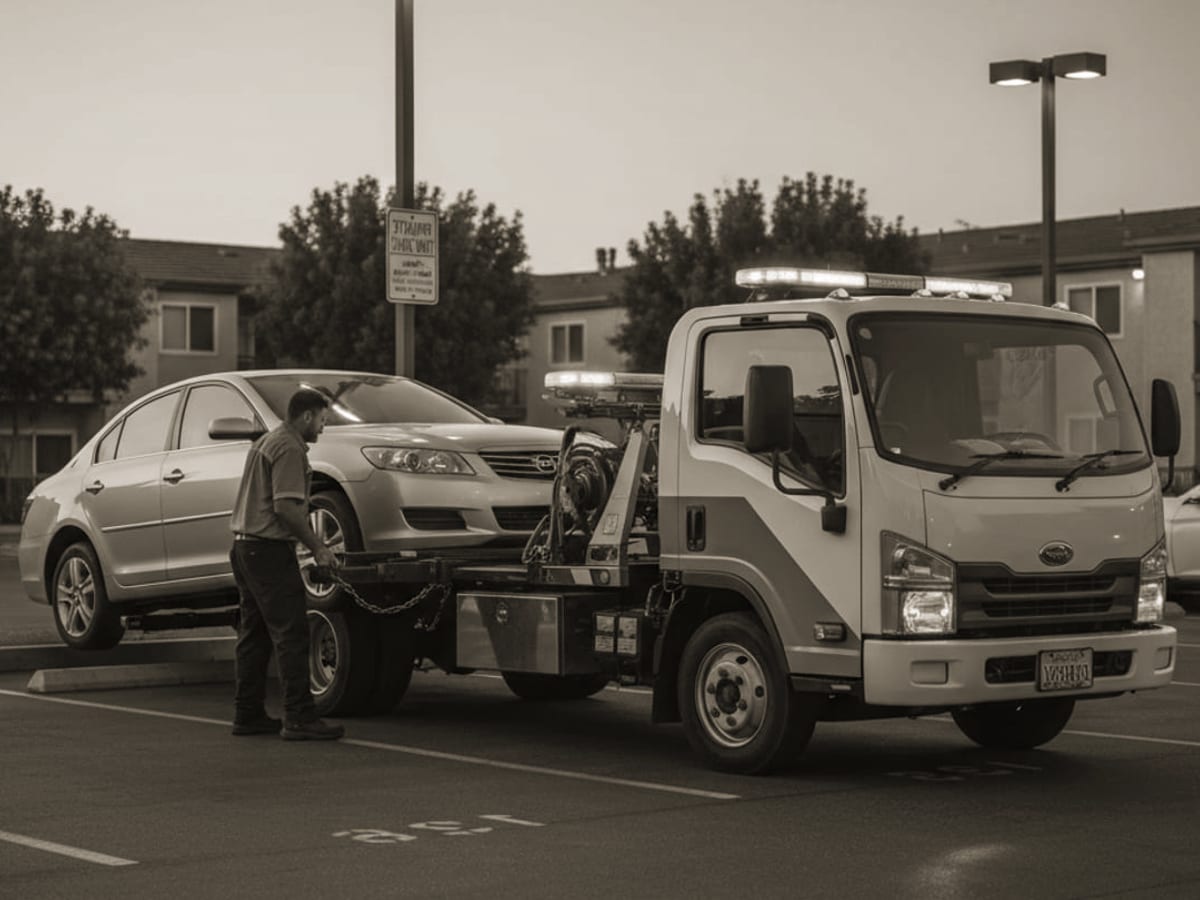
Start where the car was parked: read the tow sign and call the number on it, because Texas rules require a posted lot to give you a way to find your car. If there’s no sign, call URVMS at (915) 212-0205 or search its online database for a police-ordered tow, then call EPPD non-emergency at (915) 212-4000 to check private tow reports. If you find a boot on the car, call the number on the window sticker and do not try to remove it or drive with it, per TDLR.
Quick Tow EP is a referral service. We connect drivers with independent local tow operators. The operator you choose quotes the price, does the work and gets paid by you directly. Quick Tow EP does no towing, roadside work or storage itself.
First 30 minutes: what to do at the spot
- Go back to the exact spot. Look for a sign, a sticker on the curb, fresh paint or a notice on a nearby pole.
- Photograph everything: signs, curbs, cross streets, the empty space, the time on your phone.
- Note the time you came back and found the car gone. Write it down.
- Check for broken glass or pry marks. If you see any, don’t touch anything and call police.
- Decide whether you parked on private property (a lot, garage, apartment complex) or a public street.
- If it’s private property, read the sign for the towing company name and number.
- Ask the property manager or front desk which company they use and where cars are stored.
- Write down every call, the time and who you spoke with.
The order matters. The sign is the fastest answer, and a facility with compliant signs must let you locate your car by calling that number, under Occupations Code Section 2308.303.
Private lot or public street?
Private property tows follow the sign. A lot owner may have an unauthorized vehicle towed without the owner’s consent if compliant signs were posted at the time of towing and for the preceding 24 hours; or the driver got actual notice; or a windshield notice was posted and a certified-mail notice sent (the car may be towed if not moved before the 15th day after the postmark); or the car is blocking an aisle, entry or exit, a fire lane, a disabled space without a placard, is leaking hazardous fluid, or is in or obstructing a paved driveway, and on request the owner is told which tow company and storage facility will be used, per Sections 2308.251 and 2308.252. The lot also can’t remove a car except as the chapter allows or at the direction of a peace officer or the owner, per Section 2308.254.
Public street and police tows work differently. EPPD lists reasons it may tow: parked illegally or appeared abandoned, involved in an accident or unsafe to drive, driver arrested or without a license, or expired registration, according to EPPD. Those cars often go to the city facility.
Police tows: the URVMS database
The City of El Paso partners with UR Vehicle Management Solutions, which runs the City of El Paso Municipal Vehicle Storage Facility at 11615 Railroad Drive, El Paso, Texas 79934. The phone is (915) 212-0205 and it’s open 24 hours, per URVMS.
Search the URVMS online vehicle database or call that number. The database lists all vehicles currently stored there and their charges. URVMS says cars may be there after accidents or abandonment, when the driver is arrested, at an officer’s discretion, and recovered stolen vehicles. Call before you drive out, because some vehicles have a hold and can’t be released.
Private tows: the two-hour report
Within two hours of accepting a towed unauthorized vehicle, the storage facility must report it to the police department of the city it was towed from, with description, plate, VIN, tow location and the facility’s name and location, per Section 2308.2565. Give the plate, VIN and exact spot when you call.
If the number on the sign doesn’t work, call EPPD non-emergency at (915) 212-4000 and ask whether a tow was reported, and ask the property manager which company they use. Then verify the company before you pay anyone.
Verify the tow company on TDLR
TDLR licenses tow companies, tow operators and vehicle storage facilities in Texas, per TDLR. Anyone can check a license with the TDLR License Search by name, license number, city, county or ZIP. Do this before you hand over money. It takes a minute. If a company won’t give its name or license number, that’s a reason to slow down.
Have this ready before you call
- Plate number and VIN
- Photo ID: state driver’s license or ID, federal photo ID, or a foreign government photo ID such as a Mexico license or matricula consular
- Proof of ownership: any one of a matching driver’s license, insurance card naming you, title, notarized power of attorney signed by the owner, tax receipt plus renewal card, current lease or rental agreement, or TDLR’s Personal Vehicle Owner Removal and Inspection form
- Payment method
- A pen and paper, or a notes app, for logging calls
If the registration is in someone else’s name, the document you bring must connect you to the vehicle, and a notarized power of attorney signed by the owner is one accepted option. A facility can’t refuse release just because your valid photo ID shows a different address than the title and registration, per Section 2303.160. If your papers are in the glove box, the facility must let you get to them, per Section 2303.158.
Getting the car released
Call the storage facility, confirm the car is there and released for pickup using the plate and VIN, and ask for the address, hours, documents accepted, payment methods and an itemized total. URVMS accepts cash and Discover, Mastercard and Visa, with a 1.98% government fee added for credit cards, and its listed costs are estimates; the price its representatives quote is what must be paid.
A facility that takes cars 24 hours a day must let you claim or access your car within one hour at any time, per TDLR. One that doesn’t must do so within one hour between 8 a.m. and midnight Monday to Saturday and 8 a.m. to 5 p.m. Sunday, except national holidays.
If you believe the facility violated TDLR rules, you may file a complaint online with TDLR, and a TDLR complaint is not a substitute for requesting a tow hearing. Filing a TDLR complaint does not extend or pause the 14-day deadline to request a tow hearing. Keeping your own written record of each call, with the time and the name of the person you spoke with, is practical advice that can help you later.
Fees, disputes and your deadline
When a vehicle towed on a police-ordered tow is released from a storage facility, City Code Section 12.54.060 adds a $20 fee collected and remitted to the police department, per EPPD. Separately, a vehicle towed to a city-owned vehicle storage facility is charged a $20 impoundment fee before release. For Sheriff-towed vehicles handled through the EPCSO Abandoned Motor Vehicle process, per the El Paso County Sheriff’s Office FAQ, the AMV process lists a wrecker service fee, storage at $20 per day plus tax after hold release, a $10 process fee plus tax and a $25 notification fee. Per the County FAQ, a Sheriff-towed vehicle may be at the Sheriff’s contracted towing company lot or the EPCSO Abandoned Motor Vehicle Evidence Lot.
After a tow without consent, you’re entitled to a hearing on whether there was probable cause. The written request must reach the court before the 14th day after the car was placed in storage, not counting Saturdays, Sundays and legal holidays, per Section 2308.456. If the required notice was never given, the deadline doesn’t apply, and the clock doesn’t start until you get the information needed to fill out the request. File in any justice court in the county the car was towed from. TDLR notes the court may charge a $20 filing fee, and the hearing must be held before the 21st calendar day after the court receives the request. You can also file a complaint with TDLR, and that doesn’t replace the hearing.
The county route
Sheriff tows in the county go to the Sheriff’s contracted towing company lot or the EPCSO Abandoned Motor Vehicle Evidence Lot at 12501 Montana Ave., Building F, El Paso, TX 79938, per the County. Recovery needs an appointment with the AMV Office and the plate or VIN, incident date and case number if given, title, current registration or bill of sale, proof of insurance and a valid driver’s license.
Towed or stolen?
If no lot, no sign company and no police record confirms a tow, report it stolen to the police jurisdiction where it was parked. Do it the same day. Bring your plate, VIN, photos and your call log. A parking boot can also explain a disappearance: if you find a boot, call the number on the window sticker and don’t try to remove it or drive with it, per TDLR.
Across the line and after a crash
Sunland Park, Santa Teresa, Chaparral and Anthony NM are in New Mexico. Texas TDLR rules and Texas statutes don’t govern a tow, storage or registration there. Contact the agency or company that handled the tow, and use the New Mexico Motor Vehicle Division for titles and registration. If the car was towed after a crash, ask the responding agency for the tow record and case number first.
What to avoid
- The tow company must issue an itemized tow ticket for each nonconsent tow, and you should keep it.
- Don’t argue with a lot attendant or block the lot.
- Don’t skip the TDLR check.
- Don’t miss the deadline to file your hearing request, which is before the 14th day after storage, not counting weekends and legal holidays, unless required notice was never given.
- Don’t assume a suburb like Socorro, Horizon City or Canutillo follows city fee caps; Chapter 12.54 covers El Paso city limits, per the ordinance.
For the full release walkthrough, read how to get a car out of an El Paso impound. If a friend is picking it up, see someone else picking up a car from impound. Towed on post? Read towed on Fort Bliss. For fee background, see Texas towing fee limits.
Frequently asked questions
How do I find out if my car was towed or stolen?
Call the number on the lot sign first. If there’s no sign, search the URVMS database or call (915) 212-0205 for a police tow, then call EPPD non-emergency at (915) 212-4000 for private tow reports. If nothing confirms a tow, report it stolen.
Which number do I call to check if my car was towed?
For police-ordered tows taken to the City of El Paso Municipal Vehicle Storage Facility, call URVMS at (915) 212-0205 or use its online database. For private lot tows, call the company on the sign, then EPPD non-emergency at (915) 212-4000.
What do I need to bring to get my car back?
A valid photo ID, one proof of ownership such as your title, insurance card or registration, and payment. Non-owners should call (915) 212-0205 for URVMS cars to learn what extra documents are needed.
How long do I have to dispute a tow?
The written hearing request must reach the court before the 14th day after the car was placed in storage, not counting weekends and legal holidays, per Section 2308.456. If required notice was never given, the deadline doesn’t apply.
Can I get my belongings out without paying?
Yes. At the storage facility you may access your car to recover personal property, and you do not have to pay a fee to do this. You may not remove or dismantle any part attached to the car while it is at the facility.
What if there was no sign where I parked?
Photograph the spot and the surrounding area. A lot may tow without consent if compliant signs were posted for the preceding 24 hours, or the driver got actual notice, or a windshield notice plus certified mail was sent, or the car is blocking an aisle, entry, exit, fire lane, paved driveway, leaking hazardous fluid, or in a disabled space without a placard, so those photos matter at a hearing.
When to call for a tow
If your car is found but won’t start, has a flat, or can’t be driven safely after a crash, you need a tow operator, not a search. Call (915) 320-5573 and Quick Tow EP will connect you with an independent local tow operator.