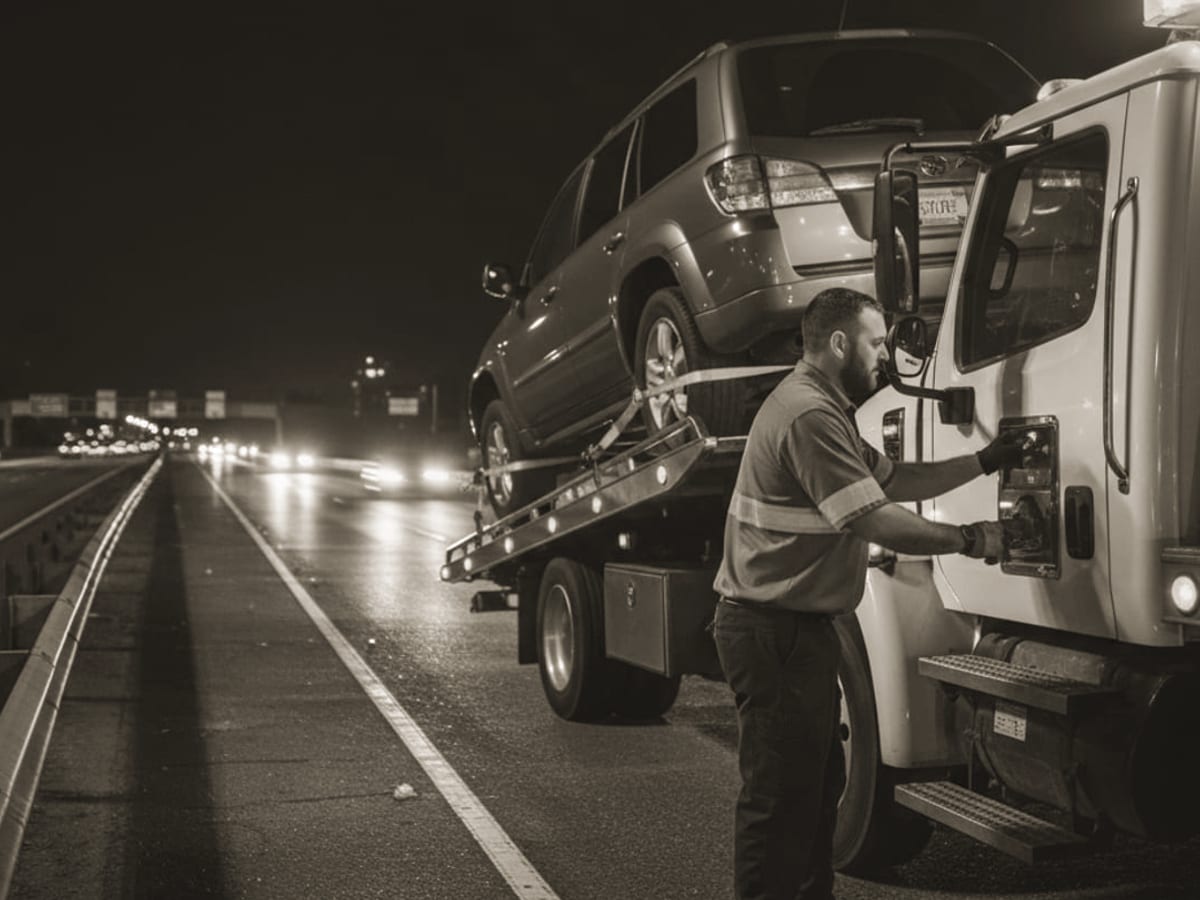
There’s no single answer, and anyone who gives you an exact number before asking where you are is guessing. How long a tow takes in El Paso depends on how far the operator has to drive to reach you, what kind of truck your vehicle needs, the time of day, traffic on I-10 and Loop 375, weather, how complete your information is, and whether police are controlling a crash scene. The farther out you are, the longer the drive for whichever operator takes the call.
Quick Tow EP is a referral service. It connects drivers with independent local tow operators. The driver hires and pays the operator directly, and the operator quotes the price and does the work. Quick Tow EP does no towing, roadside work or storage itself.
Why nobody will give you a time before asking where you are
Distance is the first thing any operator has to solve. El Paso’s metro is spread wide, from Canutillo and Santa Teresa on the west side out to Horizon City, Fabens and Tornillo in the east, plus Socorro, San Elizario and Clint in the Lower Valley, and Vinton in the northwest. An operator close to one caller may be a long drive from another in the same hour. Until dispatch knows your exact spot, any estimate is fiction.
The second factor is truck type. A flatbed handles most cars, but a heavy duty recovery needs different equipment that fewer operators run. If your vehicle needs a flatbed because of all-wheel drive, low clearance or EV battery concerns, that narrows the pool of available trucks. See our pages on flatbed towing and Tesla and EV towing for why that matters.
Does your location really change the wait that much?
Yes, and more than most people expect. On a busy commercial street like Mesa Street or Montana Avenue, give a precise cross street so the operator can find you. A breakdown on a rural road outside Tornillo or on the long stretch toward Fabens means a driver has to commit to a round trip, and that changes who can take the call.
Outer towns and rural roads mean a longer drive for whichever operator takes the call, so give the most exact location you can, including mile markers or landmarks.
If you’re broken down well outside the city, our Far East El Paso and Horizon City pages cover the areas where distance matters most. For a breakdown on the freeway itself, see broke down on US 54.
Is waiting on the freeway faster than a side street?
Not automatically. A crash scene with police control can delay access, because officers manage traffic and decide when a tow can approach, and under Section 12.54.070 of the El Paso city code, it is an offense to arrive at a traffic accident or incident scene to do a nonconsent or incident management tow without first being contacted by the police department, the vehicle owner, the driver or the vehicle’s insurer.
On a side street, you avoid scene control but you may be harder to find. A precise cross street helps more than a general neighborhood name.
Will weather or heat delay the truck?
Weather can, and El Paso has a few specific patterns. Spring wind and dust storms cut visibility and slow everyone on the road, including tow trucks. Summer monsoon rain floods low spots and makes some roads risky. Summer heat stresses both vehicles and people, and it’s the reason you should never wait inside a car you can’t cool. Get to shade or a business if you can do it safely.
Stay clear of traffic while the operator secures the vehicle. If a dust storm is the reason you’re stranded, our post on dust storm breakdowns has specific advice.
How to judge whether a quoted estimate is realistic
Ask the operator for an arrival estimate and the price structure, and write both down. Ask how the price is calculated and get the total before you agree. Our guide to tow truck cost in El Paso explains the pieces, and Texas towing fee limits covers what the law caps for nonconsent tows in city limits.
What to do while you wait
Safety first, and it starts before the truck arrives.
- Turn on your hazards as soon as you know you’re stopping.
- Move as far off the traffic side as you safely can, and stay out of the vehicle if it’s in a live lane.
- Note your exact exit, mile marker or cross street, plus any landmark you can see.
- Call and state your precise location, your vehicle, and what happened.
- Ask for the arrival estimate and the price structure, and write both down.
- Stay put and visible. Don’t wander to find a better spot unless you’re unsafe.
- Cancel only if the vehicle starts and drives safely.
At night, keep reflective gear or a light on you if you have it, and stay behind a barrier rather than in front of your car. In heat, get to shade or a business if you can do it safely, and drink water. On a rural road, stay off the roadway entirely and keep your phone charged. If you’re on a highway, remember that on a road with two or more lanes in your direction, Texas law requires drivers approaching a stopped tow truck or emergency vehicle with lights on to move over a lane, or slow to 20 mph under the posted limit (5 mph if the limit is under 25 mph). Under Transportation Code Section 545.157, fines are $500 to $1,250, $1,000 to $2,000 for a repeat within five years, and a Class A misdemeanor if someone is injured.
What to have ready when you call
A short checklist saves dispatch time and gets a truck moving sooner.
- Your exact location: exit, mile marker, cross street or address
- Vehicle make, model, year and color
- Whether it rolls, steers and brakes
- Whether it’s all-wheel drive, lowered, or an EV
- What happened: dead battery, flat, crash, stuck, no start
- Your name and a callback number
- Whether you’re in a live lane or a safe spot
- Payment method you plan to use with the operator
Is there a free roadside service that could help me?
Possibly. TxDOT’s El Paso HERO program patrols I-10 from Transmountain Road to Horizon Boulevard, Loop 375 from I-10 West to Paisano, and US 54 from McCombs to Loop 375. Crews change flat tires, add air, bring gas, diesel and water, jump start batteries, do minor repairs and provide phone service, all at no cost. Hours are Monday to Friday 5 a.m. to 9 p.m. and weekends 9 a.m. to 9 p.m. Call 915-790-HERO (4376), and call 911 first in an emergency. HERO is not described by TxDOT as a service that tows your car to a shop of your choice, so plan on a private tow if the car can’t be fixed on the spot. Our HERO guide has the details.
Your own insurance may also help. The Texas Department of Insurance says towing and labor coverage pays to tow a car that can’t be driven and covers labor to change a flat or jump a battery, up to a dollar limit, with you paying the difference above it. Check your policy before you assume you’re paying out of pocket.
Should you wait and see if the car restarts first?
If the battery is dead and you can jump it safely, move off the traffic side first and stay out of a live lane while you do it. If the car starts and drives safely, cancel the tow. If it is a crash, a flat with no spare, smoke, or the car cannot be driven safely, call right away.
Frequently asked questions
How long until a tow truck gets to me?
No one can promise a number before knowing your location, truck type and traffic conditions. Distance from available operators is the biggest factor, followed by time of day and whether police are managing a scene. Ask the operator for their estimate and how far away the truck is starting from.
Why can’t you tell me a time before asking where I am?
Because the answer is mostly about distance. El Paso stretches from Canutillo to Horizon City and beyond, and an operator close to one caller may be a long drive from another. Location also determines which operators can realistically take the job.
Is it faster to break down on the highway than in a neighborhood?
Not automatically. Crash scenes with police control can slow access, and a side street can be harder to find without a precise cross street. Neither is reliably faster.
Why does being out in a rural area take so much longer?
Distance affects the drive for whichever operator takes the call. Give the most exact location you can, including mile markers or landmarks.
Can I get a free roadside fix instead of a tow?
Maybe. TxDOT’s HERO crews provide free jumps, tire changes, fuel and water on I-10, Loop 375 and US 54 during their posted hours. HERO isn’t described as towing your car to a shop, so if the car can’t be fixed on the spot, you’ll need a private operator. Your own towing and labor coverage may also reimburse part of a tow.
What should I tell the dispatcher to get help faster?
Your exact location, vehicle details, whether it rolls and steers, and what went wrong. Mention landmarks, exits or mile markers. Ask for both an arrival estimate and the price structure, and write them down.
When to call for a tow
Call when the vehicle can’t be driven safely, when you’re in a live lane, after a crash, or when a flat, battery or mechanical problem won’t resolve on the spot. If you’re unsure, describe the situation and let the operator tell you what they can do. Call (915) 320-5573 and Quick Tow EP will connect you with an independent local tow operator.