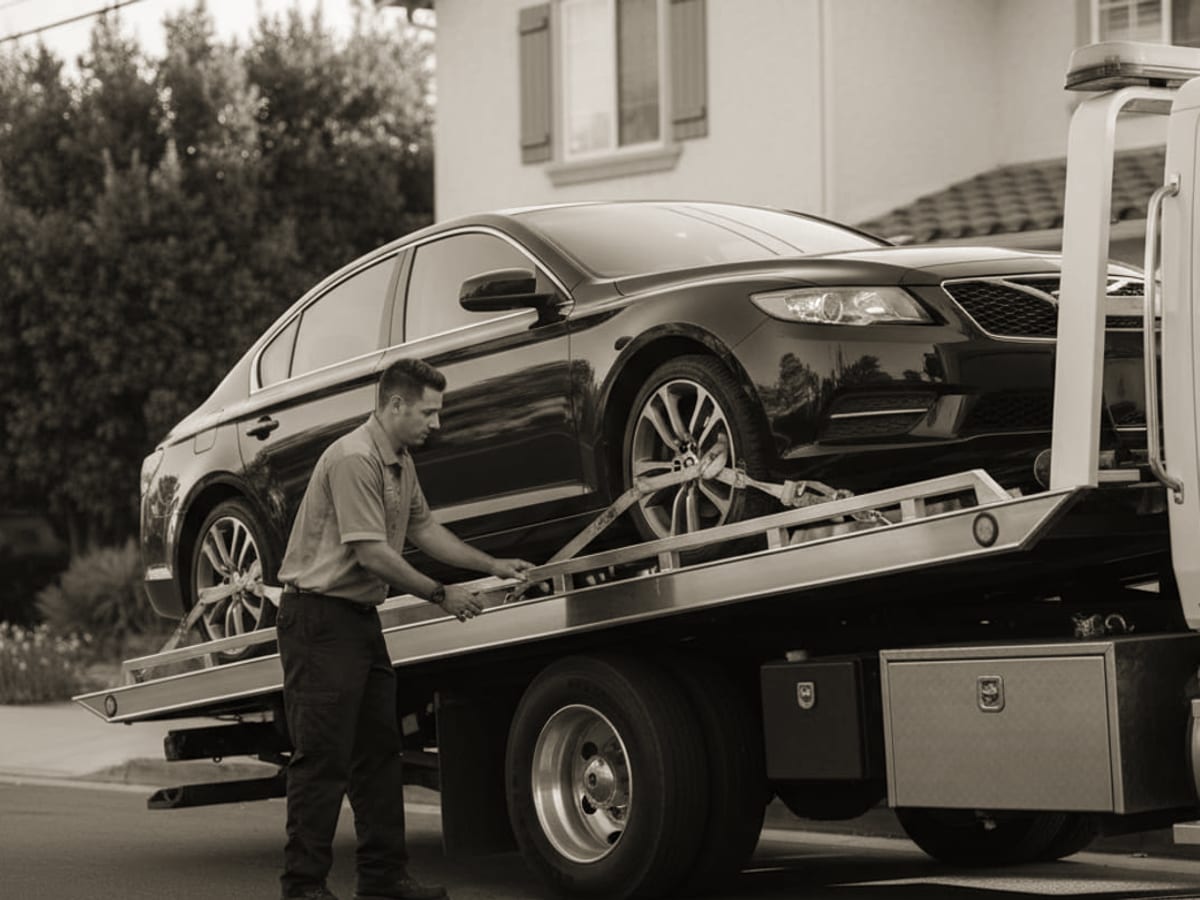
Texas regulates some towing fees and not others. If your car was towed without your consent, state and city caps apply to the tow, the drop fee and storage. If you called for the tow yourself, the operator sets the price. The first question is not “is this too much” but “which kind of tow was this,” because that answer decides which fee caps apply to you.
Quick Tow EP is a referral service. We connect drivers with independent local tow operators. The driver hires and pays the operator directly, and the operator quotes the price. Quick Tow EP does no towing, roadside work or storage itself.
Which rules apply to your tow
There are two families of rules, and they overlap.
Tows without your consent are capped. Outside El Paso city limits, TDLR’s statewide maximum for a private property tow applies: $272 for a vehicle up to 10,000 lbs, $380 for more than 10,000 but less than 25,000 lbs, and $489 per unit for vehicles over 25,000 lbs with a $978 total maximum, per TDLR’s consumer page. Cities and counties can set lower rates in their own territory, never higher, under Occupations Code Section 2308.202.
Tows you request yourself are not capped by TDLR’s table. A consent tow is priced by the operator you hire, and no TDLR maximum table applies to it. The operator quotes the price for a consent tow, so ask for that price before you authorize the tow. Nonconsent tows are capped by TDLR or by the city.
Inside El Paso city limits, the city cap is lower
The City of El Paso’s own code governs nonconsent tows inside city limits, and its numbers are well under the state maximum. Under City Code Section 12.54.020, the maximum for a nonconsent tow, including debris cleanup, is $100 for a light duty tow (gross vehicle weight rating up to 10,000 lbs), $350 for medium duty (more than 10,000 but less than 25,000 lbs), and $450 for heavy duty (more than 25,000 lbs), as listed on the EPPD towing page.
The same section allows up to $25 more for dollies or go-jacks. For a vehicle over 10,000 lbs, if the tow runs longer than two hours from arrival to completion, up to $55 per hour for each hour past two, plus actual cost if cargo must be moved by hand.
Outside city limits, the state maximum usually applies
Chapter 12.54 is El Paso’s own code, so it covers tows within city limits. Socorro, Horizon City, Anthony, Clint, San Elizario, Vinton, Fabens, Canutillo and Tornillo are not covered by it. There the TDLR statewide maximums apply unless that city has set lower ones. If your car was towed in Horizon City or Socorro, ask which schedule the operator used.
New Mexico places like Sunland Park, Santa Teresa, Chaparral and Anthony NM are outside Texas rules entirely. Contact the agency that handled the tow, and NMMVD for NM title questions.
Was it a police tow or a private tow?
This matters because it changes who has your car and what you can be charged.
EPPD lists reasons it may tow a vehicle: parked illegally or appeared abandoned, involved in an accident or unsafe to drive, driver arrested or without a license, or expired registration. Police ordered tows go through the city’s partner, UR Vehicle Management Solutions, which runs the City of El Paso Municipal Vehicle Storage Facility at 11615 Railroad Drive, El Paso, Texas 79934, phone (915) 212-0205, open 24 hours, per URVMS.
A private property tow is ordered by a lot owner or property manager, not police. To find the tow company and storage facility, call the number on the no-parking sign, per TDLR.
To find your car, start with your tow ticket or any notice left at the scene. If it points to the city facility, call (915) 212-0205 or search the URVMS online vehicle database, which lists stored vehicles and their charges. For a police matter you can also call the El Paso Police non-emergency line at (915) 212-4000. Our guide to towed car lookup in El Paso walks through the same steps.
What storage, notification and impoundment fees can be
Storage is capped separately from the tow.
- Daily storage is $20 per day or part of a day for a vehicle 25 feet or less and $35 for longer, subject to a biennial adjustment; per the 2023 adjustment, $22.85 and $39.99, per TDLR.
- A day begins and ends at midnight, and a facility may not charge more than one day if the vehicle was there less than 12 hours, per Occupations Code Chapter 2303.
- For a Texas registered vehicle, a facility may not charge more than five days of storage unless owner notice was mailed or published, per TDLR.
- The notification fee is up to $50, and it is not allowed if the car is reclaimed within 24 hours or before notice is sent, per TDLR.
- The impoundment fee may not exceed $20, and only when the facility had to protect a car with broken or open doors, windows, trunk, hood or similar, plus an inventory or registration lookup. The bill must list the exact services behind the impoundment fee, per TDLR.
- A facility may also collect fees owed to a law enforcement agency or government entity. It may not charge other storage related fees, per TDLR and Chapter 2303.
For a police ordered tow released from storage, City Code Section 12.54.060 adds a $20 fee collected and remitted to the police department, and a vehicle towed to a city owned facility is charged a $20 impoundment fee before release. These City Code Section 12.54.060 fees are separate from TDLR’s conditional $20 impoundment fee. The TDLR impoundment fee applies only when the facility had to protect a car with broken or open doors, windows, trunk, hood or similar, plus an inventory or registration lookup, and the bill must list the exact services. The city’s $20 police department fee applies to a police ordered tow released from storage, and the city’s $20 impoundment fee applies to a vehicle towed to a city owned facility before release.
Can storage grow forever? Not automatically. For a Texas registered vehicle, a facility may not charge more than five days of storage unless the owner notice is mailed or published. If no notice was sent, the five day cap applies. Holds are another issue: URVMS says some vehicles have a hold and cannot be released, so call (915) 212-0205 before visiting.
Belongings, payment and the hookup moment
At the storage facility you may access your car to recover personal property and you do not have to pay a fee to do this, per TDLR. Our post on getting belongings from a tow yard in Texas covers how to ask.
Do you have to pay cash only? For a drop fee, the driver must accept cash, credit cards and debit cards, per TDLR. At the city facility, URVMS accepts cash and Discover, Mastercard and Visa, with a 1.98% government fee added for credit cards.
What if the tow already started but the car has not moved? If you get back while it is being hooked up and it is not fully hooked up and ready for towing, you can keep it with no charge and no proof of ownership, per TDLR. If it is fully hooked up but has not left the lot, you can keep it but must pay a drop fee. Inside El Paso city limits, City Code Section 12.54.020(D) governs the drop fee: no charge if the car is not yet hooked up, and one half the regular tow fee if it is hooked up but not yet towed from the scene. The TDLR statewide drop fee maximums of $135 for 10,000 lbs or less, $190 for over 10,000 but under 25,000 lbs, and $244 over 25,000 lbs apply outside city limits.
Once it has left the parking facility but is not yet in storage, you do not have the right to get it back, per TDLR.
How to read a tow ticket
For each nonconsent tow, the tow company must issue a tow ticket. It must itemize each charge and show the company’s licensed name, public phone number, certificate of registration number and the operator’s TDLR license number, per TDLR. A copy goes to the owner if present and to the storage facility.
Before you pay, check the bill against this list:
- The tow type and weight class, so you know whether the city cap or the TDLR cap applies.
- The itemized tow charge, drop fee, storage days, notification fee and any impoundment fee, each with its amount.
- The exact services behind any impoundment fee, since the bill must list them.
- The storage start and end times, to confirm the day count and the under 12 hour rule.
- The company name, phone, certificate of registration number and operator license number.
- Any charge you cannot match to a listed fee.
Then ask for the written nonconsent fee schedule. Tow companies must give it to every storage facility they deliver to, and it must be shown to the public on request, per TDLR. For each nonconsent tow the company must issue an itemized tow ticket, and if you do not receive one, note that and the date.
How to dispute a charge
- Confirm who towed the car and where it is stored.
- Ask which fee schedule applies: El Paso city code, the TDLR statewide table, or a lower local rule.
- Request a full itemized total before paying anything.
- Verify storage days and any added service charges.
- Retrieve the vehicle and your belongings promptly, since storage keeps running.
- Note prohibited or unexplained fees on the bill.
- Ask for the written rate schedule and the authorization for the tow.
- Dispute what is still unresolved through the proper channel.
Two channels exist. TDLR can order refunds of overcharges, because Occupations Code Section 2308.2065 bars a licensed tower from charging more than the fee set by state rule or by the city or county, and from charging for a service not on those lists. Storage facilities must tell owners TDLR’s website, email, mailing address and phone for complaints, per TDLR.
The second channel is a justice court hearing. After a tow or boot without consent, the owner or operator is entitled to a hearing on whether there was probable cause. The written request must reach the court before the 14th day after the car was placed in storage or booted, not counting Saturdays, Sundays and legal holidays, and the 14 days do not start until the tow company or storage facility gives you the information needed to fill out the request. If the required notice was never given, the deadline does not apply, per Occupations Code Section 2308.456. Missing the deadline waives the hearing.
File in any justice court in the county the car was towed from, or for a boot, the county where the parking facility is. The request needs your name, address and phone, where and when the car was removed, who authorized it, the storage facility and tow company names, addresses and phones, copies of receipts or notices, and photos of any parking sign or a statement that none was posted. TDLR notes the court may charge a $20 filing fee, and the hearing must be held before the 21st calendar day after the court receives the request. At the hearing the burden is on the person who asked for it, on probable cause and on whether the charge exceeded the allowed amount. If the court finds no probable cause, the tow company, storage facility, parking facility owner or agency that authorized the tow must pay or reimburse the towing and storage costs, and an overcharge must be refunded even with probable cause. The court may also award court costs and attorney’s fees to the prevailing party.
One more El Paso note: since June 1, 2026, City Code Section 12.54.070 makes it an offense to show up at a crash scene to do a nonconsent or incident management tow without first being contacted by police, the owner, the driver or the insurer. The section also bars soliciting towing, repair, storage or buying or selling related to a damaged vehicle on public property, and entering an accident scene under a peace officer’s control without permission. Under Section 12.54.070(B), the presence of a tow company vehicle, employee, dolly, equipment, business card or flyer at an accident scene that was not dispatched by police or requested by the owner, driver or insurer is prima facie evidence of solicitation. Fines run up to $500 under Section 12.54.040, per the city ordinance. Our breakdown of the 2026 El Paso towing ordinance explains what shifted.
Frequently asked questions
How do I know if my tow fee is too high?
Match the tow type to the right cap first. Inside El Paso city limits, City Code Section 12.54.020 caps a light duty nonconsent tow at $100. Outside city limits, TDLR’s statewide maximum is $272 for a vehicle up to 10,000 lbs. A tow you requested yourself has no TDLR maximum.
Where do I find my car after it’s towed?
Start with the tow ticket or any notice left behind. For a police ordered tow, call the city facility at (915) 212-0205 or search the URVMS online vehicle database. Call before visiting, because some vehicles have a hold and cannot be released. The El Paso Police non-emergency line is (915) 212-4000.
Can they charge me to get my stuff out of the car?
Under TDLR rules you may access the car to recover personal property and you do not have to pay a fee to do this. Ask for an itemized bill and question any charge you cannot match to a listed fee.
Do I have to pay cash, or can I use a card?
For a drop fee, the driver must accept cash, credit cards and debit cards, per TDLR. At the city facility, URVMS accepts cash and Discover, Mastercard and Visa, with a 1.98% government fee added for credit cards.
How much storage am I being charged per day?
Per TDLR, daily storage is $22.85 for a vehicle 25 feet or less and $39.99 for longer, after the 2023 adjustment. A day runs midnight to midnight, and a facility may not charge more than one day if the car was there less than 12 hours.
How do I dispute a tow bill I think is unfair?
Complain to TDLR, which can order refunds of overcharges, and request a justice court hearing. The written request must reach the court before the 14th day after the car was placed in storage, not counting weekends and legal holidays, and the 14 days do not start until the tow company or storage facility gives you the information needed to fill out the request. If the required notice was never given, the deadline does not apply. Ask the storage facility for TDLR’s complaint contact information if you do not have it.
When to call for a tow
If your car will not move safely, or you simply want it transported rather than risk driving it, that is a job for a tow operator, not a fee dispute. If you break down on an El Paso County highway, TxDOT’s HERO program provides free roadside help such as flat tire changes, jump starts, fuel and water on I-10, Loop 375 and US 54, and you can call 915-790-HERO (4376), with 911 first in an emergency. When you pass a stopped tow truck or emergency vehicle using its lights, Texas Move Over or Slow Down rules require you to vacate the closest lane or slow well below the limit. If a dust event catches you on the road, follow National Weather Service guidance: pull off the pavement as far as possible, stop, turn off lights, set the emergency brake and take your foot off the brake; never stop on the traveled portion of the roadway. A consent tow you arrange yourself is priced by the operator, so ask the independent operator you hire for the price before authorizing the tow. Call (915) 320-5573 and Quick Tow EP will connect you with an independent local tow operator.