Yes, someone else can usually get your car out of impound in Texas, but only with the right documents. The person picking up your car needs a valid photo ID, proof they are authorized to act for you, and payment for the fees. What counts as proof depends on where the car is stored, so call the lot first and ask for its non-owner document list.
Quick Tow EP is a referral service. It connects drivers with independent local tow operators. The driver hires and pays the operator directly, and the operator quotes the price. Quick Tow EP does no towing, roadside work or storage itself.
Start by finding out exactly where the car is
El Paso has more than one kind of impound lot, and the rules change with the lot. A car towed by El Paso police may end up at the City of El Paso Municipal Vehicle Storage Facility at 11615 Railroad Drive, run by UR Vehicle Management Solutions (URVMS). The city lists common tow reasons: parked illegally or appeared abandoned, involved in an accident or unsafe to drive, driver arrested or had no driver’s license, or expired registration (EPPD).
A car towed by the El Paso County Sheriff’s Office may be at the Sheriff’s contracted towing company lot or the EPCSO Abandoned Motor Vehicle Evidence Lot at 12501 Montana Ave., Building F, El Paso, TX 79938 (EPCSO). Recovery at the evidence lot requires an appointment with the AMV Office.
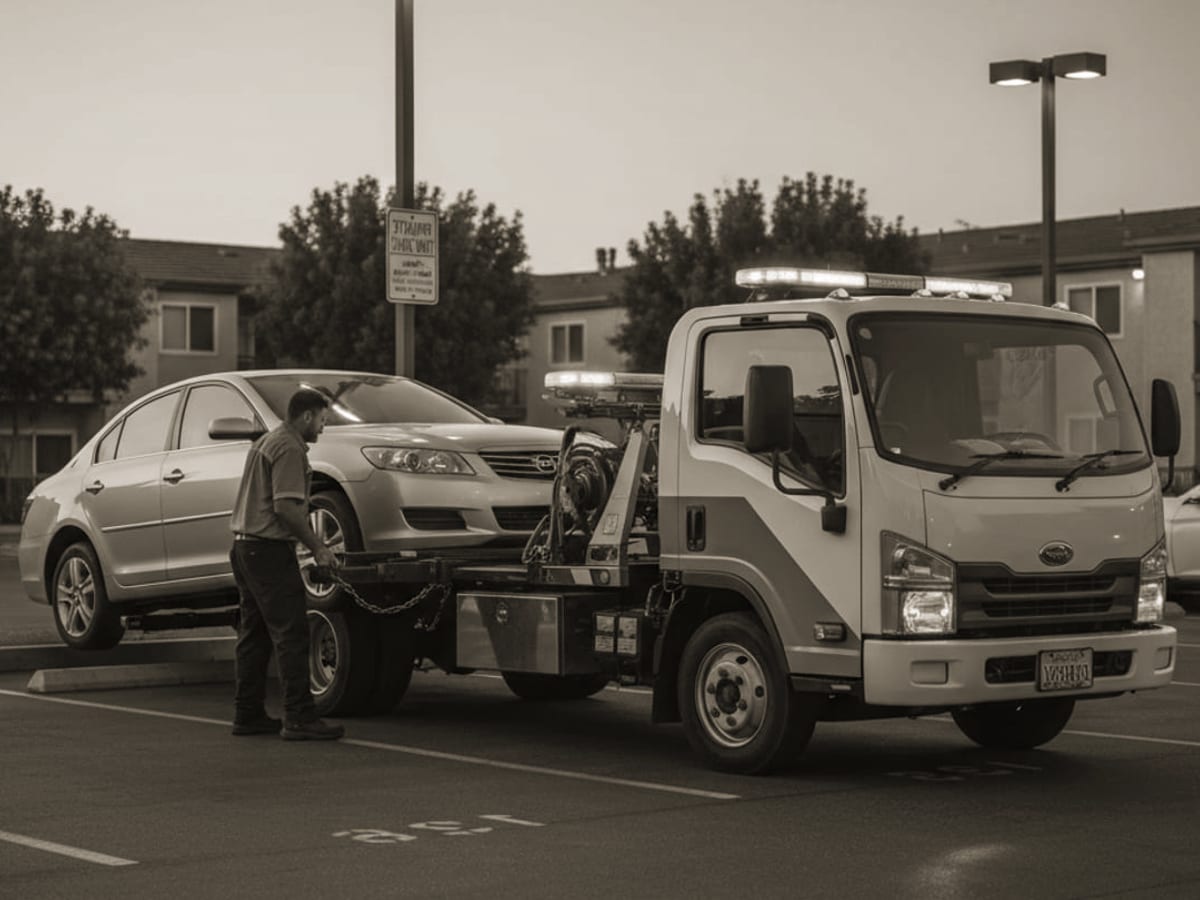
A car towed from private property, like an apartment complex or shopping center, is typically taken to a vehicle storage facility (VSF). To find which tow company and VSF were used, call the number on the no-parking sign, as TDLR advises, and confirm with that company.
So the first job is confirming the lot. Call the city facility at (915) 212-0205 or search the URVMS online vehicle database, which lists every vehicle currently stored there and its charges (URVMS). For a Sheriff tow, call the AMV Office at (915) 273-3800 ext. 5431; for a car at the Montana Ave. evidence lot, the lot phone is 915-538-2007. If you are not sure who towed it, our guide to a towed car lookup in El Paso walks through the calls in order.
Ask two questions before anyone drives to the lot
Before a spouse, friend or coworker spends an hour on Loop 375 or Montana Avenue, make two calls.
- Confirm the car is there and released for pickup. URVMS says to call before visiting because some vehicles have a hold and cannot be released.
- Ask for the non-owner document list. URVMS says non-owners acting for the owner should call (915) 212-0205 to learn what extra documents they need. Get that list in writing if you can, by text or email, and send it to the person going.
While you are on the phone, confirm the hours, the payment methods and the exact balance. URVMS accepts cash and Discover, Mastercard and Visa, and adds a 1.98% government fee for credit cards. URVMS also says its listed costs are estimates and the price its customer service representatives quote is what must be paid, and that charges are current only through midnight of the day quoted. That last point matters: a quote you got Tuesday morning may not be the number on Wednesday.
Who can actually pick up the car
If the car is in your name
An owner picking up their own car brings a valid federal or state photo ID and one of registration, title or insurance, plus the balance owed, per URVMS. A power of attorney, court order or rental agreement may also be provided. For a non-owner, call the lot and ask what authorization it requires.
If the car is in your spouse’s or parent’s name
The registered owner is the one whose name is on the title and registration, not the one who drives it. If the car is in your spouse’s name and you are the one going to the lot, you are a non-owner in the lot’s eyes. The same goes for a car titled to a parent. Call the lot and ask what it accepts from a spouse. A notarized power of attorney signed by the owner is one document TDLR lists as acceptable proof of ownership at a Texas VSF, so ask whether the lot will take it, and bring your own photo ID and the fees.
If you are at work, in the hospital, deployed or out of town
This is the situation a power of attorney was made for. TDLR lists a notarized power of attorney signed by the owner as one acceptable proof of ownership at a Texas VSF (TDLR). The lot’s non-owner document list controls, so confirm with the lot what form it accepts before anyone signs anything.
If you are deployed or otherwise unable to sign, ask the lot and the agency that ordered the tow what alternatives they accept. A court order is one option URVMS mentions. Do not guess at what will work. Ask first, then gather papers.
If the car is a rental
URVMS lists a rental agreement among the documents that may be provided. The rental company is the owner, so call the rental company’s local office or roadside line and ask what authorization letter they will issue. Bring that letter, the rental agreement, your photo ID and payment.
What the person going should bring: a checklist
Documents vary by lot, so treat this as a starting list and add whatever the lot told you on the phone.
- Valid photo ID for the person picking up the car. TDLR accepts any state driver’s license or ID card, any federal photo ID, or a photo ID from a foreign government, such as a Mexico driver’s license or a matricula consular.
- Proof of ownership, any one of: a driver’s license whose name matches the registration record, an insurance card naming the owner, the title, a notarized power of attorney signed by the owner, a tax collector’s receipt plus registration renewal card, a current lease or rental agreement, or TDLR’s Personal Vehicle Owner Removal and Inspection form.
- A notarized power of attorney signed by the owner if the person going is not the owner.
- A copy of the owner’s photo ID.
- Payment in an accepted form, with enough to cover the quoted balance.
- The case number, plate number or VIN, so the counter can find the car fast.
- For a Sheriff tow: an appointment with the AMV Office, plus the plate number or VIN, the incident date and case number if given, title, current registration or bill of sale, proof of insurance, and a valid driver’s license (EPCSO FAQ).
A few practical tips. Photograph the signed power of attorney before it leaves your hands. Write down the name of the person you spoke to at the lot and the time of the call. If the paperwork proving ownership is in the glove box or console, Texas law says the VSF must let you get to it (Occupations Code Section 2303.158). And a VSF may not refuse release just because your valid photo ID shows a different address than the title and registration records (Section 2303.160).
Can the lot refuse, and what about a hold
Bring valid photo ID, proof of ownership or authorization, and payment, and call ahead about holds. That is why the phone call comes first. Some vehicles have a hold and cannot be released, so call before visiting, and ask the agency that placed the hold what is needed.
Timing is a separate issue. A VSF that takes cars 24 hours a day must let you claim or access your car within one hour at any time. One that does not must do so within one hour between 8 a.m. and midnight Monday to Saturday and 8 a.m. to 5 p.m. Sunday, except national holidays (TDLR). The Sheriff’s AMV Office works Monday to Friday 8 a.m. to 5 p.m., with property release hours 8:30 to 11:30 a.m. and 1:30 to 4 p.m., and recovery requires an appointment.
What it costs, so nobody is surprised
The person at the counter pays the balance, so send them with a realistic number. For a Sheriff tow, the county FAQ lists a wrecker service fee, storage at $20 per day plus tax after hold release, a process fee of $10 plus tax, and a notification fee of $25. At the city facility, a vehicle towed on a police-ordered tow carries an additional $20 fee collected at release and remitted to the police department, and a vehicle towed to a city-owned storage facility is charged a $20 impoundment fee before release (City Code Section 12.54.060). The tow portion itself is capped inside El Paso city limits: $100 for a light duty tow, $350 for medium duty and $450 for heavy duty (Section 12.54.020). Those caps apply only inside El Paso city limits; outside city limits, TDLR statewide maximums apply unless a local rule sets lower ones. Our post on El Paso impound fees breaks those numbers down.
If the fees look wrong, keep any receipts or notices, since the hearing request asks for copies of receipts or notices. The written hearing request must reach the court before the 14th day after the car was placed in storage, not counting Saturdays, Sundays and legal holidays, and missing that deadline waives the hearing. Texas law lets a justice court decide whether a charge exceeded the city’s authorized amount and order the excess refunded (Occupations Code Section 2308.458).
Frequently asked questions
Can my wife pick up my car from impound in El Paso?
Yes, if she brings the right documents. If the car is titled in your name, she is a non-owner, so call (915) 212-0205 for the city facility’s non-owner document list. TDLR lists a notarized power of attorney signed by the owner as one acceptable proof of ownership, and the lot’s non-owner document list controls.
Do I need a notarized letter to get someone’s car out of impound in Texas?
A notarized power of attorney signed by the owner is one of the documents TDLR accepts as proof of ownership at a Texas VSF. Whether a plain letter works depends on the lot. Ask the specific lot before anyone signs anything, and get the answer from the person who will be at the counter.
Can a friend get my car out of the impound?
A friend may be able to pick up the car with proper authorization, and the lot’s non-owner document list controls. A notarized power of attorney is one accepted proof of ownership. The friend should call ahead and confirm the list before making the trip.
What ID does the person need?
A valid photo ID. TDLR accepts any state driver’s license or ID card, any federal photo ID, or a photo ID from a foreign government such as a Mexico driver’s license or a matricula consular. Confirm with the lot what it accepts.
Can someone else get my car from the sheriff’s lot?
That depends on the Sheriff’s AMV Office, not just the lot. Recovery requires an appointment with the AMV Office and the listed papers, including title, current registration or bill of sale, proof of insurance and a valid driver’s license. Call (915) 273-3800 ext. 5431 and ask what a non-owner needs to bring.
What if the car is a rental?
Call the rental company first. URVMS lists a rental agreement among the documents that may be provided at the city facility. The rental company may need to issue its own authorization, so get that in hand before the person going to the lot leaves.
When to call for a tow
If the car is still out on the road, or it was released and now will not start, you need a tow operator rather than a trip to the lot. A dead battery in summer heat, a flat on I-10 or a car that failed after a monsoon storm all fit that situation. Call (915) 320-5573 and Quick Tow EP will connect you with an independent local tow operator.