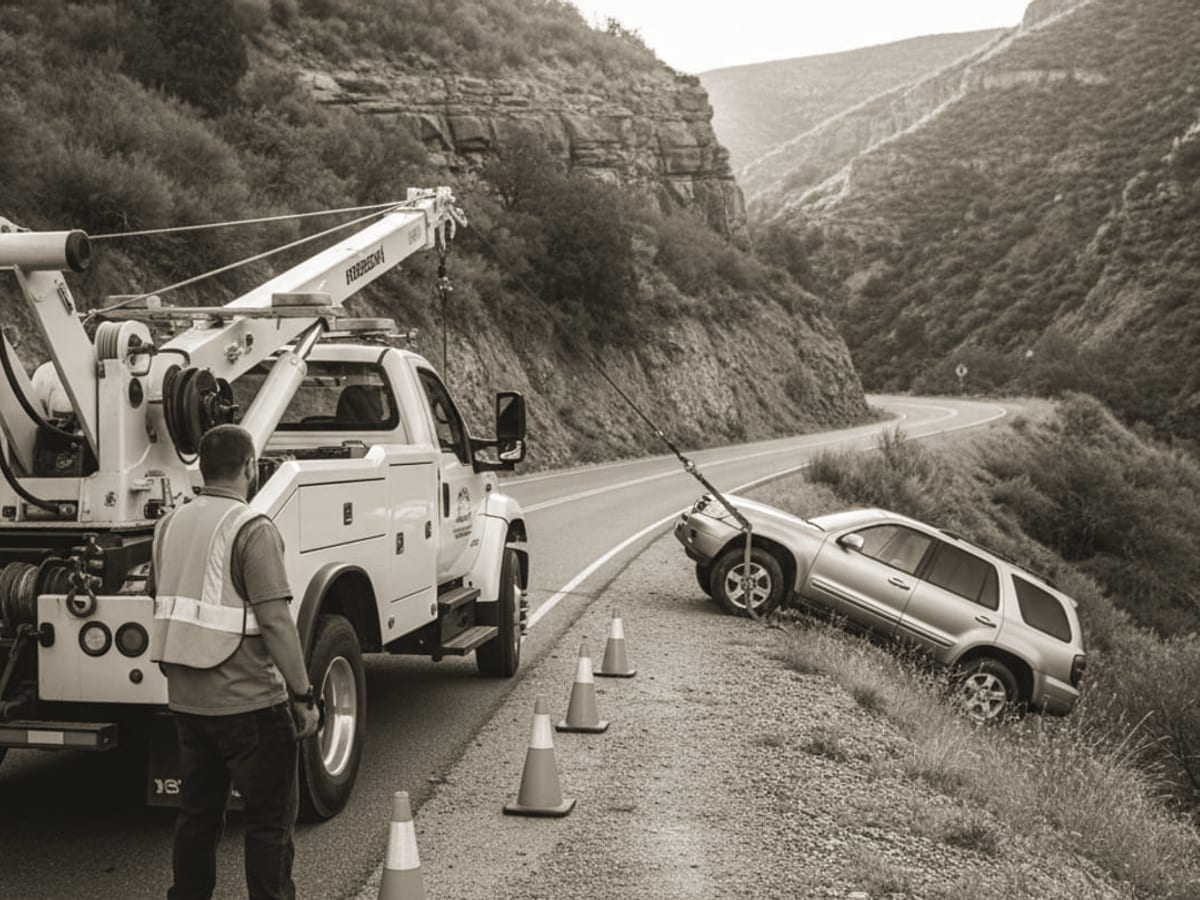
You do not have to let an uncalled tow truck take your car. If nobody requested that truck, arriving at the scene to tow is a violation under El Paso City Code Section 12.54.070, so tell the police officer you did not call it and keep the choice of operator in your hands. If the truck has already left with your vehicle and you did not authorize the tow, and the tow was a nonconsent tow, call the number on the posted sign or the storage facility to locate it. Note that once the car has left the lot but is not yet in storage there is no right to get it back. The lookup tools cover the City of El Paso Municipal Vehicle Storage Facility at (915) 212-0205 and the URVMS database. Check the bill against the City Code 12.54.020 caps, request a tow hearing and file a TDLR complaint. A tow you agreed to is a consent tow priced by the operator.
Quick Tow EP is a referral service. We connect drivers with independent local tow operators. The driver hires and pays the operator directly, and the operator quotes the price. Quick Tow EP does no towing, roadside work or storage itself.
The moment it happens: what to do at the scene
A truck rolls up on I-10 or Loop 375 with lights on and a driver walking toward you with a card. Here is the order that keeps you in control.
- Get safe first. If anyone is hurt or a lane is blocked, call 911. Move to a safe location off the traveled roadway, behind a barrier if possible.
- Tell the officer you did not request that truck. Say it plainly and early. The officer controls the scene, and your statement matters.
- Do not hand over keys or sign anything you have not read. A business card or flyer on your windshield is not a contract.
- Photograph the truck. Get the company name, the truck number, the license plate and the operator if you can do it safely.
- Choose your own operator, or let police order one. Those are the two clean paths.
Is it actually illegal in El Paso?
Yes, in the situation described. Under Section 12.54.070 of the El Paso City Code, a person commits an offense by arriving at a traffic accident or incident management scene to do a nonconsent or incident management tow without first being contacted by the police department, the vehicle owner, the driver, or the vehicle’s insurance company (ordinance text). The same section bars soliciting towing, repair, storage or buying and selling of damaged vehicles on public property, entering an accident scene under an officer’s control without permission, and using a third party to solicit for you.
The rule came from Ordinance 019867, adopted April 28, 2026, and effective June 1, 2026, which added Section 12.54.070 and amended the penalty section. The El Paso Police Department’s vehicle towing page links the amending ordinance and notes the effective date.
One more detail helps at the scene. Section 12.54.070(B) says the presence of a tow company vehicle, employee, dolly, equipment, business card or flyer at an accident scene that was not dispatched by police or requested by the owner, driver or insurer is prima facie evidence of solicitation. In plain terms, the card in your hand is part of the proof.
Who is allowed to call a tow after a crash?
Only a short list, per the same section: the police department, the vehicle owner, the driver, or the vehicle’s insurance company. If none of those people called the truck in front of you, that is the whole conversation. You can say, “I did not call you and I am not authorizing this tow,” then walk toward the officer.
What if the police order a tow?
Under Transportation Code Section 545.305, a peace officer may remove, or make the driver move, a vehicle from a highway if it is unlawfully parked and blocking the entrance to a private driveway, is reported stolen, is unattended and believed abandoned more than 48 hours, is disabled and the driver is incapacitated or not nearby, is disabled and the driver names no tow company, the driver is arrested, or it is a hazard. If the officer directs the tow, cooperate, ask which company is being called and where the car is going, and write both down.
What if they pressure you or hand you a card?
Stay calm and stay verbal. Repeat that you did not request the tow. Hand the card back or keep it as evidence, and tell the officer a truck you did not call is working the scene. You can also call the El Paso Police non-emergency line at (915) 212-4000 if no officer is present. Pressure is not authority.
If your car is drivable, move it
On a freeway main lane, ramp, shoulder or median in a metropolitan area, Texas law wants the road cleared. Under Transportation Code Section 550.022, if every vehicle can be normally and safely driven after a damage-only crash, each driver must move it as soon as possible to a frontage road, the nearest suitable cross street or another safe location (Section 550.022). A car that needs a tow is not considered drivable. If there is any doubt whether the car is safe to drive, leave it and let a licensed operator move it.
So if your car rolls and steers and is safe to drive, get it off I-10 or US-54 Patriot Freeway and into a lot or side street. That single move often ends the tow truck conversation, because there is nothing left to hook. Move to a safe location off the traveled roadway, behind a barrier if possible, and call 911 if anyone is hurt or a lane is blocked.
If you need a tow, get your own
You can pick any licensed operator you want. Ask for the price before you agree, and ask where the car will be stored. For a nonconsent tow the company must issue a tow ticket itemizing each charge and showing the licensed name, public phone number, certificate of registration number and the operator’s TDLR license number; ask for it. Operators quote their own rates, and you pay them directly. The City Code 12.54.020 caps apply to nonconsent tows, and a tow you call for yourself is a consent tow priced by the operator.
Two things to check before the truck hooks up:
- The license. TDLR licenses tow companies, tow operators and vehicle storage facilities in Texas (TDLR consumer info). Look the company up in the TDLR License Search by name, license number, city, county or ZIP.
- The fee cap. Inside El Paso city limits, Section 12.54.020 caps a nonconsent light duty tow at $100.00 for a vehicle with a gross vehicle weight rating of 10,000 lbs or less, per the city code posted on the EPPD towing page. An additional fee of no more than $25 may be charged for dollies or go-jacks under Section 12.54.020(B).
If you are outside city limits, for example in Socorro, Horizon City, Anthony, Clint, San Elizario, Vinton, Fabens, Canutillo or Tornillo, the city caps do not apply. There the TDLR statewide maximums apply unless a local rule sets lower ones: $272 for a vehicle up to 10,000 lbs, $380 for more than 10,000 but under 25,000 lbs, and $489 per unit for vehicles over 25,000 lbs with a $978 total maximum, subject to lower local rules. Texas Occupations Code Section 2308.202 lets a city set nonconsent fees below the state maximum (Occupations Code). Anthony, New Mexico, along with Sunland Park, Santa Teresa and Chaparral, is in New Mexico, so Texas TDLR rules and Texas statutes do not govern a tow there; use the New Mexico Motor Vehicle Division for titles and registration (NMMVD).
For a planned tow of your own, Tesla’s owner’s manual recommends a flatbed for Tesla vehicles and says to transport the car with all four tires off the ground. You can read more in our guides to accident recovery and flatbed towing, or see what a tow costs in El Paso.
If the truck already took your car
Act the same day. Here is the sequence.
- Find the car. For a parking-lot tow, call the number on the posted no-parking sign. For a city-facility tow, call the City of El Paso Municipal Vehicle Storage Facility at (915) 212-0205 or search the URVMS online vehicle database. For a Sheriff-towed vehicle, contact the EPCSO AMV Office at (915) 273-3800 ext. 5431 or the AMV lot at 12501 Montana Ave., Building F, (915) 538-2007. Our towed car lookup guide walks through the search.
- Check the fees against the caps. If the tow was a nonconsent tow and it happened inside city limits, compare the bill to Section 12.54.020. Under Occupations Code Section 2308.2065 a tower cannot charge more than the fee authorized by the city, and Section 2308.458 lets the justice court decide whether a charge exceeded the city’s authorized amount and order the excess refunded. A tow you agreed to is a consent tow priced by the operator, and the city caps do not apply to it.
- Ask about release rules. Section 12.54.020(D) says that if the owner or operator is at the scene and does not want the vehicle towed, there is no charge and the vehicle is returned if it has not been hooked up. If it has been hooked up but not towed from the scene, it must be released on payment of one-half the regular tow fee in Section 12.54.020(A).
- Request a tow hearing if you believe the tow or the charge was wrong. Filing a TDLR complaint is not a substitute for requesting a tow hearing, but you may do both.
- File a TDLR complaint about the company, operator or storage facility online at the TDLR complaints page. Towing customer service is (800) 803-9202 in state and (512) 463-6599.
- Report it to EPPD as well, especially if you have photos of the truck or the card.
Bring these when you go to the lot:
- A valid photo ID, such as a state driver’s license or ID card, any federal photo ID, or a photo ID from a foreign government such as a Mexico driver’s license or a matricula consular
- One proof of ownership: a driver’s license whose name matches the registration record, an insurance card naming you, the title, a notarized power of attorney signed by the owner, a tax collector’s receipt plus registration renewal card, a current lease or rental agreement, or TDLR’s Personal Vehicle Owner Removal and Inspection form
- Payment of the towing and storage fees
The $20 police-ordered-tow fee under Section 12.54.060 applies only when the tow was a police-ordered tow, and the $20 impoundment fee applies only at a city-owned vehicle storage facility. TDLR also allows a separate impoundment fee of up to $20 only when the VSF had to protect a car with broken or open doors, windows, trunk, hood or similar plus an inventory or registration lookup, and the bill must list the exact services. Our impound guide covers the pickup process.
Can you sue for an unlawful tow?
That is a question for a Texas attorney, not for a blog. What the code gives you is a complaint path: the ordinance makes violating Sections 12.54.020, 12.54.030 or 12.54.070 an offense punishable by a fine not to exceed $500 under Section 12.54.040, and the justice court route under Section 2308.458 handles excess charges. Start with the hearing and the TDLR complaint, and keep every document.
Frequently asked questions
Do I have to use the tow truck that shows up at my accident?
No. If you did not call that truck and police did not dispatch it, you are not obligated to hand over your car. Tell the officer you did not request it, and choose your own licensed operator or let the officer order one.
Is it illegal for tow trucks to chase accidents in El Paso?
Arriving at a crash scene to do a nonconsent tow without being contacted by police, the owner, the driver or the insurer is an offense under City Code Section 12.54.070. A company vehicle, employee, dolly, card or flyer at a scene nobody requested is prima facie evidence of solicitation under Section 12.54.070(B).
Who can request a tow after a crash?
Under Section 12.54.070, the police department, the vehicle owner, the driver, or the vehicle’s insurance company. A tow truck driver who shows up on their own is not on that list.
What if the tow truck already took my car?
If you did not authorize the tow and it was a nonconsent tow, the path depends on where the car went. For a parking-lot tow, call the number on the posted no-parking sign. For a city-facility tow, call the City of El Paso Municipal Vehicle Storage Facility at (915) 212-0205 or search the URVMS online vehicle database. For a Sheriff-towed vehicle, contact the EPCSO AMV Office at (915) 273-3800 ext. 5431. Then check the bill against the City Code 12.54.020 caps, request a tow hearing if you dispute it, and file a complaint with TDLR. If you agreed to the tow, it is a consent tow priced by the operator you hired.
How do I report a tow company in Texas?
File online through the TDLR complaints page, or call (800) 803-9202 in state or (512) 463-6599. You can also report the scene to EPPD, and you can do both a TDLR complaint and a tow hearing.
Can I pick my own tow company after an accident?
Yes. Ask for the price first, confirm the company’s license in the TDLR License Search, and ask where the car will be stored. Outside El Paso city limits, remember that the city fee caps do not apply.
When to call for a tow
If your car will not roll and steer safely, or the officer directs a tow, you need a licensed operator at the scene. Ask for the price and destination before you agree. Quick Tow EP is a referral service that can connect drivers with independent local tow operators. Call (915) 320-5573 and Quick Tow EP will connect you with an independent local tow operator.