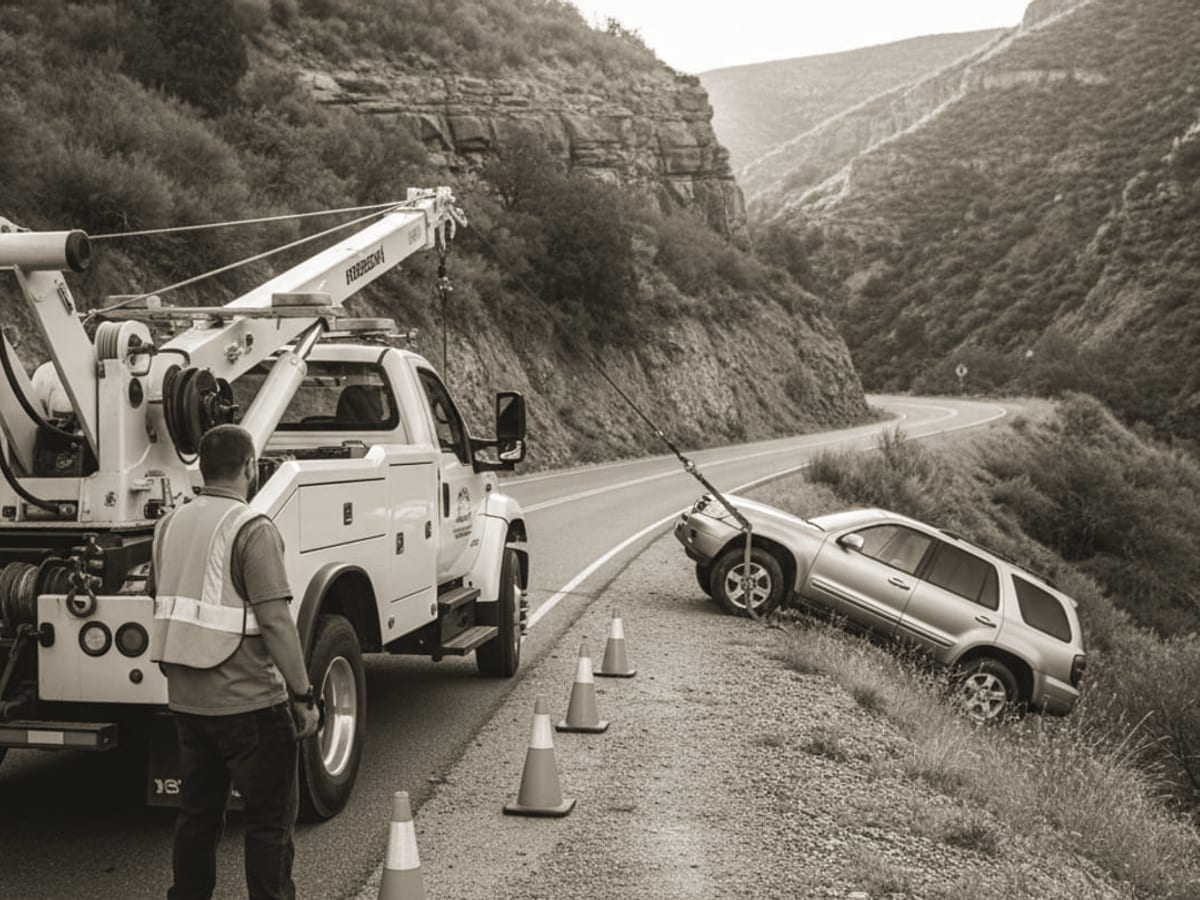
In Texas, towing is usually not included in a standard auto policy. It comes as an optional towing and labor add-on with a dollar limit, and after a crash your collision, comprehensive or the at-fault driver’s liability coverage may pay instead. Ask your carrier whether it pays the operator directly or reimburses you, and note that the coverage pays up to the dollar limit with you paying any difference.
Quick Tow EP is a referral service. We connect drivers with independent local tow operators. Those operators quote the price, do the work and are paid directly by you. Quick Tow EP does no towing, roadside work or storage itself.
Start with safety, then get the car moving
Insurance paperwork can wait a few minutes. Your first job is to get off the roadway and out of traffic.
- Pull as far off the road as you can, turn on your hazards and stay in the vehicle if it’s unsafe outside.
- Call 911 if anyone is hurt or the car is blocking a lane on I-10, US-54 or Loop 375.
- Once you are safely off the roadway and it is safe to wait, arrange a tow.
- Ask the operator for the total price and the destination before they hook up.
- Pay at service and keep an itemized receipt.
On El Paso highways, TxDOT’s HERO program may already be patrolling. HERO crews cover I-10 from Transmountain Road to Horizon Boulevard, Loop 375 from I-10 West to Paisano, and US 54 from McCombs to Loop 375. They change flats, jump batteries, add fuel and water, and handle minor repairs at no cost, Monday to Friday 5 a.m. to 9 p.m. and weekends 9 a.m. to 9 p.m. Call 915-790-HERO (4376), or 911 first in an emergency. HERO is built around getting traffic moving, and TxDOT does not describe HERO as a service that tows your car to a shop of your choice, so plan on a private tow if the car can’t be fixed on the spot. Our post on TxDOT HERO free roadside help goes deeper.
What Texas policies actually cover
The Texas Department of Insurance spells out the pieces. Towing and labor coverage pays to tow your car if it can’t be driven, and pays for labor to change a flat or jump-start a battery. It has a dollar limit, the most the company will pay. If the bill runs higher, you pay the difference.
Towing is a separate add-on. Check your declarations page for a towing and labor line and confirm two numbers: the per-incident cap and any mileage limit.
The other coverages work differently. Collision pays to repair or replace your car after an accident. Comprehensive covers fire, hail, theft, flood, flying gravel or hitting an animal. Rental reimbursement pays for a rental if your car is stolen or in the shop after an accident. If you owe money on the car, your lender will require collision and comprehensive.
So the coverage that applies depends on the scenario:
- Breakdown, dead battery, flat tire: only the towing and labor add-on applies, if you bought it.
- Crash you caused: collision may handle the damage, and the add-on may handle the tow.
- Crash someone else caused: the at-fault driver’s liability coverage may come into play.
- Theft, hail, flood or animal strike: comprehensive may apply.
Pay first, then file
Ask the operator how and when payment is collected. Ask your carrier whether it pays the operator directly or reimburses you, and get an unclear answer confirmed in writing. Our FAQ page covers how referrals work.
Keep clean paperwork. A claim with a blurry photo and no itemized bill is a claim that stalls.
- Itemized receipt showing the base tow, mileage, after-hours charge and any storage
- Date, time and location of the pickup and drop-off
- Company name, driver name and phone number
- Total paid and method of payment
- Photos of the vehicle and the scene
- Your policy number and the claim number, if one was opened
Ask your carrier how it handles reimbursement. If a claim is denied, ask for the reason in writing and follow the appeal steps in the denial letter.
Will a tow claim raise your rates?
Ask your agent directly how a towing and labor claim affects your policy. One rule is in the statute book: a company can refuse to renew your towing and labor coverage if you have four towing and labor claims in 36 months, per TDI. That’s a renewal rule for the add-on, not a rate rule for the whole policy.
When the bill looks too high
Inside El Paso city limits, the city code caps what a tow company may charge for a nonconsent tow. Under Section 12.54.020 of the City of El Paso code, the maximum for a nonconsent tow inside El Paso city limits is $100 for a light-duty tow, $350 for medium duty and $450 for heavy duty. Dollies or go-jacks can add up to $25. For a vehicle over 10,000 lbs, if the tow takes longer than two hours from arrival at the scene to completion, the operator may charge up to $55 per hour for each hour over two hours, plus actual cost if cargo must be moved by hand, per Section 12.54.020(C).
Outside city limits, in Socorro, Horizon City, Canutillo, Fabens, Clint, San Elizario, Vinton, Tornillo and similar places, the city caps don’t apply. There the TDLR statewide maximums govern nonconsent tows unless a local rule sets lower ones: $272 up to 10,000 lbs, $380 for more than 10,000 but less than 25,000 lbs, and $489 per unit with a $978 total maximum over 25,000 lbs. A consent tow you call for yourself is priced by the operator you hire, and no TDLR maximum table applies to it. Under Occupations Code Section 2308.2065, a tower can’t charge more than the fee authorized by the city, and Section 2308.458 lets a justice court decide whether a charge exceeded the authorized amount and order the excess refunded. Our guides to Texas towing fee limits and the 2026 El Paso towing ordinance explain more.
If the bill looks wrong, ask for an itemized statement, photograph it, and pay under protest if you need the car back. Then dispute it in writing.
Storage fees and city impounds
Storage is where costs climb. Under TDLR rules, daily storage is $22.85 per day or part of a day for a vehicle 25 feet or less, and $39.99 for longer, after the 2023 biennial adjustment. A day begins and ends at midnight, and a facility may not charge more than one day if the vehicle is there less than 12 hours. A notification fee of up to $50 applies unless the car is reclaimed within 24 hours or before notice is sent. An impoundment fee of up to $20 applies only in specific circumstances, and the bill must list the exact services.
If El Paso police ordered the tow, the car may be at the City of El Paso Municipal Vehicle Storage Facility at 11615 Railroad Drive, run by UR Vehicle Management Solutions. Call (915) 212-0205 or search the URVMS online database to confirm the car is there and see the charges. Call before visiting, because some vehicles have a hold and can’t be released. Bring a valid photo ID plus registration, title or insurance, and the balance owed. URVMS takes cash and Discover, Mastercard and Visa, with a 1.98% government fee added for credit cards, and quotes are current only through midnight of the day given.
Under Section 12.54.060, when a vehicle towed on a police-ordered tow is released from a storage facility, an additional $20 fee is collected and remitted to the police department. A separate $20 impoundment fee applies to a vehicle towed to a city-owned vehicle storage facility before release. Our impound guide and El Paso impound fees post walk through the rest.
If your car was towed from private property, different rules apply. See Texas tow-away sign rules.
If you have no towing coverage
If you don’t have towing coverage, you still need the car moved. Compare the add-on against a roadside membership plan, and ask what each excludes. Our post on roadside plans and what they cover and roadside help without membership can help you decide. If money is tight right now, read need a tow with no money.
Frequently asked questions
Does my insurance cover towing?
Only if you bought towing and labor coverage as an add-on, or if a crash claim under collision, comprehensive or the other driver’s liability covers the tow. Check your declarations page for a towing line and its dollar limit.
Am I covered if my car just won’t start?
A dead battery or flat tire is a labor item under the towing and labor add-on, which pays for jump-starts and tire changes up to your limit. Without the add-on, you pay out of pocket unless a membership plan covers it.
Do I pay the tow truck driver or my insurance?
Ask the operator how and when payment is collected, and ask your carrier whether it pays directly or reimburses you. Get that answer in writing if it’s unclear.
Will my rates go up if I claim a tow?
No one can promise an answer for your policy. Ask your agent how a towing claim is treated. TDI does note that a company can refuse to renew your towing and labor coverage after four such claims in 36 months.
How much towing does my policy actually cover?
It depends on the dollar limit and any mileage limit on your declarations page. The insurer pays up to the cap, and you pay anything above it.
What do I do if my car gets impounded?
Call (915) 212-0205 or search the URVMS database to confirm where it is and what it costs. Bring photo ID plus registration, title or insurance, and the balance owed, and call before you go in case of a hold.
When to call for a tow
Call for a tow when the car can’t be driven safely, when a repair on the roadside isn’t possible, or when police or a property manager had it moved and you need it relocated. Don’t sit on a shoulder longer than you must. In a dust storm, National Weather Service guidance is to pull off the pavement as far as possible, stop, turn off lights, set the emergency brake, and never stop on the traveled portion of the roadway. Call (915) 320-5573 and Quick Tow EP will connect you with an independent local tow operator.