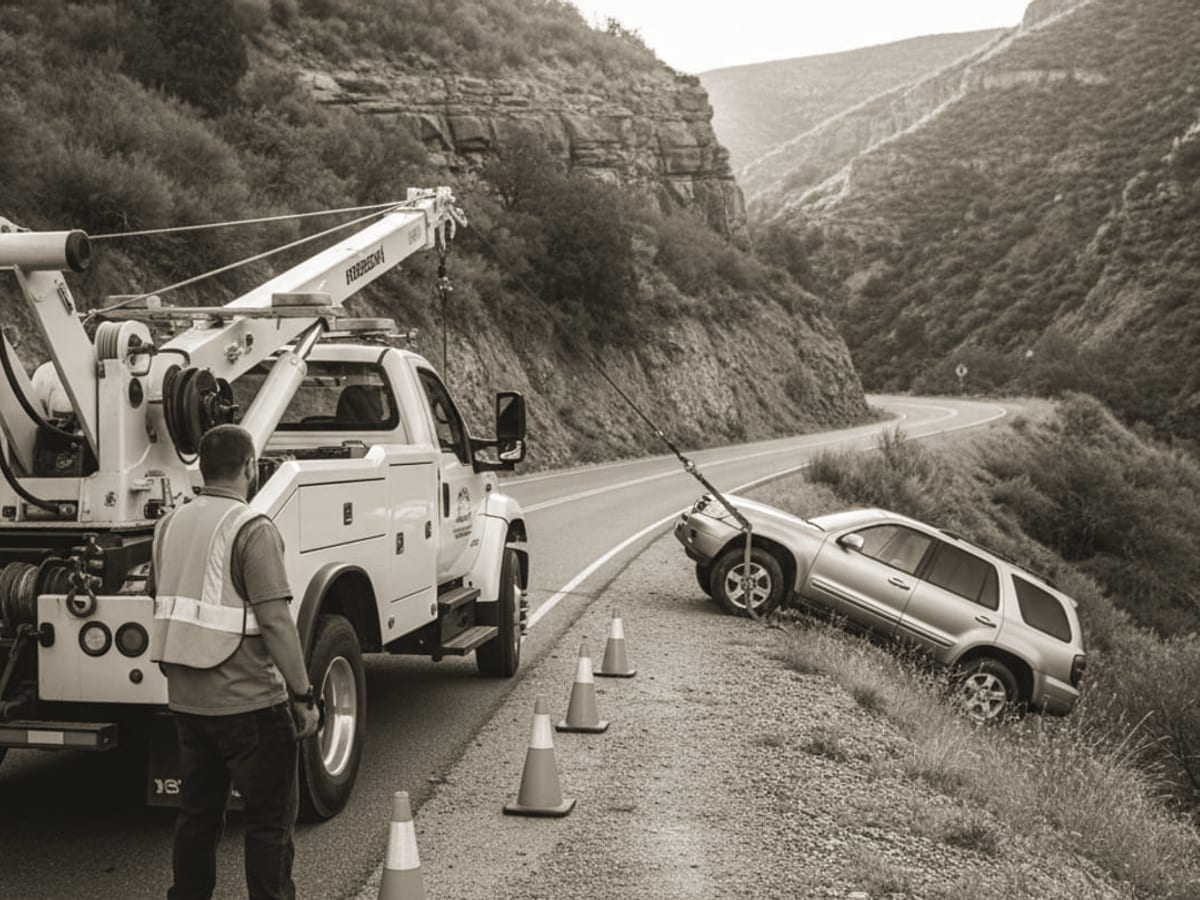
El Paso’s 2026 towing ordinance did not change what a tow company can charge you. Ordinance 019867, effective June 1, 2026, added Section 12.54.070, which bans uncalled tow trucks and solicitation at crash scenes, and it amended the penalty section so the new offense carries a fine of up to $500; the fee caps in Section 12.54.020 stayed exactly as they were. Inside city limits, a nonconsent tow still maxes out at $100 for light duty, $350 for medium duty and $450 for heavy duty, per the City of El Paso code posted by EPPD.
Quick Tow EP is a referral service. We connect drivers with independent local tow operators. The driver hires and pays the operator directly, and the operator quotes the price. Quick Tow EP does no towing, roadside work or storage itself.
What Ordinance 019867 actually changed
The amendment is short and narrow. Adopted April 28, 2026 and effective June 1, 2026, it did two things, according to the ordinance text posted by EPPD.
- It added Section 12.54.070, a new set of rules against showing up uninvited at crash scenes and soliciting tow work on public property.
- It amended Section 12.54.040, the penalty section, so a violation of the fee caps, the debris rule or the new solicitation rule is punishable by a fine up to $500.
That’s it. No fee line moved. The current caps trace back to Ordinance 18774 from April 17, 2018, and the 2026 amendment left them alone. If you read a headline saying El Paso “changed towing fees,” that’s not what happened.
What a tow company can legally charge in El Paso
Section 12.54.020 sets the maximum for a nonconsent tow in the city, and that includes cleanup of debris, no matter what kind of truck shows up.
- Light duty, gross vehicle weight rating of 10,000 lbs or less: $100, per Section 12.54.020(A).
- Medium duty, over 10,000 but under 25,000 lbs: $350, per Section 12.54.020(A).
- Heavy duty, over 25,000 lbs: $450, per Section 12.54.020(A).
- Dollies or go-jacks: up to $25 more, per Section 12.54.020(B).
- Heavy vehicle that takes more than two hours from arrival to completion: up to $55 per hour for each hour past two, plus actual cost if cargo has to be moved by hand, per Section 12.54.020(C).
Two more numbers matter at release time. For a police-ordered tow released from storage, a $20 fee is collected and sent to the police department, and a vehicle taken to a city-owned storage facility pays a $20 impoundment fee before release, both under Section 12.54.060. Those are code fees, not the operator’s tow charge.
And if you show up before the hookup is done, Section 12.54.020(D) gives you a break. Not hooked up yet: no charge, and you get the car back. Hooked up but not yet towed from the scene: you pay one-half the regular tow fee.
City caps next to the state caps
This is where people get confused, so here’s the plain comparison. TDLR’s statewide maximum for a private property nonconsent tow is $272 for a vehicle up to 10,000 lbs, $380 for over 10,000 but under 25,000 lbs, and $489 per unit for vehicles over 25,000 lbs with a $978 total cap, per TDLR’s consumer page. El Paso’s city limits run lower, at $100, $350 and $450. Texas Occupations Code Section 2308.202 lets a city set nonconsent fees below the state maximum, and Section 2308.2065 bars a licensed tower from charging more than the city allows, per the Texas Occupations Code.
So the answer to “how much can a towing company legally charge in El Paso” depends on one question: where was the car? Inside city limits, the city caps control. Outside them, the TDLR table applies unless a local rule sets something lower.
The drop fee works the same way. TDLR’s statewide maximum drop fee is $135 for a vehicle 10,000 lbs or less, $190 for over 10,000 but under 25,000 lbs, and $244 over 25,000 lbs, and a city can set it lower but never higher, per TDLR. In El Paso, Section 12.54.020(D)‘s one-half rule is the local answer.
What counts as illegal towing in El Paso
Section 12.54.070 is the new one, and it’s worth reading in plain words. A person commits an offense if they:
- Arrive at a traffic accident or incident management scene to do a nonconsent or incident management tow without first being contacted by the police department, the vehicle owner, the driver or the vehicle’s insurance company.
- Solicit towing, repair, storage, or buying or selling related to a damaged vehicle on public streets, public ways, other public property or city sidewalks.
- Enter an accident or incident scene under a peace officer’s control without permission.
- Use a third party to solicit at the scene.
The section also gives you a built-in evidence rule. Under Section 12.54.070(B), a tow company vehicle, employee, dolly, equipment, business card or flyer at an accident scene that wasn’t dispatched by police or requested by the owner, driver or insurer is prima facie evidence of solicitation. In other words, if the truck is there and nobody called it, that alone can make the city’s case.
Separately, overcharging is its own violation. Charging above the Section 12.54.020 caps, or skipping the debris cleanup required by Section 12.54.030, falls under the same penalty section.
At a crash scene: what to do
- Know where you are. City limits versus Socorro, Horizon City, Canutillo, Anthony TX or Fabens changes which fee table applies. If you are unsure which city you are in, note the address and ask the responding officer or the tow company which city the tow is in. Keep in mind that the tow ticket must itemize charges and show the company’s licensed name, public phone number, certificate of registration number and the operator’s TDLR license number.
- Only accept a tow requested by police, by you or your driver, or by your insurer. If a truck rolls up on I-10 near Downtown or on Loop 375 and nobody called it, that’s the exact conduct Section 12.54.070 targets. Decline it.
- Ask who called them and write down the company name, truck number and plate. Photograph the truck and any business card left behind.
- Photograph the scene before the car moves: damage, debris, signs, the position of the vehicles.
- Get the price in writing before you agree, and check it against the caps above.
- Keep every receipt, and keep the tow ticket and storage paperwork together.
If a driver pressures you at the scene, stay calm and call the El Paso Police non-emergency line at (915) 212-4000. The ordinance targets that behavior. For a deeper look at this exact scenario, see our post on what to do when a tow truck shows up at a crash in El Paso.
After a private property tow
Private property tows are nonconsent tows, so the caps apply inside city limits. If you catch the hookup in progress, Section 12.54.020(D) is your friend: no charge if not yet hooked up, half the regular fee if hooked up but not towed from the scene. That local rule is lower than TDLR’s statewide drop fee maximums, which is exactly how the law is supposed to work.
Once the car has left the parking facility, you no longer have the right to get it back before it reaches storage, per TDLR. At that point you’re dealing with the tow yard, so bring your ID, proof of ownership and payment, and check the bill line by line against the caps. Our guides on Texas tow away sign rules and getting your belongings from a tow yard cover the next steps.
How to report a violation and get overcharges back
These are two separate tracks, and you can run both.
Report the conduct to EPPD. The solicitation rule and the fee caps are city code, and violations are punishable by a fine up to $500 under Section 12.54.040 as amended. Call the EPPD non-emergency line at (915) 212-4000 and have photos, the company name, the truck plate and the location ready.
Request a tow hearing for the money. Under Occupations Code Section 2308.458, a justice court decides whether a charge exceeded the city’s authorized amount and can order the excess refunded. File in any justice court in the county the car was towed from, per Section 2308.453. The written request must reach the court before the 14th day after the car was placed in storage, not counting Saturdays, Sundays and legal holidays, per Section 2308.456. If the required notice was never given, the deadline doesn’t apply, and the clock doesn’t start until you get the information you need to fill out the request. Missing it waives the hearing.
Your request should include:
- Your name, address and phone number
- Where and when the car was removed
- Who authorized the tow
- The tow company’s and storage facility’s names, addresses and phone numbers
- Copies of receipts or notices
- Photos of any parking sign, or a statement that none was posted
TDLR notes the court may charge a $20 filing fee, and the hearing must be held before the 21st calendar day after the court receives the request, per TDLR and Occupations Code Section 2308.458. At the hearing the burden of proof is on you, and the issues are probable cause and whether the charge exceeded the allowed amount. If the court finds no probable cause, the tow company, storage facility, parking facility owner or agency that authorized the tow must pay or reimburse the towing and storage costs. Even with probable cause, an overcharge gets refunded.
File a TDLR complaint. TDLR licenses tow companies, operators and storage facilities, and you can file a complaint online. It isn’t a substitute for the hearing, but you can do both. Before you hire anyone, check the license search by name, license number, city, county or ZIP. TDLR towing customer service is (800) 803-9202 in state and (512) 463-6599.
One more thing worth knowing: if you call a tow for yourself, that’s a consent tow, and the operator you hire sets the price. No TDLR maximum table applies. Ask the operator for the total before you agree.
Frequently asked questions
What did El Paso’s 2026 towing ordinance change?
Ordinance 019867, effective June 1, 2026, added Section 12.54.070 against uncalled tow trucks and solicitation at crash scenes, and it amended Section 12.54.040 so violations carry a fine up to $500. It did not change any fee. The caps in Section 12.54.020 still apply as written.
How much can a tow truck charge in El Paso?
Inside city limits, Section 12.54.020 caps a nonconsent tow at $100 for light duty, $350 for medium duty and $450 for heavy duty, plus up to $25 for dollies. TDLR’s statewide private property maximums are higher, at $272, $380 and $489 per unit, so the city number controls locally.
Is it illegal for a tow truck to show up at an accident?
Yes, if nobody called it. Under Section 12.54.070, arriving at a crash scene to do a nonconsent tow without being contacted by police, the owner, the driver or the insurer is an offense. A truck, dolly, card or flyer at the scene that wasn’t dispatched or requested is prima facie evidence of solicitation.
What is the drop fee in El Paso?
Section 12.54.020(D) sets it at one-half the regular tow fee if the vehicle is hooked up but not yet towed from the scene, and no charge at all if it isn’t hooked up yet. That’s lower than TDLR’s statewide drop fee maximums of $135, $190 and $244, which is allowed because cities can go lower.
Do the city caps apply in Socorro or Horizon City?
No. Chapter 12.54 is El Paso’s own code, so it governs tows inside city limits only. In Socorro, Horizon City, Anthony TX, Clint, San Elizario, Vinton, Fabens, Canutillo or Tornillo, the TDLR statewide maximums apply unless that local government has set lower ones. New Mexico places like Sunland Park and Santa Teresa fall outside Texas rules entirely, so contact the agency that handled the tow and the New Mexico Motor Vehicle Division (NMMVD) for title questions.
How do I report an illegal tow in El Paso?
Call the EPPD non-emergency line at (915) 212-4000 and have photos, the company name, the truck plate and the location ready. For the money, file a tow hearing request in justice court before the 14th day after the car went into storage, not counting Saturdays, Sundays and legal holidays, per Occupations Code Section 2308.456; the deadline does not apply if the required notice was never given. You can also file a TDLR complaint, and doing both is fine.
When to call for a tow
If your car is disabled, undrivable after a crash, or stuck somewhere you can’t safely leave it, you need a tow operator, and you want one you contacted yourself. The rule targets tow trucks that show up at crash scenes without being called by police, the owner, the driver or the insurer. Call (915) 320-5573 and Quick Tow EP will connect you with an independent local tow operator.