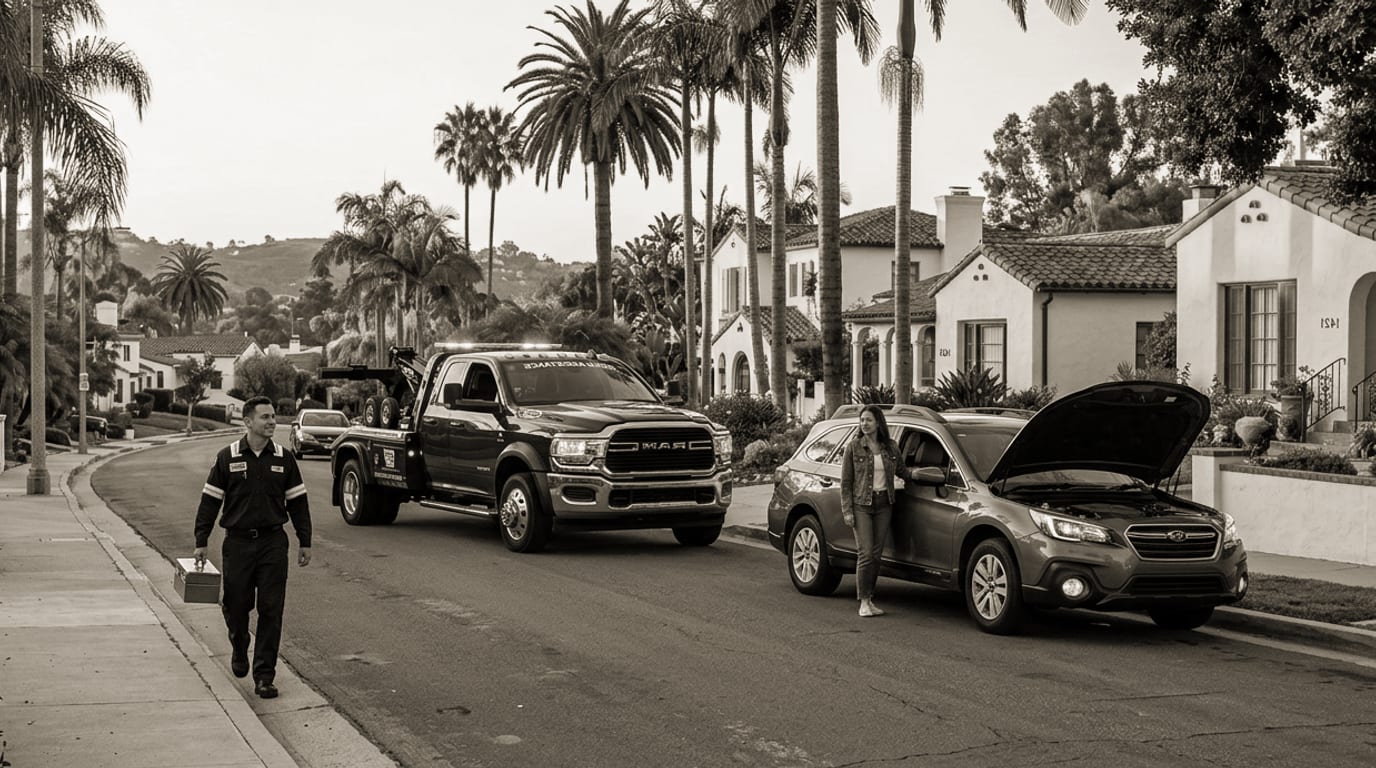
You don’t need a membership or an insurance add-on to get a tow. Roadside help in El Paso is available pay-per-call, and many drivers already carry coverage they forgot about through a credit card, new-car warranty, phone plan, employer, or auto policy. The real question is which option costs less for your car and your breakdown history, and what to confirm before anyone hooks up your vehicle.
Quick Tow EP is a referral service. It connects drivers with independent local tow operators. The driver hires and pays the operator directly, and the operator quotes the price. Quick Tow EP does no towing, roadside work, or storage itself.
First, get safe and get found
Before you compare plans or prices, deal with the situation on the road.
- Move yourself and passengers behind a barrier or well off the travel lane if you can do it safely. Leave pets and children out of traffic lanes.
- Turn on hazards. Set out a warning triangle or flares if you have them and it’s safe to place them.
- Note your exact location: highway, direction of travel, exit or mile marker, and nearest landmark. On I-10 near Transmountain Rd. (mile marker 6), note your direction of travel and the nearest mile marker.
- If the car can’t move at all and sits in a live lane, treat it as an emergency and call 911 first.
Summer heat, spring dust storms, and monsoon rain all make waiting on a shoulder more dangerous, so if you must leave the vehicle, exit away from traffic (the side away from passing cars) and move behind a barrier; never stand between the car and passing traffic. In a dust storm, National Weather Service guidance is to pull the vehicle off the pavement as far as possible, stop, turn off lights, set the emergency brake, and take your foot off the brake pedal so the tail lights are not lit. Never stop on the traveled portion of the roadway. NWS dust storm safety
If you’re waiting on a shoulder, know that Transportation Code Section 545.157 requires drivers approaching a stopped tow truck, emergency vehicle, TxDOT vehicle or certain others using their lights to vacate the closest lane on a road with two or more lanes in that direction, or slow to 20 mph under the posted limit (5 mph if the limit is under 25 mph). Transportation Code 545.157
Check what you already have before you pay anyone
Most drivers pay for a tow they already had coverage for. Run this checklist before you call anyone.
- Auto insurance policy: look for towing and labor coverage. The Texas Department of Insurance says it pays to tow a car that can’t be driven and pays for labor to change a flat or jump-start a battery. TDI
- The dollar limit: under TDI’s rule for towing and labor coverage, the policy has a maximum the company will pay, and if the cost is higher you pay the difference.
- Credit cards: some cards include roadside benefits. Read the guide to benefits that came with the card, not the marketing page.
- New-car warranty or manufacturer program: check the booklet that came with the vehicle for roadside terms and how long they last.
- Phone plan: some wireless plans bundle roadside help. Check your plan details.
- Employer or union: ask HR or your union rep whether a roadside benefit exists.
- Extended warranty or service contract: read the contract language on towing and whether it reimburses or dispatches.
Two things to confirm in the fine print: whether the benefit dispatches a provider for you or reimburses you after you pay, and what it excludes. A reimbursement benefit means you pay the operator at the scene and file a claim later.
Also know the TDI rule on frequency: a company can refuse to renew your towing and labor coverage if you file four towing and labor claims in 36 months. If you break down often, that changes the math.
Free help that already exists in El Paso
TxDOT runs the Highway Emergency Response Operator program, HERO, in El Paso County. It launched June 15, 2020, and patrols three highways: I-10 from Transmountain Rd. (mile marker 6) to Horizon Blvd. (mile marker 38), Loop 375 from I-10 West to Paisano, and US 54 from McCombs to Loop 375. TxDOT
HERO crews provide at no cost: flat tire changes and air, gas, diesel and water, battery jumps, minor repairs, cell phone service, and drinking water. Hours per TxDOT are Monday to Friday 5 a.m. to 9 p.m. with five trucks and one tow truck per shift, and Saturday and Sunday 9 a.m. to 9 p.m. with two trucks and one tow truck. Coverage is limited to those three stretches and those posted hours. Call 915-790-HERO (4376), and in an emergency call 911 first.
Know the limits. HERO’s job is helping stranded motorists and keeping traffic moving on those highways. TxDOT does not describe it as a service that tows your car to a shop of your choice, so if the car can’t be fixed on the spot, plan on a private tow. It also only covers those three stretches, so a breakdown outside them may not be covered. Check hours and coverage for your road before you count on it.
If you need help and you’re not sure who to call, use the El Paso Police non-emergency line at (915) 212-4000, or 911 in an emergency.
Pay-per-call versus membership versus insurance
There’s no single cheaper option. It depends on your car and how often it strands you.
- New car under warranty, few breakdowns: use the warranty or manufacturer program first, then pay per call. A membership you rarely use is money spent for nothing.
- Older car, frequent small problems: a membership or a towing and labor add-on can pencil out, but watch the claim limits and the four-claims-in-36-months renewal rule.
- Car you depend on daily with no backup: coverage you can actually reach matters more than saving a few dollars.
- Rarely drive, second vehicle: pay per call, and keep a card with a roadside benefit in the glovebox.
Compare what each option actually covers, not the sticker. Under TDI’s rule for towing and labor coverage, the policy pays up to a dollar limit, and if the cost is higher you pay the difference, so a low limit can leave you covering the rest of a long tow.
What to ask before you authorize the work
This is where pay-per-call goes right or wrong. Ask these questions in order, and write down the answers.
- What is the total price before you dispatch, and what does it include for this specific job? A consent tow is priced by the operator you hire.
- Is this a roadside fix or a tow? Say clearly which one you’re authorizing.
- What’s included and what costs extra: winching, extra passengers, storage, after-hours fees?
- What payment methods do you take, and is there an added processing charge for cards?
- Where exactly are you taking the vehicle? Name the destination before loading begins.
- How long should I expect, and what number do I call to follow up?
If a fix fails at the roadside, you’re back to a tow, so ask upfront what a tow would cost from that same spot. Decide your destination now: a repair shop near home, or your driveway if you’ll handle it later. Tell dispatch if the car cannot be shifted into neutral. For a Tesla, note that the owner’s manual requires all four wheels off the ground on a flatbed, or wheel lifts and dollies if a flatbed is not possible. Tesla’s manual also says to enable Transport Mode before winching: make sure the car is not connected to a charger, shift into Park, chock the tires, then turn it on from the touchscreen, and shifting into Park cancels it.
If the car is hooked up but has not yet been towed from the scene, the owner can keep it by paying a drop fee. Inside El Paso city limits, City Code Section 12.54.020(D) governs the drop fee: one-half the regular tow fee if the vehicle is hooked up but not towed from the scene, and no charge if it is not yet hooked up. The TDLR statewide drop-fee maximums ($135 for a vehicle 10,000 lbs or less, $190 for over 10,000 but under 25,000 lbs, and $244 over 25,000 lbs) and the TDLR rule requiring the driver to accept cash, credit cards and debit cards for the drop fee apply outside city limits or where no lower local rule exists. You do not have the right to get the car back after it has left the parking facility but before it is placed in a storage facility.
Spotting a legitimate operator: ask for the company name and the operator’s TDLR license number, and verify it on the TDLR License Search by name, license number, city, county or ZIP. TDLR License Search
If you are overcharged or mistreated, complaints about a tow company, tow operator, storage facility or booting company can be filed online with TDLR. TDLR towing customer service is (800) 803-9202 (in state only) and (512) 463-6599. TDLR complaints
If police arrange the tow
Ask the officer which company is responding and where the vehicle is going. If the car ends up at the City of El Paso Municipal Vehicle Storage Facility at 11615 Railroad Drive, phone (915) 212-0205, open 24 hours, you can call that number or search the URVMS online vehicle database, which lists all vehicles currently stored there and their charges. URVMS Under City Code Section 12.54.060 a police-ordered tow released from a storage facility carries an additional $20 fee collected and remitted to the police department, and a vehicle towed to a city-owned storage facility is charged a $20 impoundment fee before release. Photograph the scene and the vehicle before it’s loaded. Keep every paper you’re handed, and read the guide to what happens when a tow truck shows up at a crash so you know what to expect.
After a nonconsent tow the owner is entitled to a hearing on probable cause. The written request must reach a justice court in the county the car was towed from before the 14th day after the car was placed in storage, not counting Saturdays, Sundays and legal holidays, and missing the deadline waives the hearing. If the required notice was never given, the deadline does not apply, and the 14 days do not start until the tow company or storage facility gives the owner the information needed to fill out the request.
Paperwork to keep for reimbursement
If you plan to claim this against a card benefit, warranty, or policy, the paperwork decides whether you get paid.
- Itemized invoice showing services and charges
- Payment receipt or card statement
- Photos of the vehicle, the problem, and the location
- The operator’s company name and license number
- Your policy, card, or contract number and the claim phone number
- A copy of the police report if an officer was involved
File the claim promptly and follow the instructions in your policy or card guide exactly. For more on how insurers handle these claims, see does insurance pay for towing in Texas.
Frequently asked questions
Do I really need a membership to get a tow?
No. You can call an independent tow operator and pay for the job directly, with no plan required. Many drivers find a card benefit, warranty, or policy already covers part of the cost.
Is there any free roadside help near me right now?
Possibly. TxDOT’s HERO program covers I-10 from Transmountain to Horizon, Loop 375 from I-10 West to Paisano, and US 54 from McCombs to Loop 375, during posted hours. Call 915-790-HERO (4376) to check, and call 911 first in an emergency.
Does my insurance already include towing?
Not automatically. Towing and labor is separate coverage, and it has a dollar limit above which you pay the difference. Read your policy declarations page or call your agent to confirm.
How much will a one-time tow cost me?
It depends on the type of tow. A tow you call for yourself is a consent tow, and the operator you hire sets the price. A nonconsent tow is capped. Inside El Paso city limits, City Code Section 12.54.020 sets the maximum at $100 for a light duty tow (vehicle gross vehicle weight rating not more than 10,000 lbs), $350 for medium duty (more than 10,000 but less than 25,000 lbs), and $450 for heavy duty (more than 25,000 lbs). Outside city limits, TDLR statewide maximums apply: $272 up to 10,000 lbs, $380 for more than 10,000 but less than 25,000 lbs, and $489 per unit for over 25,000 lbs with a $978 total maximum, and a city or county rule can set them lower. For a nonconsent tow, the fee must be itemized on a tow ticket. Ask for the total price before dispatch and what it includes, and get the destination named before loading.
What is the Move Over law in Texas?
Transportation Code Section 545.157 requires drivers approaching a stopped tow truck, emergency vehicle, TxDOT vehicle or certain others using their lights to vacate the closest lane on a road with two or more lanes in that direction, or slow to 20 mph under the posted limit (5 mph if the limit is under 25 mph). Fines run $500 to $1,250, $1,000 to $2,000 for a repeat within five years, and a Class A misdemeanor if someone is injured. Transportation Code 545.157
What should I ask before they hook up my car?
Ask for the total price before dispatch, whether it’s a roadside fix or a tow, what’s included, the payment methods and any card processing charge, and the exact destination. Verify the operator’s TDLR license number.
When to call for a tow
Call a tow operator when the car can’t be driven safely, when a roadside fix fails, or when you’re outside HERO coverage and hours and need the vehicle moved. Nonconsent tow fees are capped by City Code Section 12.54.020 in El Paso city limits and by TDLR maximums elsewhere. Call (915) 320-5573 and Quick Tow EP will connect you with an independent local tow operator.