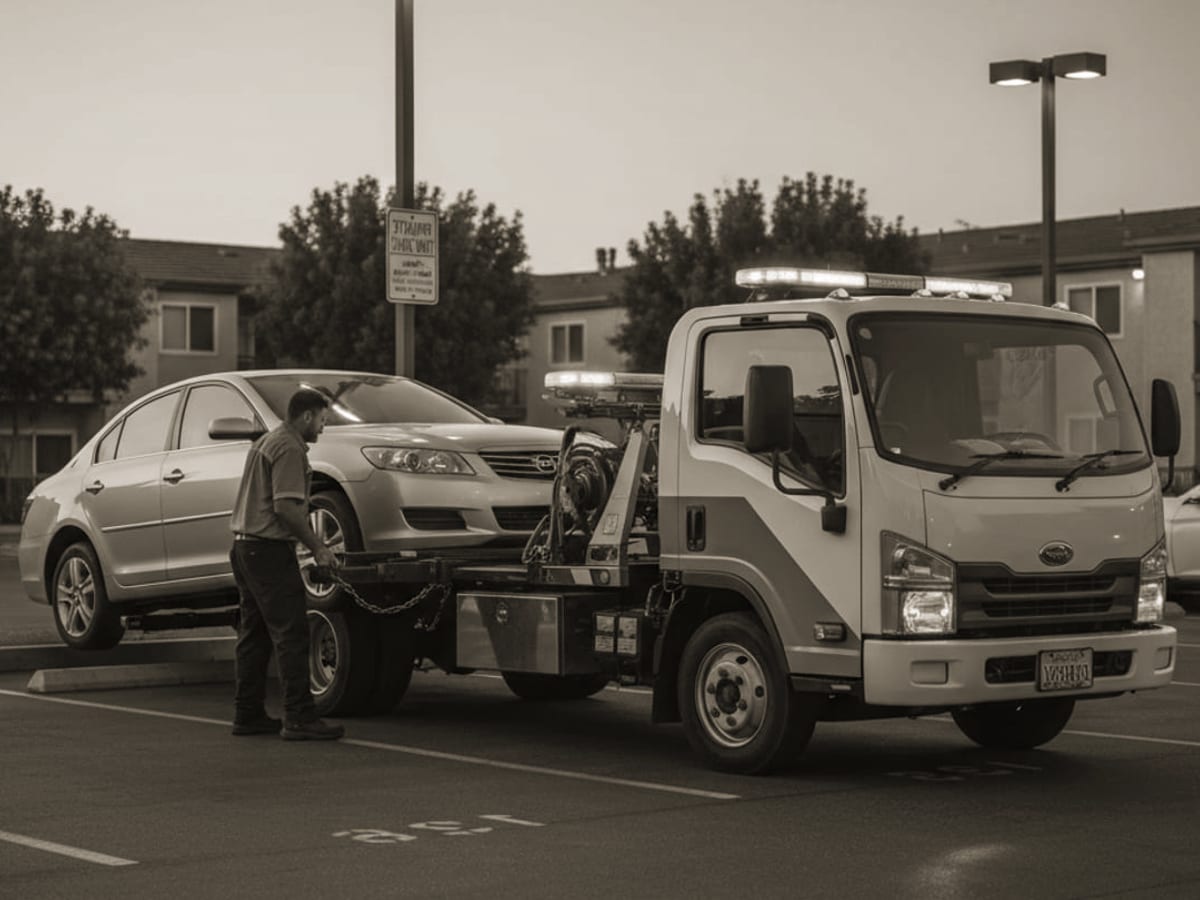
If your car was towed from a private lot in Texas, the tow is legal only if compliant signs were posted at the time of the tow and for the 24 hours before it, or one of the other notice paths in the law applied. A valid Texas private property tow sign has to be conspicuous at each entrance, mounted with its bottom edge five to eight feet off the ground, at least 18 by 24 inches, and carry the required red and white wording, enforcement hours, and a 24-hour phone number. If any of that was missing or wrong, you may have grounds for a hearing and a refund.
Quick Tow EP is a referral service. It connects drivers with independent local tow operators, and those operators quote the price, do the work, and get paid by the driver directly. Quick Tow EP does no towing, roadside work or storage itself.
The sign checklist for property owners and drivers
This is the part to measure. Walk the lot with a tape and your phone camera, whether you manage it or you’re standing in it after your car vanished.
Placement and height
- The sign must face and be conspicuously visible to drivers entering the lot.
- It goes to the right or left of each driveway or curb cut entrance, including entrances from an alley.
- For wide, undefined entrances over 35 feet, signs must be placed so no entrance point is more than 25 feet from a sign.
- It must be permanently mounted on a pole, post, wall or barrier on the property.
- The bottom edge sits between five and eight feet above the ground.
The height is easy to check with a tape measure. A sign bolted flat to a wall at eye level, or a sign on a flimsy stake, doesn’t match the spec in Section 2308.301 of the Occupations Code (Texas Occupations Code Chapter 2308).
Size, colors and wording
Every sign must be weather resistant and at least 18 inches wide and 24 inches tall. Each one must show:
- The international towing symbol.
- Who may park, and that all others are prohibited.
- Wording such as “Unauthorized Vehicles Will Be Towed at Owner’s or Operator’s Expense.”
- The days and hours of enforcement.
- A phone number with area code, answered 24 hours a day, to locate a towed car.
The color and lettering rules are specific too. At the top, a bright red tow truck symbol on a white background, at least four inches tall. Below it, white letters at least two inches tall on bright red reading “Towing Enforced” (or “Towing and Booting Enforced” or “Booting Enforced”). Then the other required text in bright red letters at least one inch tall on white, and phone numbers at the bottom in white letters at least one inch tall on red. The storage facility’s name and address may be added.
Restricted spaces, fire lanes and the 24-hour rule
An otherwise unrestricted lot can restrict individual spaces with a compliant sign at the entrance to that group of spaces or at the end of each space, with the top no higher than seven feet.
Fire lanes that aren’t covered by another rule need red painted curbs marked “FIRE LANE—TOW AWAY ZONE” in white letters at least three inches tall, repeated at intervals of no more than 50 feet.
Timing matters as much as the sign itself. A property owner may have an unauthorized vehicle towed without consent if compliant signs were posted at the time of towing and for the preceding 24 hours. That’s why a brand new sign doesn’t justify an instant tow, and why drivers should check whether the sign was actually up the day before. The tow company may make the tow only with written verification from the parking facility owner that signs are posted or notice was given, only if insured for property damage, and only if the owner requested that specific tow or has a standing written agreement to enforce parking. Other paths exist: actual notice to the driver, a windshield notice plus certified mail (the car may be towed if not moved before the 15th day after the postmark), or the car blocking an aisle, entry, exit, fire lane, a disabled space without a placard, leaking hazardous fluid, or obstructing a paved driveway.
If you think the sign was wrong
Photograph every entrance and any posted warning before you leave the lot. Get the sign’s wording, its size and height if you can estimate, and the phone number shown. Save the tow receipt with date, time and operator. Then confirm which facility holds your vehicle, ask what fees are owed before you go, and pay to release the car while keeping every receipt. Ask what the total includes.
Photograph and note the sign’s condition, its visibility, and the phone number shown, and raise those details at the hearing rather than treating them as proof the tow was improper. Ask for the tow ticket, which must itemize each charge and show the company’s licensed name, public phone number, certificate of registration number and the operator’s TDLR license number, and any of these can be checked on the TDLR License Search (TDLR License Search).
The hearing process is real, and the clock is short. After a tow or boot without consent, you’re entitled to a hearing on whether there was probable cause. The written request must reach the court before the 14th day after the car was placed in storage or booted, not counting Saturdays, Sundays and legal holidays. If the required notice was never given, the deadline does not apply, and separately the 14 days do not start until the tow company or VSF gives you the information needed to fill out the request. Missing the deadline waives the hearing.
File in any justice court in the county the car was towed from. TDLR consumer guidance notes the court may charge a $20 filing fee under Occupations Code Section 2308.458, and the hearing must be held before the 21st calendar day after the court receives the request (TDLR consumer page). Bring this checklist:
- Your name, address and phone number.
- Where and when the car was removed or booted.
- Who authorized it.
- The storage facility’s and tow company’s names, addresses and phones.
- Copies of receipts or notices.
- Photos of any parking sign, or a statement that no sign was posted.
At the hearing the burden of proof is on the person who asked for it, and the issues are probable cause and whether the charge exceeded the allowed amount. If the court finds no probable cause, the tow company, storage facility, property owner or agency that authorized the tow must pay or reimburse the towing and storage costs. Even with probable cause, an overcharge must be refunded, and the court may award court costs and attorney’s fees to the prevailing party.
The money side in El Paso
Inside El Paso city limits, Chapter 12.54 of the city code caps nonconsent tows at $100 for light duty, $350 for medium duty and $450 for heavy duty, per the El Paso Police Department towing page (El Paso Police Department towing page). Dollies or go-jacks can add no more than $25 under Section 12.54.020(B). Under Section 12.54.020(D), if you come out and the car hasn’t been hooked up, there’s no charge; if it’s hooked but not towed away, it’s released for one-half the regular fee. Outside El Paso city limits the TDLR statewide maximum drop fee applies: $135 for vehicles 10,000 lbs or less, $190 for over 10,000 but under 25,000 lbs, and $244 over 25,000 lbs, with the driver required to accept cash, credit and debit cards.
Places outside El Paso city limits, such as Socorro, Horizon City, Canutillo, Fabens, Clint, San Elizario, Vinton and Tornillo, are not covered by Chapter 12.54. There the TDLR statewide maximums apply unless a local rule sets lower ones. A justice court can still decide whether a charge exceeded the amount authorized by the applicable city or state rule.
Frequently asked questions
How do I know if the tow sign at my lot was legal?
Measure it against the checklist: placement at each entrance, bottom edge five to eight feet up, at least 18 by 24 inches, correct red and white lettering, enforcement hours, and a 24-hour phone number. Also ask whether it was posted for the 24 hours before your tow. Photos of every entrance help.
Does each entrance to my apartment lot need its own sign?
Yes, each driveway or curb cut entrance needs a sign to its right or left, including alley entrances. Very wide undefined entrances over 35 feet have a different spacing rule: no entrance point more than 25 feet from a sign. One sign at the main gate isn’t enough for a lot with several ways in.
Can they tow me the same day a new sign goes up?
Not on the sign path alone. Compliant signs must have been posted at the time of towing and for the preceding 24 hours. Other paths, like actual notice to you or your car blocking a fire lane or aisle, work differently. Check the timing before you assume the tow was proper.
What should I do first if I think my car was towed illegally?
Photograph the entrances and signs, save your receipt, confirm which facility has the car, and pay to release it while keeping every receipt. Then file your hearing request with a justice court in the county the car was towed from before the 14th day, not counting weekends and legal holidays.
Can I get my tow and storage money back if the sign was wrong?
Possibly. If the court finds no probable cause, the tow company, storage facility or property owner that authorized the tow must pay or reimburse the towing and storage costs. An overcharge must be refunded even if probable cause existed. The court may also award costs and attorney’s fees.
Do I have to pay first before challenging?
Paying to get your car back doesn’t erase your right to a hearing, and keeping receipts is part of the request. The deadline runs from when the car was placed in storage or booted, so don’t wait on the dispute to retrieve it. Ask for an itemized total before you pay.
When to call for a tow
If your car is disabled, stuck, or needs to move before a lot owner has it removed, a tow operator is the right call. The same goes for a vehicle you need hauled to a yard or shop. Call (915) 320-5573 and Quick Tow EP will connect you with an independent local tow operator.