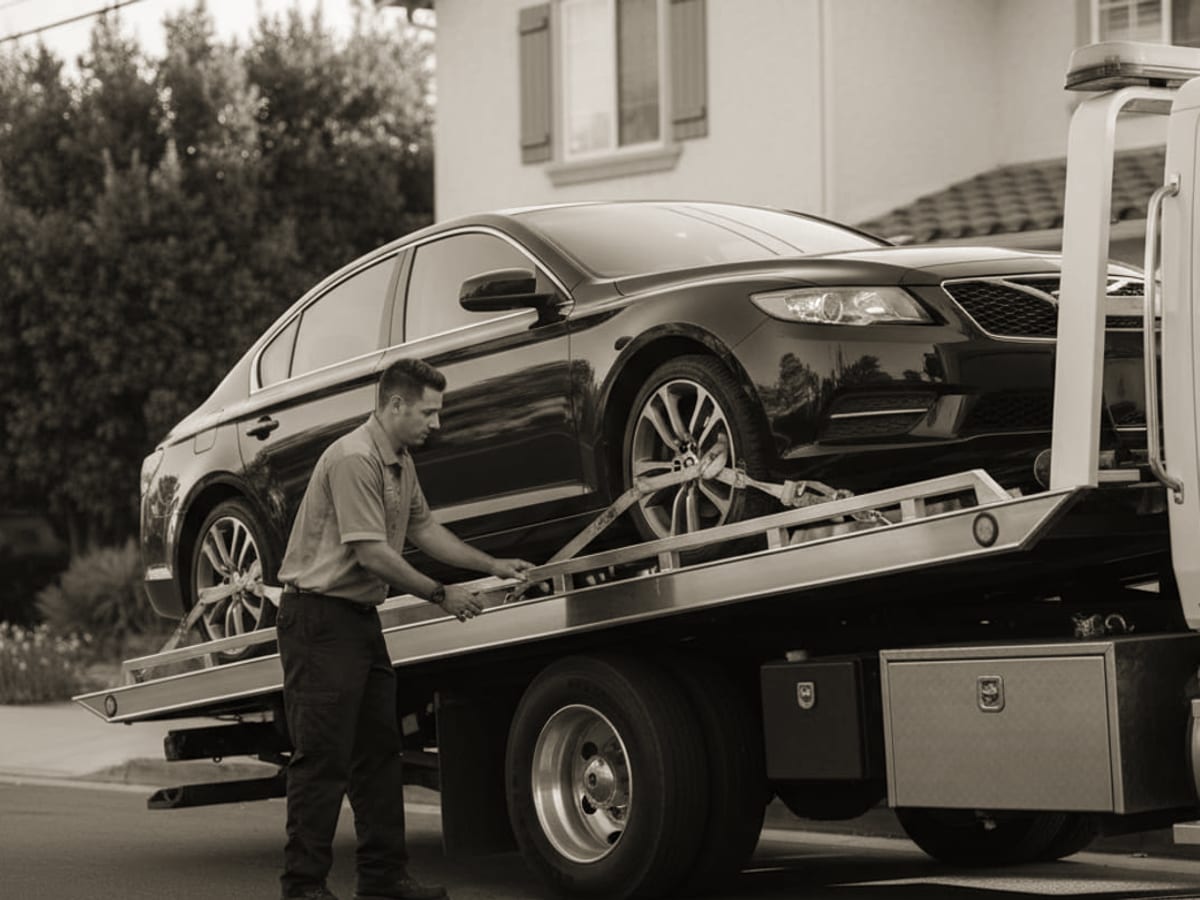
There’s no single tow price in El Paso, because your cost depends on which of three price worlds you land in: a tow you call for yourself (the operator quotes it), a police-ordered tow to the city lot (El Paso code caps the tow), or a private property tow (TDLR statewide maximums, or lower local ones). Inside city limits, City Code Section 12.54.020 caps nonconsent tows at $100 for light duty, $350 for medium duty and $450 for heavy duty, plus up to $25 for dollies. A tow you request yourself has no cap at all, so the quote you get before dispatch is the whole game.
Quick Tow EP is a referral service. It connects drivers with independent local tow operators. You hire and pay the operator directly, and the operator quotes the price. Quick Tow EP does no towing, roadside work or storage itself.
Start with the three price worlds
Most confusion about tow pricing in El Paso comes from mixing these up. They follow different rules.
1. A tow you call for yourself (a consent tow)
You call, you choose the company, you agree to the price. TDLR’s consumer page is clear that its caps cover nonconsent tows, and a tow you call for yourself is priced by the operator you hire. No TDLR maximum table applies. That means the quote is everything, and you should get it before the truck rolls.
2. A police-ordered tow to the city lot
When EPPD orders a tow, the tow portion is capped by the City of El Paso. Under City Code Section 12.54.020, the maximum for a nonconsent tow in city limits is $100 for a light duty tow (10,000 lbs or less), $350 for medium duty (over 10,000 but under 25,000 lbs) and $450 for heavy duty (more than 25,000 lbs), regardless of truck type. Dollies or go-jacks can add up to $25. For a vehicle over 10,000 lbs, if the tow runs longer than two hours from arrival to completion, up to $55 per hour for each hour past two can be added, plus actual cost if cargo has to be moved by hand.
The city partners with UR Vehicle Management Solutions, which runs the City of El Paso Municipal Vehicle Storage Facility at 11615 Railroad Drive, phone (915) 212-0205, open 24 hours. Storage and release fees there are separate from the tow.
3. A private property tow
If a lot, apartment complex or business has your car towed without your consent, TDLR’s statewide maximum applies: $272 for a vehicle up to 10,000 lbs, $380 for over 10,000 but under 25,000 lbs, and $489 per unit for vehicles over 25,000 lbs with a $978 total maximum. A city or county can set lower rates, never higher. Inside El Paso city limits, the city’s own caps above govern instead.
Outside city limits, in Socorro, Horizon City, Anthony, Clint, San Elizario, Vinton, Fabens, Canutillo or Tornillo, Chapter 12.54 doesn’t apply. There the TDLR maximums apply unless a local rule sets lower ones.
What moves a quote on a tow you requested
No honest operator can quote a consent tow from “my car broke down.” These factors drive the number:
- Distance: a hookup in the Lower Valley going to a shop in the Northeast crosses most of the city. A Far East pickup on Joe Battle headed to Downtown is a different job again.
- Truck type: a flatbed costs more to run than a wheel-lift, and some vehicles need one.
- Vehicle weight: a half-ton pickup, a loaded work van and a compact sedan are not the same pull.
- Winching or recovery: a car buried in sand off Transmountain, hung up on a curb, or sitting in a monsoon-flooded low water crossing takes rigging and time.
- Location: shoulder work on I-10, Loop 375 or US-54 Patriot Freeway carries risk that a quiet parking lot doesn’t.
- Condition: no keys, dead battery in park, damaged suspension or a locked steering wheel all change the loading plan.
Two companies can quote the same job differently because they run different trucks, staff differently, or build in different margins. That’s normal. What shouldn’t happen is a price that grows after the truck arrives without you agreeing to it.
Ask these questions before dispatch
- Describe the pickup location, the destination and the vehicle: year, make, model, whether it rolls, steers and has keys.
- Ask for a full quoted total before dispatch, not a “starting at” number.
- Confirm the hookup fee, the per-mile rate and any surcharges inside that total.
- Ask directly whether the rate is all-in or whether extras can be added later.
- Confirm how the vehicle will be loaded: flatbed or wheel-lift.
- Ask about storage fees if the destination is a yard rather than a shop.
- Ask about wait-time charges and a cancellation fee if you change your mind.
- Ask how a destination change mid-job gets repriced.
- Get an itemized receipt at drop-off.
If a company won’t give you a full price upfront, that’s your answer. Call the next one. You can also check any tow company, operator or vehicle storage facility on the TDLR License Search by name, license number, city, county or ZIP.
Flatbed or wheel-lift?
A wheel-lift lifts two wheels and drags the rest. It’s fine for many running, rolling vehicles on short hops. A flatbed carries all four wheels off the ground, which matters for all-wheel-drive and low-clearance cars, EVs, exotics and anything with damaged suspension or bodywork. If your car is lowered, has a body kit, or you’re not sure, say so on the phone and ask for a flatbed quote. It’s better to pay for the right truck than to explain a scraped bumper later.
What if the price changes after the truck arrives?
On a consent tow, the quote you agreed to is your anchor. If the operator says the job is bigger than described, ask for the new total before any work continues, and ask what changed. Photograph the vehicle and the scene before hookup. If a truck damages your car, photograph it immediately, note the operator’s name and license plate, and ask for the company’s insurance information. Then contact the company in writing and, if you can’t resolve it, file a complaint with TDLR. TDLR licenses tow companies, operators and storage facilities, and you can file online.
If you’ve already paid a consent-tow bill you think was wrong, write down what you were quoted, what you were charged, and request an itemized invoice. Disputes over consent tows are between you and the operator, so keep everything in writing and consider your card issuer’s dispute process if you paid by card.
Nonconsent tows: drop fees and getting your car back
If you reach your car while it’s being hooked up and it is not fully hooked up and ready to tow, TDLR says you can keep it with no charge and no proof of ownership. If it is fully hooked up but hasn’t left the lot, you can keep it but pay a drop fee. TDLR’s statewide maximum drop fee is $135 for 10,000 lbs or less, $190 for over 10,000 but under 25,000 lbs, and $244 over 25,000 lbs, and the driver must accept cash, credit and debit cards. A city can set it lower, never higher. Inside El Paso city limits, City Code Section 12.54.020(D) sets the drop charge at one-half the regular tow fee, with no charge if the vehicle is not yet hooked up. Outside city limits, TDLR’s statewide drop caps of $135, $190 and $244 apply.
Once the car has left the parking facility but before it’s placed in storage, you no longer have the right to get it back. From there it’s an impound question.
For the city facility, call (915) 212-0205 or search the URVMS online vehicle database, which lists stored vehicles and their charges. Call before visiting, because some vehicles have a hold. Bring:
- A valid federal or state photo ID
- Registration, title or insurance
- Payment for the balance owed
- A power of attorney, court order or rental agreement if you’re not the registered owner
URVMS takes cash and Discover, Mastercard and Visa, with a 1.98% government fee added for credit cards. URVMS says its listed costs are estimates, and the price its customer service representatives quote is what must be paid. URVMS operates the city facility at 11615 Railroad Drive, open 24 hours. For context, TDLR’s statewide VSF storage cap is $22.85 per day or part of a day for a vehicle 25 feet or less and $39.99 for longer, after the 2023 adjustment. Under TDLR rules, a storage day begins and ends at midnight, and a facility may not charge more than one day if the vehicle was there less than 12 hours. El Paso’s Section 12.54.060 adds a $20 fee collected for the police department on police-ordered tow releases, and a $20 impoundment fee applies to a vehicle towed to a city-owned vehicle storage facility before release.
General VSF rules: notification and impoundment fees
Statewide, a vehicle storage facility may charge a notification fee of up to $50, but not if the car is reclaimed within 24 hours or before notice is sent. An impoundment fee may not exceed $20, and only when the facility had to protect a car with broken or open doors, windows, trunk, hood or similar, plus an inventory or registration lookup, and the bill must list the exact services. A VSF may also collect fees that must be paid to a law enforcement agency or government entity, and it may not charge any other storage-related fees.
Insurance, HERO and free help
Check your auto policy for towing and labor coverage. The Texas Department of Insurance explains that it pays to tow a car that can’t be driven and covers labor to change a flat or jump a battery, up to a dollar limit. If the bill is higher, you pay the difference. A company can refuse to renew towing and labor coverage if you have four towing and labor claims in 36 months.
On the highway, TxDOT’s HERO program patrols I-10 from Transmountain to Horizon, Loop 375 from I-10 West to Paisano, and US-54 from McCombs to Loop 375. Crews change flats, add air, fuel and water, jump batteries, do minor repairs and hand out drinking water at no cost. Call 915-790-HERO (4376), and call 911 first in an emergency. HERO isn’t a tow-to-your-shop service, so if the car can’t be fixed on the spot, plan a private tow.
Frequently asked questions
How much will it cost to tow my car?
It depends on which price world you’re in. A tow you request is quoted by the operator, so get the full total before dispatch. A police-ordered tow in El Paso is capped at $100 light, $350 medium and $450 heavy under City Code Section 12.54.020. A private property tow falls under TDLR’s $272, $380 and $489 maximums unless a local rule is lower.
Can you give me the full price before you dispatch?
Ask for it, and treat a refusal as a warning sign. Give the operator the pickup spot, destination, vehicle details and whether it rolls, steers and has keys. Then ask for the all-in total, including hookup, mileage and any surcharges, and confirm whether extras can be added later.
Is there an extra charge for nights or weekends?
Ask the operator directly whether their quote changes by time of day. Get the answer inside the quoted total, not as a verbal aside. If the price depends on when the truck arrives, you want that in writing or in a text before dispatch.
Do I need a flatbed for my vehicle?
Not always, but ask. All-wheel-drive and low-clearance cars, EVs, exotics and anything with damaged suspension usually belong on a flatbed. A wheel-lift can handle many rolling vehicles on short trips. Describe your car honestly and let the operator recommend the truck, then confirm it in the quote.
What happens if my car gets towed without my permission?
Inside El Paso, the tow is capped by City Code Section 12.54.020, and TDLR’s statewide caps apply elsewhere unless a local rule is lower. If you arrive before hookup, you get the car back free. If it’s hooked up but not gone, you pay a drop fee: TDLR caps it at $135, $190 or $244 depending on vehicle weight, and a city rule can set a lower drop fee, never higher. Under El Paso’s Section 12.54.020(D), the drop charge is one-half the regular tow fee. After that, call the facility and bring your documents and payment.
How do I avoid surprise fees on my bill?
Ask for an itemized total before dispatch, confirm what’s included, and get an itemized receipt at drop-off. On a nonconsent tow, request the itemized fee schedule and dispute anything above the city or TDLR cap. TDLR can order refunds of overcharges, and a justice court can decide whether a charge exceeded the city’s authorized amount. You can file a TDLR complaint online, and that doesn’t replace a tow hearing.
When to call for a tow
Call a tow operator when the car can’t be driven safely, won’t start after a jump, is stuck or damaged, or needs to move to a shop or storage. Describe the spot, the destination and the vehicle, then get the full quoted total before dispatch. Call (915) 320-5573 and Quick Tow EP will connect you with an independent local tow operator.