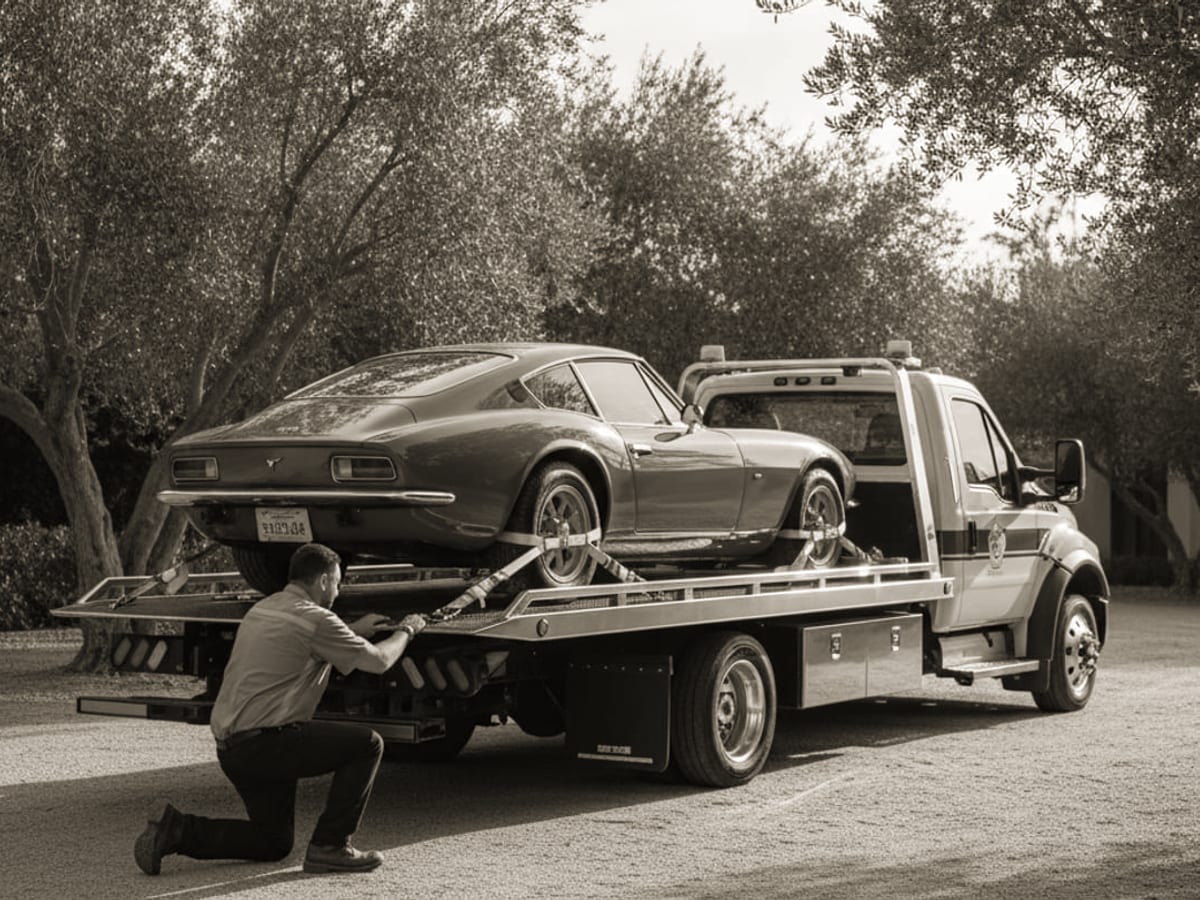
For many low clearance cars, a flatbed is the usual choice. Ask the operator what equipment they carry, and check your owner’s manual for the specific car. Tell the operator your exact ground clearance and any splitter, lip, or air suspension when you call them. Photograph the car first, watch the loading, and stop the job if the plan conflicts with your owner’s manual.
Quick Tow EP is a referral service. We connect drivers with independent local tow operators. The driver hires and pays the operator directly, and the operator quotes the price. Quick Tow EP does no towing, roadside work, or storage itself.
Why a flatbed is usually the starting point
A flatbed keeps the whole car level on a deck, so the risky moment is the transition from ground to ramp.
That transition is where most damage happens. Ask the operator how the car will be loaded and whether their equipment is set up for a car that sits low. Ask before you book, and don’t assume every flatbed in El Paso is set up for a car that sits low.
If you want a plain-language overview of flatbed work, see flatbed towing. For exotics and classics specifically, exotic and classic towing covers the same ground with more detail on paint and trim protection.
What to tell the operator when you call
This is the part you control. The more precise you are, the better the operator can plan.
- Note the year, make, model, trim, and drivetrain. All-wheel drive and some all-wheel steer systems change how a car can be moved.
- List every modification that affects height or shape: lowering springs, coilovers, air suspension, body kits, front splitters, side skirts, rear diffusers, spoilers, wide wheels, stretched tires, aftermarket exhaust.
- Report whether the car rolls, steers, brakes, and shifts. A locked wheel or a car stuck in park changes everything.
- Photograph the low points, all four wheels, and any existing damage. Timestamped photos protect you if a dispute comes up later.
- Describe the pickup surface: concrete, gravel, dirt, a slope, a speed bump, a steep driveway apron.
- Describe the space around the car: garage width, overhead clearance, alley width, parked cars, low tree branches.
- Check your owner’s manual for transport instructions and share whatever it says.
- Share any tow hook, tie-down point, or tow eye the manufacturer specifies, and hand it over if it’s a removable piece.
- Confirm access rules for a garage, gated community, or apartment property.
- Verify destination access and who will receive the car.
Say the ground clearance number out loud, in inches, measured at the lowest point. “It’s lowered” means nothing to an operator. “Four inches at the front lip, and the splitter is carbon” means something.
Loading, strapping, and the details that matter
Wheel straps versus frame hooks
Ask how the car will be secured. Ask whether the car will be held by the wheels or by the frame, and tell the operator what your owner’s manual says about tie-down points. If an operator plans to hook the frame on a car with a body kit, that’s a conversation to have before the winch moves.
Air suspension and drivetrain
If the car has air suspension, tell the operator, and check your owner’s manual for transport guidance. For EVs and hybrids, there are separate considerations around transport mode and rolling. See tow an electric car on a flatbed and Tesla transport mode steps if that applies to you. For general EV work, Tesla and EV towing is the relevant service page.
Locked or damaged wheels
A locked wheel changes the loading plan, so ask the operator what plan they propose. Ask what the plan is before they arrive.
Tight garages and narrow streets
A flatbed is a long vehicle. A tight garage in the Lower Valley or a narrow street in Downtown may not give the truck room to line up. Tell the operator the width and overhead clearance when you call, and ask whether they want the car rolled out to the street first. If the car can’t roll, that changes the plan again. Ask the operator whether the car can be reached at all. See winch out for that scenario.
Who decides the method, and who’s liable
The operator decides how to load, because the operator has the equipment and the training. You decide whether to let the job proceed. Those are different decisions.
If loading damages the car, that’s between you and the operator you hired. Quick Tow EP doesn’t do the work and isn’t part of that transaction. Practical advice: photograph the car before, watch the loading, and stop the job if what’s happening conflicts with your owner’s manual. Ask the operator to note any pre-existing damage on the paperwork. If something goes wrong, document it immediately with photos and a written description, and raise it with the operator directly.
On the money side, towing and labor coverage on a Texas auto policy pays to tow your car if it can’t be driven, and pays for labor to change a flat or jump-start a battery, according to the Texas Department of Insurance. That coverage has a dollar limit, and if the cost is higher you pay the difference. The same source notes a company can refuse to renew your towing and labor coverage if you have four towing and labor claims in 36 months. For a deeper look, read does insurance pay for towing in Texas.
Finding an operator who can actually handle a low car
There’s no shortcut here. Ask direct questions and listen to the answers.
- “What equipment do you carry for a car this low?”
- “How do you plan to get the car onto the deck?”
- “How do you strap the car, wheels or frame?”
- “Have you loaded a car this low before?”
- “What’s the plan if it scrapes on the first attempt?”
An operator who answers with specifics is a better bet than one who says it’ll be fine. You can verify any operator’s license through the Texas Department of Licensing and Regulation license search before you commit. That’s a reasonable step for any tow, and especially for a car you care about.
Before the car moves, and after it arrives
Before the winch starts, walk the ramp line with the operator. Point out the lowest point on the car. Confirm the straps go on the wheels. Confirm the car is in the gear or mode the manual specifies. If anything looks wrong, say so before the cable tightens.
At delivery, check these before you sign anything:
- Front lip, splitter, and bumper corners
- Side skirts and rocker panels
- Rear diffuser and exhaust tips
- All four wheels and tires for fresh curb rash or flat spots
- Underside for fresh scrapes
- Ride height, if the car has air suspension
- That the car starts, shifts, and rolls as it did before
Compare against your photos. If something new shows up, note it on the delivery paperwork and photograph it on the spot.
El Paso specifics worth planning around
The National Weather Service advises drivers caught in a dust storm to pull the vehicle off the pavement as far as possible, stop, turn off the lights, set the emergency brake, and take the foot off the brake pedal so the tail lights are not lit. Never stop on the traveled portion of the roadway.
What matters to you is the pickup and delivery surface. A steep driveway apron in the Westside or a gravel lot in Socorro changes the loading plan. Say so when you call.
If you’re in the Northeast, Downtown, or out toward Horizon City, the local service pages list coverage areas: Northeast El Paso, Downtown El Paso, and Horizon City. For a broader look at what a tow costs in the region, read tow truck cost in El Paso.
Frequently asked questions
How do I know my lowered car won’t scrape?
You don’t, until the operator measures the ramp against your clearance. Ask the operator what equipment they carry, share your lowest point in inches, and ask how they plan to load the car. Watch the first few feet of the load and stop it if contact looks likely.
Do I need a flatbed for a low car?
A flatbed is the usual choice because it keeps the car level. Ask for a flatbed and ask the operator whether their equipment is set up for a low car.
What should I tell them when I call?
Give the year, make, model, trim, and drivetrain, your measured ground clearance, every modification that changes height or shape, and whether the car rolls, steers, brakes, and shifts. Describe the pickup surface and the space around the car. Photos help.
Can they get it out of a tight garage?
Sometimes, and sometimes not. A flatbed needs room to line up, and a narrow garage or alley may not allow it. Tell the operator the width and overhead clearance when you call and ask whether they want the car rolled out first. If it can’t roll, ask the operator what plan they propose.
What if my car won’t roll or shift into neutral?
Say so when you call. A locked wheel or a car stuck in park may need a different plan entirely. Ask the operator what they intend to do before they arrive, and follow whatever your owner’s manual says about moving the car.
Will it unload safely at my destination?
Unloading has the same ramp problem as loading, so the destination surface matters. Tell the operator about steep driveway aprons, gravel, or tight streets at the delivery address. Check the car against your photos before you sign.
When to call for a tow
Call when the car can’t be driven safely, when a wheel is locked or damaged, or when the loading plan needs equipment you don’t have. If you’re unsure whether the car can be loaded at all, that’s a conversation to have with an operator before anything moves. Call (915) 320-5573 and Quick Tow EP will connect you with an independent local tow operator.