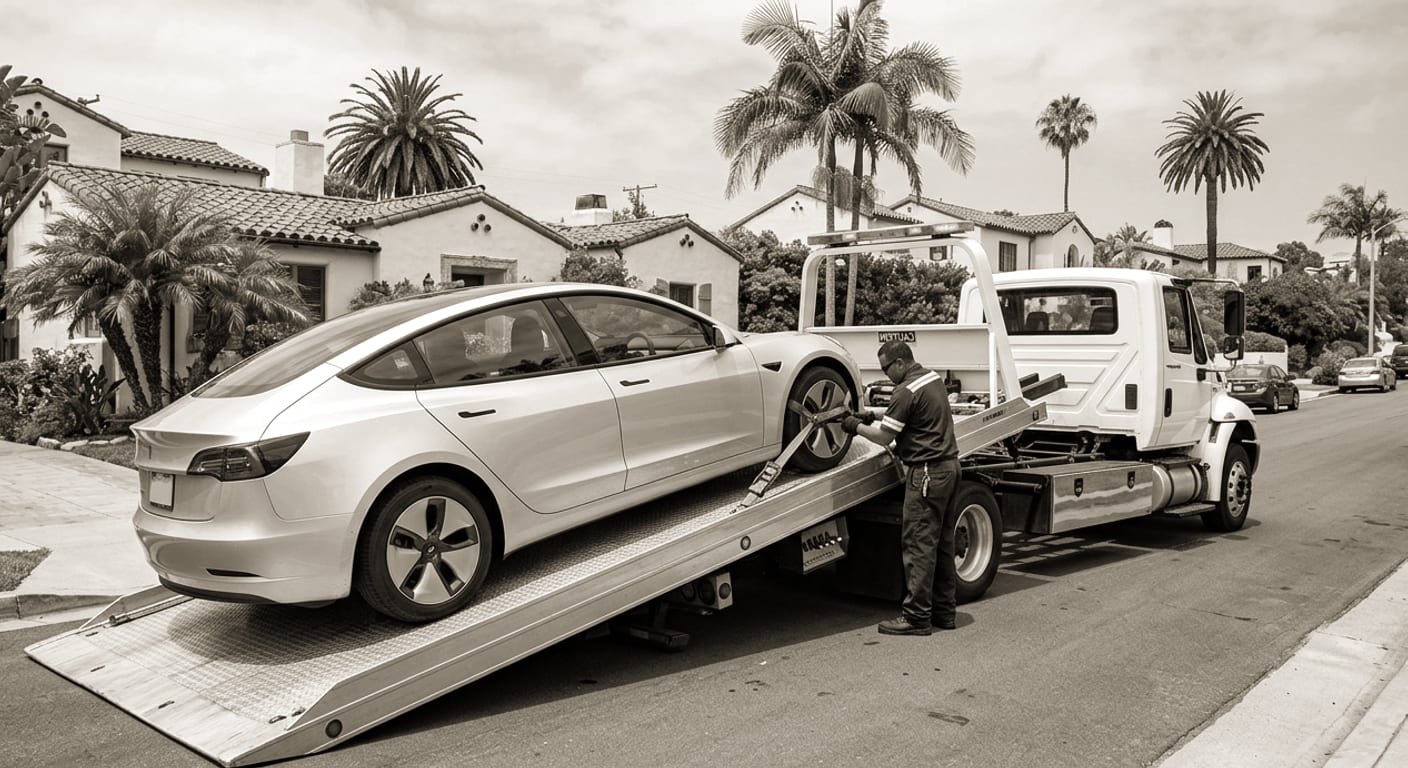
The short answer: plan on a flatbed with all four wheels off the ground, tell the dispatcher “it’s an EV” before anything else, and confirm the operator will follow your car’s own manual for transport. Tesla’s manual for the Model Y, for example, says to always transport the car with all four tires off the ground and to make sure the tires cannot spin, with a flatbed as the recommended method. Your model may differ, so check its manual’s transport section. The rest of this post walks through what to say, what to ask, and what to check before anything moves.
Quick Tow EP is a referral service. It connects drivers with independent local tow operators. The driver hires and pays the operator directly, and the operator quotes the price. Quick Tow EP does no towing, roadside work or storage itself.
Why an EV goes on a flatbed
Tesla’s manual is blunt about it: all four tires off the ground, tires unable to spin, flatbed recommended, and no transport method the manufacturer has not specified.
On a flatbed, the whole car rides on the deck. Tesla’s manual notes the car may face either direction on it. Describe the clearance and the angle to the operator so they can plan the load.
Wheel lifts and dollies are a fallback, not a plan
Tesla’s manual allows wheel lifts plus dollies only if a flatbed is not possible, and then only to lift all four wheels off the ground. If an operator proposes a wheel lift without dollies, ask why a flatbed isn’t being used and how their setup keeps all four tires off the ground.
No flat towing, no tow bar
Tesla’s manual says do not transport the car by any method Tesla has not specified, so check the manual for your exact model. Treat any “we’ll just flat-tow it” suggestion as a reason to call a different operator.
What to tell the dispatcher, in order
- Say “it’s an EV” first, before the address.
- Give the exact year, make, model and trim.
- State the drivetrain: rear-wheel, all-wheel or front-wheel drive.
- Say whether the car powers on and whether it shifts out of Park.
- Report the charge level, even roughly, and whether it is plugged in.
- Describe the location and access: garage, alley, shoulder, tight street.
- Report damage, especially a wheel that won’t roll.
- Confirm keys are with you.
- Request a flatbed explicitly.
- Ask how their equipment matches your manufacturer’s transport procedure.
That order saves the callback. Give the drivetrain, shift status and exact location so the operator can plan the load. Lead with the EV and model details so the operator can match equipment.
Transport mode and the 12V question
Transport Mode keeps the parking brake disengaged so the car can be winched onto a flatbed. Tesla’s manual gives the sequence: make sure the car is not connected to a charger, shift into Park, and chock the tires or otherwise secure the car. Then turn it on from the touchscreen. Menu names vary by model, year and software, and one Model Y manual lists Controls > Service > Towing. Make sure the tow eye is securely tightened and pull the car slowly onto the truck. Shifting into Park cancels Transport Mode.
Two cautions. Tesla notes that wording and steps differ by model, region and software version, so check the manual for your exact car. And if the car won’t shift, tell the operator and check the manual’s transport section.
Checklist before the truck moves
- Manual transport section read, or screenshotted, for your exact car.
- Operator told “EV” and the exact model, year and drivetrain.
- Charge level and plug status reported.
- Keys in hand and confirmed with the dispatcher.
- Damage and non-rolling wheels described.
- Flatbed requested by name.
- Ask the operator for the total price and what it covers before agreeing.
- Ask the operator directly for their own arrival estimate.
- Photos of all four corners taken before loading.
- Operator inspection done before any movement.
- All four wheels confirmed off the ground before the truck rolls.
That last item is the one to watch. Tesla’s requirement is that all four tires be off the ground and unable to spin during transport.
Cost, arrival and the questions people actually ask
How much will this cost, and is there an EV surcharge? The operator quotes the price, not Quick Tow EP. Ask the operator to state the total price and what it includes before the tow.
How long until the truck arrives? Ask the operator directly for their own estimate. Timing depends on traffic and flatbed availability, and on access at your location.
What if the car is locked and I have no key? Say so up front. Ask the operator whether a locked car that won’t unlock changes how they plan to load it, and raise the lockout as a separate problem with the operator you hire.
What if a wheel is damaged and won’t roll? Report the non-rolling wheel to the operator and ask how they plan to load it.
What if the car was in a crash or flood? Tell the operator plainly that the car was in a crash or flood so they can decide how to handle it.
What if it’s stuck in a tight garage or on a shoulder? Describe the clearance and the angle to the operator so they can plan the load. For highway situations, put safety first: get yourself to a safe spot away from traffic before anything else.
Dust and visibility in El Paso
In a dust storm, pull off the pavement as far as possible, stop, and never stop on the traveled portion of the roadway. Tell the dispatcher if visibility is a factor at your spot.
Verifying the operator and sorting out liability
You can look up the tow company or operator on the TDLR License Search by name, city or license number. Quick Tow EP is a referral service that connects drivers with independent operators and does no towing, storage or roadside work itself. Ask the operator whether they have loaded your model before and how they plan to secure it. Photograph all four corners and the roof before loading, note existing damage in writing, and ask who to contact if something goes wrong. Note the company name and any identifying details the operator gives you. If damage happens, document it immediately, and note that complaints about a tow company can be filed online with TDLR. Filing a TDLR complaint is not a substitute for requesting a tow hearing, but you may do both. Quick Tow EP refers; the contract is between you and the operator.
Frequently asked questions
Can my Tesla be towed on a flatbed?
Yes, a flatbed is the method Tesla’s Model Y manual recommends, with all four tires off the ground and unable to spin. Ask for a flatbed explicitly when you call. Confirm the operator will follow your car’s manual for your exact model and year.
Will a wheel-lift damage my electric car’s motor?
Tesla’s manual calls for all four tires off the ground. Wheel lifts with dollies are the fallback when a flatbed isn’t possible, and only to lift all four wheels. If an operator proposes a wheel lift alone, ask how they’ll keep the tires from spinning.
My EV won’t shift out of Park. What now?
Tell the operator the car won’t shift and ask how they plan to load it. Check your manual’s transport section. Don’t force anything or guess at a procedure. If the manual isn’t accessible, let the operator inspect the car first.
How much does an EV flatbed tow cost?
The independent operator quotes the price, and Quick Tow EP does not set or state prices. Ask the operator for the total price before agreeing.
What is Transport Mode and should I enable it?
Transport Mode keeps the parking brake disengaged so the car can be winched onto a flatbed. Tesla’s manual says to disconnect any charger, shift into Park, chock the tires, then enable it from the touchscreen, with menu names varying by model and software. Shifting into Park cancels it. Check your manual for your exact car.
What should I tell the dispatcher when I call?
Lead with “it’s an EV,” then give the year, make, model, drivetrain, whether it powers on, the charge level, your exact location and access, any damage, and that you have the keys. Request a flatbed and ask the operator for their price and timing directly. That one call covers everything the operator needs.
When to call for a tow
If the car will not power on or shift, or a wheel will not roll, tell the operator and check the manual’s transport section before anyone hooks it up. If you’re unsure whether a flatbed is required for your model, check your owner’s manual and ask the independent operator you hire. Quick Tow EP is a referral service connecting drivers with independent operators, and the driver hires and pays the operator directly. Call (915) 320-5573 and Quick Tow EP will connect you with an independent local tow operator.