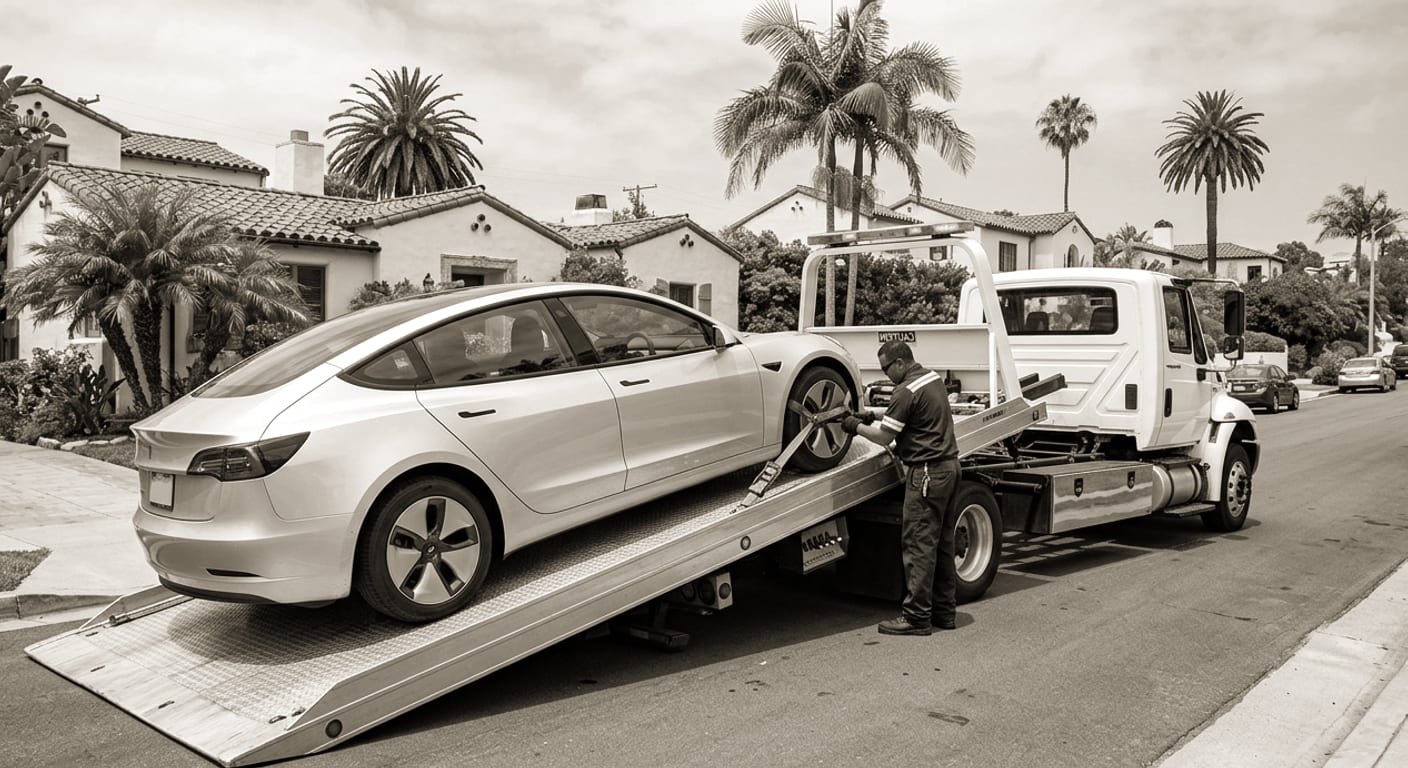
Tesla’s own manual says to transport the car with all four tires off the ground, and Transport Mode is the setting that releases the parking brake so the car can be winched onto a flatbed. The car must be unplugged from any charger, shifted into Park, and chocked or otherwise secured before Transport Mode is enabled, per Tesla’s manual. Then confirm the setting shows active before the truck arrives. If the screen is dead, stop and tell the operator your car has lost power and the screen won’t come on, and that Tesla recommends a flatbed; if a flatbed is not possible, wheel lifts and dollies must lift all four wheels off the ground.
Quick Tow EP is a referral service. It connects drivers with independent local tow operators. The driver hires and pays the operator directly, and the operator quotes the price. Quick Tow EP does no towing, roadside work or storage itself.
Before the truck arrives: the pre-tow checklist
Work through this in order. If any step doesn’t match your car, stop and check the manual for your exact model, year and software version, because Tesla notes the wording and steps differ by model, region and software.
- Park safely. Get as far off the pavement as possible, turn on your hazards, and shift into Park. If you cannot leave the traveled lane, call 911 and get out of the travel lane and away from traffic. In a dust storm, follow the National Weather Service guidance to pull off as far as possible and never stop on the traveled portion of the roadway.
- Unplug from any charger. The manual says to make sure the car is not connected to a charger before enabling Transport Mode.
- Chock the tires or otherwise secure the car so it can’t roll once the parking brake releases.
- Write down your exact model, year and software version. You’ll need this to find the right manual and to tell the operator.
- Open the current official manual for that vehicle and read the Instructions for Transporters section.
- Confirm the on-screen control name matches your manual. One Model Y manual lists Controls > Service > Towing, but menu names vary.
- Meet the preconditions: not connected to a charger, shifted into Park, tires chocked or otherwise secured.
- Activate the mode and confirm it shows active on the screen.
- Check the tow eye is securely tightened.
- Tell the operator your screen status and exactly what you completed.
Keep a short checklist on your phone:
- Model, year, software version written down
- Charger unplugged
- Shifted into Park
- Tire chocked
- Manual open to Instructions for Transporters
- Control name confirmed against the manual
- Mode showing active
- Tow eye tight
- Operator briefed
Where the setting lives on your screen
There’s no single answer that covers every Tesla. The manual lists one path as Controls > Service > Towing on a Model Y, and Tesla says outright that menu names vary by model, year and software. So the reliable move is to open the manual for your VIN and match the wording before you touch anything. If the control name on your screen doesn’t match the manual, don’t guess at a similar-looking menu. Close it, reopen the manual, and check whether your software version changed the label. When in doubt, tell the operator the screen is on but you couldn’t confirm the setting.
What happens if you skip it
The manual says Transport Mode keeps the parking brake disengaged so the car can be winched onto a flatbed. Skip it and the parking brake stays engaged while someone tries to pull the car. That’s the scenario you want to avoid entirely, and it’s why the manual is so direct about all four tires leaving the ground. Don’t improvise by pushing the car, rigging cables, or rolling it a short distance yourself. Let the operator make the call on loading method.
If your screen is dead or won’t turn on
This is the case that goes wrong most often, so treat it as a hard stop. If the screen is black or won’t wake, don’t invent a procedure and don’t let anyone talk you through one at the roadside. Tell the operator plainly that the car has lost power and the screen won’t come on. Tesla’s manual says a flatbed is the recommended method, and that if a flatbed is not possible, wheel lifts and dollies must be used to lift all four wheels off the ground, so the operator needs to know before arriving so they can plan the loading method. The operator decides the loading method, not you, and not a friend with a trailer. If your car died on a highway or shoulder, say so when you call the operator you hire, so they can plan the right equipment. On I-10, Loop 375 and US 54, TxDOT’s HERO program patrols at no cost during listed hours at 915-790-HERO, and drivers approaching a stopped tow truck or emergency vehicle must move over a lane or slow down under the Move Over or Slow Down law.
Will a regular tow truck damage it, and can it roll on its own wheels?
A standard flatbed is the method Tesla recommends, and the manual says the car may face either direction on it. Tesla also says not to transport the car by any method it hasn’t specified, so a wheel-lift truck without dollies isn’t a shortcut. Tell the operator what Tesla’s manual requires, that all four wheels be off the ground, and let them choose the equipment and loading method. After loading, ask the operator to confirm the tires cannot spin during transport, and photograph the car on the deck. If you want more background on equipment, see our guide to towing an electric car on a flatbed and our flatbed towing service.
What to tell the driver when they show up
Give the operator a short, clear briefing:
- Your exact model, year and software version
- Whether the screen is on, and whether Transport Mode shows active
- That the charger is unplugged, the car is in Park, and a tire is chocked
- That the tow eye is tightened
- That Tesla’s manual requires all four wheels off the ground
- Where the car sits and any hazard, like a blind curve or a narrow shoulder
Then step back and let them work. Shifting into Park cancels Transport Mode, so don’t touch the shifter or the screen once loading starts.
If the car is stuck somewhere dangerous
Your safety outranks the car. Get out of the travel lane and away from traffic, call 911, and never stand between the car and traffic. If you are on Fort Bliss, ask installation authorities about on-post towing, impound and gate access. For a breakdown on the freeway, broke down on US-54 walks through the sequence.
Matching instructions to your exact car
Tesla’s manual is the only source that matches your VIN, and Tesla says to check the manual for your exact car because wording and steps differ. Open it from the touchscreen or your Tesla account, not a forum screenshot. If the preconditions can’t be met roadside, meaning the car is still connected to a charger, won’t shift into Park, or the tires can’t be chocked or otherwise secured, don’t force it. Report the problem to the operator and let them plan around it. Enable the mode close to arrival, and remember that shifting into Park cancels it.
Frequently asked questions
How do I turn on tow mode on my Tesla?
Park the car, shift into Park, unplug from any charger, and chock a tire. Then open the touchscreen menu and find the towing control, which one Model Y manual lists as Controls > Service > Towing. Menu names vary by model, year and software, so confirm the label against the manual for your car before enabling it.
My Tesla screen is black. Can it still be towed?
Yes, but the operator needs to know before they arrive. Tell them the car has lost power and the screen won’t turn on. Tesla’s manual says a flatbed is the recommended method, and that when a flatbed is not possible, wheel lifts and dollies must lift all four wheels off the ground, so the operator can plan the loading method and bring the right equipment.
Does my Tesla need a flatbed, or can it be wheel-lifted?
Tesla’s manual recommends a flatbed and says to always transport the car with all four tires off the ground. If a flatbed isn’t possible, wheel lifts and dollies must be used to get all four wheels up. A plain wheel-lift without dollies doesn’t meet that standard.
What happens if I tow my Tesla without tow mode?
The manual says Transport Mode keeps the parking brake disengaged so the car can be winched onto a flatbed. Without it, the brake stays engaged while someone tries to load the car. That’s the situation the preparation steps exist to prevent, so don’t skip them or improvise a workaround.
What do I tell the tow driver when they arrive?
Give them your model, year and software version, whether the screen is on, and whether the mode shows active. Confirm the charger is unplugged, the car is in Park, a tire is chocked, and the tow eye is tight. Then tell them Tesla’s manual requires all four wheels off the ground.
Can I tow my Tesla myself a short distance?
Tesla’s manual says not to transport the car by any method it hasn’t specified, and it calls for all four tires off the ground. A short DIY tow with two wheels rolling doesn’t fit that guidance. Use a flatbed or a properly equipped operator instead.
When to call for a tow
If your Tesla won’t power on, won’t shift, or can’t complete the preparation steps, that’s a job for a tow operator with the right equipment, not a roadside workaround. The same goes for a car sitting in a dangerous spot on I-10, Loop 375 or US 54. Call (915) 320-5573 and Quick Tow EP will connect you with an independent local tow operator.
Before you commit, you can check any operator’s license on the TDLR License Search, and our Tesla and EV towing service page covers what to ask about equipment. For general cost questions, see tow truck cost in El Paso, and for neighborhood-specific help, start with towing service in El Paso, TX. If you’re in the Northeast or Lower Valley, those city pages list local coverage too.
Call (915) 320-5573 and Quick Tow EP will connect you with an independent local tow operator.