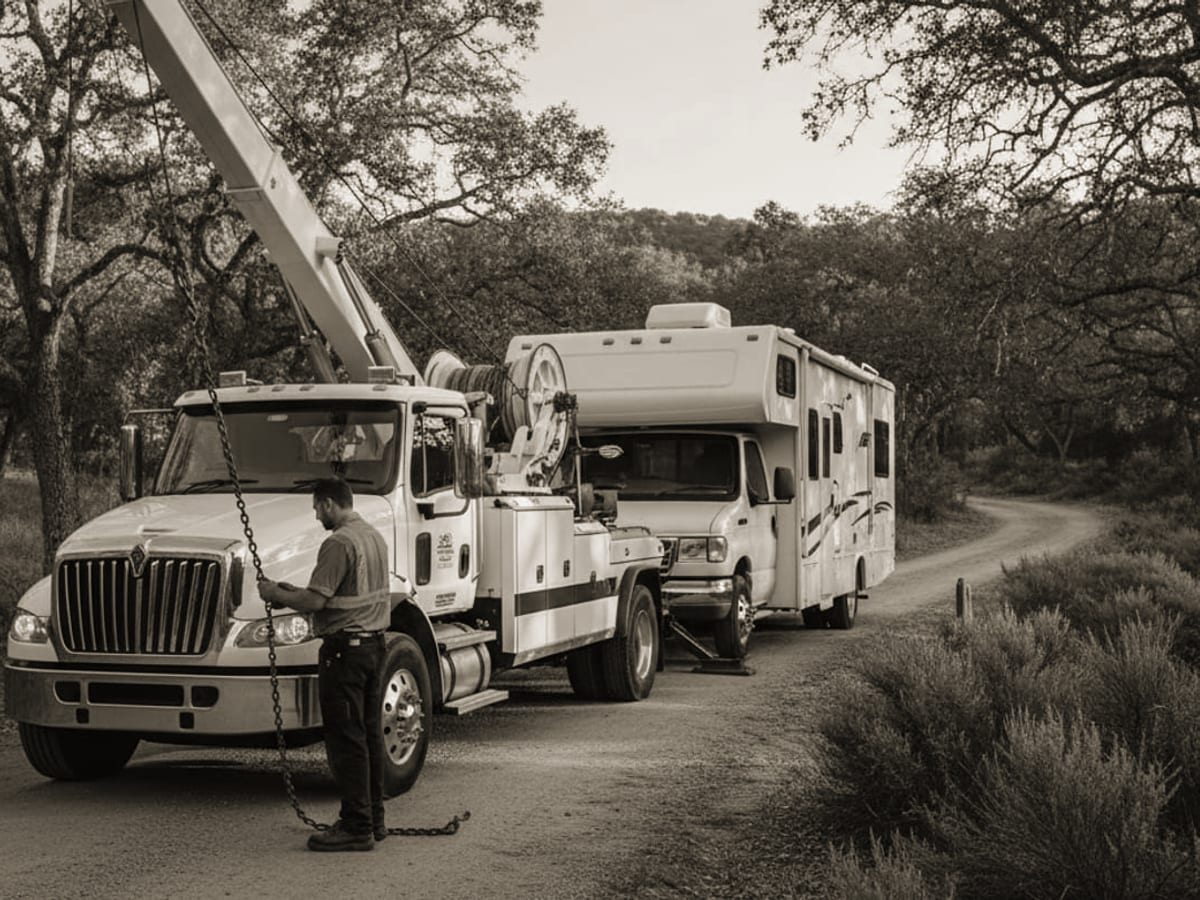
The short answer: before an RV-capable operator rolls, you need to tell them your rig’s class, overall length, loaded weight rating, chassis, number of axles, drive axle, hitch type, and whether a toad or trailer is attached, because a motorhome or fifth wheel usually needs heavy-duty equipment that a standard light-duty truck can’t handle. Get everyone out of travel lanes first, then make the call with those details ready.
Quick Tow EP is a referral service listing independent local operators. The driver contacts and hires the operator directly, and the operator quotes the price. Quick Tow EP does no towing, roadside work or storage itself, and makes no promise of connection, arrival or response.
Get people safe before you call anyone
Step 1: Clear the travel lanes
If you can coast or steer the rig onto the shoulder, frontage road or a cross street, do it. On a freeway main lane, ramp, shoulder or median in a metro area, Texas law requires drivers in a damage-only crash to move vehicles as soon as possible when every vehicle can be normally and safely driven, under Transportation Code Section 550.022. An RV that needs a tow doesn’t count as drivable, so this is about clearing what you can, not forcing a broken rig down I-10.
Turn on your hazard lights immediately. Get out on the side away from traffic, and wait behind a barrier when one is available.
Step 2: Move people and pets away from traffic
Get everyone out on the side away from traffic, behind the barrier if there is one, and into shade. El Paso summer heat and spring dust make waiting outside risky, so carry water and a shade plan. Never stand between the RV and passing lanes.
Step 3: Call for an RV-capable operator
Say “motorhome,” “fifth wheel” or “travel trailer” in your first sentence. The operator needs to know this isn’t a sedan. If you’re comparing options, our guide to roadside help without a membership covers how to line up help when you don’t have a plan.
What to tell the operator about your rig
Have this ready before you dial. Write it on your phone notes now, while you’re calm and parked.
- Class: Class A, Class C, fifth wheel, travel trailer, toy hauler, or truck camper.
- Overall length in feet, including the towed vehicle if you have one.
- Gross vehicle weight rating (GVWR) from the sticker inside the door or on the frame, and the loaded weight if you know it.
- Chassis and model year, since some chassis need specific lifting points.
- Number of axles and which one is the drive axle on a motorhome.
- Hitch type and pin weight for a fifth wheel, or ball and coupler size for a trailer.
- Whether a toad, boat or second trailer is attached.
- Whether the rig rolls, steers, and what’s damaged.
- Slide-outs, leveling jacks, awnings: are they in or up?
Why the details matter
A Class A diesel pusher with a tag axle and a towed car is a different job than a 24-foot travel trailer. The wrong truck wastes time and can damage the rig. Ask what equipment is proposed and why: a heavy-duty wrecker, a Landoll-style trailer, a flatbed for the toad. If the answer doesn’t match your rig, ask again before you authorize anything.
Can a fifth wheel be towed while hitched?
Ask the operator whether the fifth wheel can stay coupled to the tow vehicle for the move, and let them decide based on the damage, the hitch and the route. Don’t assume it.
Can the motorhome and the car be moved together?
Ask the operator how many units the quote covers, because a second unit changes the job. Mention the toad in your first call so the right equipment gets sent.
Describe exactly where you are
Send a map pin first. Then add what a driver can actually see:
- Highway, direction of travel and nearest exit or cross street, such as I-10 eastbound past Eastlake, US-54 near Fred Wilson, or Loop 375 at Joe Battle.
- Mile markers, green signs, business names, overpasses.
- Whether you’re on pavement, gravel, sand or a grade.
- Landmarks: Transmountain Road, Mesa Street, Montana Avenue, Alameda Avenue, Spur 601.
If you’re off pavement, in sand, or on a steep grade near Transmountain or the Franklins, say so, and ask the operator whether the rig will need a winch-out before it can be towed. See winch-out service for how that differs from a plain tow.
Prepare the RV before the truck arrives
Inside and out
- Bring slides in and leveling jacks up if the rig can still power them. If not, tell the operator.
- Shut off propane at the tank.
- Retract awnings and secure outside steps, grills and chairs.
- Secure loose contents and valuables. Take medications, documents and pets with you.
- Photograph the rig and surroundings from safe spots, including any existing damage.
For I-10 travelers between Las Cruces and Van Horn
This stretch is long, windy and hot, with gaps in services. If you’re westbound toward Las Cruces or eastbound toward Van Horn, tell the operator which direction and the nearest town: Canutillo, Anthony TX, Vinton, Tornillo, Fabens, Clint, San Elizario, Horizon City or Socorro. If you’re in New Mexico near Sunland Park, Santa Teresa, Chaparral or Anthony NM, Texas rules do not apply there. Contact the agency that handled it, and the New Mexico Motor Vehicle Division (NMMVD) for NM titles and registration.
Dead zones and overnight waits
If your signal drops, note your last mile marker and try texting your pin when you regain a bar. While waiting in a remote spot after dark, wait away from traffic behind a barrier when possible, and only stay in the vehicle if it is fully off the roadway and that is the safer option. Tell someone your location and the operator’s name. If a dust storm catches you while driving, National Weather Service guidance is to pull off the pavement as far as possible, stop, turn off lights, set the emergency brake and take your foot off the brake pedal so the tail lights are not lit, per NWS. Ask the operator you hire how long the wait is expected to be. Our post on tow truck wait time in El Paso explains what affects timing.
Cost, coverage and who sets the price
A tow you call for yourself is a consent tow. The operator you hire sets the price, and no TDLR maximum table applies to it, according to TDLR’s consumer information. TDLR’s caps cover nonconsent tows like private property tows, not the RV tow you request. For how consent and nonconsent pricing differ, see Texas towing fee limits.
Ask for the total price in writing before you authorize service, including mileage, heavy-duty equipment, winching, a second unit and after-hours calls.
Does roadside coverage apply to an RV?
Check your policy, don’t assume. Texas Department of Insurance says towing and labor coverage pays to tow your car if it can’t be driven, and pays for labor to change a flat or jump a battery, with a dollar limit, and you pay anything above it, per TDI. RV policies and add-ons vary, so call your insurer and ask whether your RV tow is covered, what the limit is, and whether you must use a specific provider. Our post on what roadside plans cover in El Paso walks through the questions to ask.
Verify the operator and protect yourself
Before you authorize anything, check the operator’s TDLR license on the TDLR license search. The TDLR license search covers Texas-licensed tow companies and operators, per TDLR, and may not cover out-of-state or New Mexico operators. Photograph the rig before and after the tow, and keep the written quote and the receipt. Confirm the written quote and the equipment before you authorize the tow.
Frequently asked questions
What info do I need before calling a tow for my RV?
Have your class, overall length, GVWR, chassis, axle count, drive axle, hitch type and whether a toad is attached. Add whether the rig rolls and steers, what’s damaged, and whether slides and jacks are in. Send a map pin and the nearest mile marker or cross street.
Can you tow a fifth-wheel without unhitching it first?
Ask the operator directly whether the fifth wheel can stay coupled for the move, and let them decide based on the damage, hitch and route. Don’t assume it’s fine, and mention the pin weight when you call.
How much does it cost to tow a motorhome?
The operator you hire sets the price for a consent tow, and no TDLR maximum applies, per TDLR. Get the total in writing before you authorize, and ask what changes it: mileage, heavy-duty equipment, winching or a second unit.
Will my roadside assistance cover my RV tow?
It depends on your policy or plan. TDI says towing and labor coverage pays to tow a car that can’t be driven, up to a dollar limit, and you pay the difference, per TDI. Call your insurer and ask specifically about RV towing limits and provider rules.
What do I do if my RV breaks down on a mountain grade?
Get out of travel lanes if you safely can, set hazards and keep people away from traffic. Tell the operator you’re on a grade and whether the rig rolls. Ask whether a slope may need a winch-out before a tow, so mention it early.
Can you tow my RV and my car at the same time?
Ask the operator how many units the quote covers, since a second unit changes the job. Mention the toad in your first call so the right equipment gets sent.
When to call for a tow
Call for a tow when the RV won’t roll, won’t steer, is stuck off pavement or on a grade, or has damage that makes driving unsafe. Don’t try to limp a heavy rig down I-10 or Transmountain on a bad axle. Call (915) 320-5573 and Quick Tow EP will connect you with an independent local tow operator.