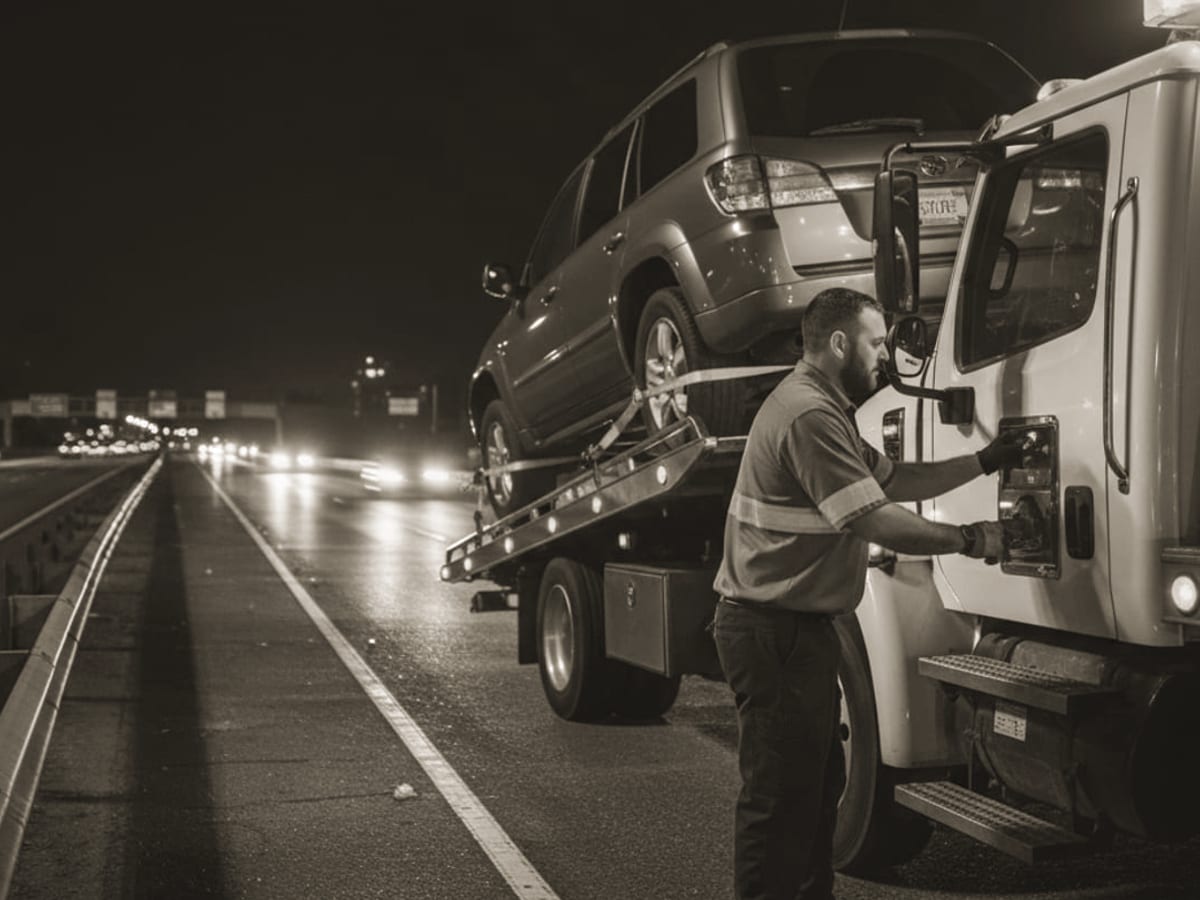
Turn your hazards on, get the car onto the right shoulder or off at the next exit ramp, get out on the passenger side away from traffic when it is safe to do so, and call for a tow with your direction, nearest exit and whether the car rolls. Everything else follows from those four moves.
Quick Tow EP is a referral service. It connects drivers with independent local tow operators. The driver hires and pays the operator directly, and the operator quotes the price. Quick Tow EP does no towing, roadside work or storage itself.
The first two minutes
Hazards on before you think
The moment the engine stumbles, a tire goes soft or a warning light turns serious, put your hazards on. That one switch is the cheapest safety gear on the car. Do it before you decide where to stop, because the drivers behind you at 60 mph need the warning more than you need the plan.
Aim for an exit, not just the shoulder
A shoulder is a strip of pavement next to live traffic. An exit ramp, a frontage road or a parking lot is off the freeway entirely. If the car will roll and steer, take the exit. Coasting a quarter mile to a ramp beats stopping under a bridge with traffic rocking the car.
Judge the shoulder before you commit
If you can’t reach an exit, look for a wide, flat shoulder with a solid white line and room to open a door away from traffic. Skip shoulders that narrow under bridges, run along a barrier, or sit next to a merge lane where cars are accelerating. If the shoulder looks tight, slow down and keep rolling to the next one.
Construction zones with no shoulder
Work zones on US-54 sometimes leave almost nothing to the right. Do not stop in a live lane. Keep the hazards on, keep rolling at a safe slow speed, and take the first exit or wide spot past the cones. Call 911 only if the car cannot move at all.
Should you stay in the car?
Get everyone out on the passenger side, away from traffic, and stand behind a barrier when it is safe to do so. Stay buckled only if exiting would put people in traffic. Keep the hazards on. Move kids and pets out on the passenger side, away from traffic, as soon as it is safe, with an adult supervising.
Call 911 or call a tow?
Call 911 if the car is blocking a lane, if anyone is hurt, or if the stopped car creates a hazard other drivers can’t see in time. Otherwise, call a tow. If you’re not sure, call 911 and let the dispatcher decide.
The steer it clear rule for crashes
If you’re in a crash with damage only, no injuries, and every vehicle can be driven normally and safely, Texas law requires each driver to move off the main lane, ramp, shoulder or median as soon as possible, to a frontage road, the nearest suitable cross street or another safe spot. That’s Transportation Code Section 550.022. A car that needs a tow doesn’t count as drivable, so if it won’t roll, leave it and call for help.
Do not accept an uncalled tow truck at a crash
El Paso’s towing ordinance, Section 12.54.070, makes it an offense for a tow company to arrive at a crash or incident scene to do a nonconsent or incident management tow without first being contacted by police, the owner, the driver or the insurer, or to solicit towing business on public streets or sidewalks. A truck, dolly, business card or flyer at the scene that nobody requested is prima facie evidence of solicitation under Section 12.54.070(B), and the fine can run up to $500 under Section 12.54.040. If a truck you didn’t call pulls up, say no, keep your keys, and call the police non-emergency line at (915) 212-4000. You can read more in our post on when a tow truck shows up at a crash in El Paso.
How to tell a dispatcher where you are
Mile markers and exit names are the fastest way to place yourself, so note the last exit you passed and the next one ahead. Before you call, have this ready:
- Direction of travel (northbound toward Northeast, or southbound toward Downtown)
- Nearest exit, cross street or mile marker
- A landmark you can see (a bridge, a business sign, the Transmountain Road interchange)
- Vehicle make, model, color and plate
- Whether the car rolls, steers and brakes, or is dead in place
- Whether anyone is still inside, and whether kids or pets are with you
If you don’t know the mile marker, describe what you see. “Northbound US-54 near the McCombs exit, in front of a tire shop sign” gives a dispatcher more than a guessed number. If your phone is low, charge it in the car if the engine runs, or ask a bystander to call. If signal is weak, text the info to someone who can call for you.
What a tow will cost
A tow you call for yourself is a consent tow, and it is priced by the operator you hire. No TDLR maximum table and no City of El Paso maximum table applies to it, so ask the operator for the price before you agree and ask whether storage is included. The fee caps below cover nonconsent tows only.
Inside El Paso city limits, the City of El Paso Code Chapter 12.54, Section 12.54.020, caps the tow portion of a nonconsent tow at $100.00 for a light duty tow (gross vehicle weight rating of 10,000 lbs or less), $350.00 for a medium duty tow and $450.00 for a heavy duty tow, per EPPD. The same section lets a company add up to $25 for dollies or go-jacks, and for a vehicle over 10,000 lbs, up to $55 per hour for each hour past two hours from arrival at the scene. Those are maximums for nonconsent tows, not quotes.
Outside city limits, in Socorro, Horizon City, Anthony, Clint, San Elizario, Vinton, Fabens, Canutillo or Tornillo, Chapter 12.54 doesn’t apply. There the statewide TDLR maximums for nonconsent tows apply unless a local rule sets lower ones, per Texas Occupations Code Chapter 2308. A tow you call for yourself is still priced by the operator you hire.
Your insurance may help. The Texas Department of Insurance says towing and labor coverage pays to tow a car that can’t be driven and pays for labor to change a tire or jump a battery, up to a dollar limit, per TDI. Check your policy before you assume you’re covered. Our guide to what roadside plans cover in El Paso walks through the difference.
How long until help arrives
No one can promise a time, and anyone who does is guessing. What you can do is ask the dispatcher for an estimate, get the operator’s name and phone number, and keep your hazards on while you wait. If the wait runs long, call back once and ask for an update rather than calling repeatedly. TxDOT’s HERO program may also be able to help on US-54 between McCombs and Loop 375 during its posted hours, and it’s free, per TxDOT. Per TxDOT, HERO changes flat tires and adds air, provides gas, diesel and water, jump starts batteries, handles minor repairs, and offers cell phone service and drinking water. HERO’s role is helping stranded motorists and keeping traffic moving, and TxDOT does not describe it as towing your car to a shop of your choice, so plan on a private tow if the car can’t be fixed on the spot. Our post on TxDOT HERO free roadside help has the details.
While you wait
- Exit on the passenger side away from traffic and stand behind a barrier when safe.
- Turn the interior light on if it’s dark so other drivers and the tow operator can see the car.
- Set flares or triangles only if you can do it safely, and never in a live lane.
- Skip the roadside repair when traffic passes close. Changing a tire on the shoulder of US-54 is not worth it.
- Watch for heat, wind and dust. In summer, crack the windows and keep water in the car. If you are still driving in a dust storm, the National Weather Service advises pulling the vehicle off the pavement as far as possible, stopping, turning off lights, setting the emergency brake, and taking your foot off the brake pedal so the tail lights are not lit, per NWS. Once the car is already stopped on the shoulder, keep the hazards on.
- Photograph the car, the plate and the location before the tow leaves.
Special cases
Far from the city near the state line
If you break down near Anthony, Tornillo or the New Mexico line, Texas rules do not apply on the New Mexico side. Contact the agency or company that handled the tow, and use NMMVD for New Mexico titles and registration. For a long haul, see long distance towing from El Paso.
Large vehicles and special equipment
A dually, box truck, motorhome or loaded trailer needs a heavier truck and possibly a flatbed. Tell the dispatcher the vehicle’s weight class and height before anyone rolls. Our pages on heavy duty towing and RV towing explain what to ask.
Move over for the tow operator
When you pass a stopped tow truck, emergency vehicle or TxDOT vehicle with lights on, Texas law requires you to move out of the closest lane if the road has two or more lanes in your direction, or slow to 20 mph under the posted limit, or 5 mph under if the limit is under 25. That’s Transportation Code Section 545.157, and the fine runs $500 to $1,250, per Texas statutes. Give the operator room. They’re standing next to live traffic.
Frequently asked questions
Who do I call if I break down on US-54?
Call 911 if you’re blocking a lane or anyone is hurt. Otherwise call a tow operator, or Quick Tow EP to be connected with an independent local operator. If you’re between McCombs and Loop 375 during HERO hours, TxDOT’s free HERO crews may be able to help, but HERO does not tow your car to a shop of your choice, so plan on a private tow if the car can’t be fixed on the spot.
Where is it safe to pull over on US-54?
An exit ramp, frontage road or parking lot is safer than the shoulder. If you must use the shoulder, pick a wide, flat stretch with room to open a door away from traffic, and avoid narrow spots under bridges or next to merge lanes.
Should I stay in my car or get out?
Get out on the passenger side, away from the lanes, when it is safe, and call 911 if the car is in a live lane. Stay buckled only if exiting would put people in traffic.
How do I tell them where I am without an address?
Give your direction, the nearest exit or cross street, and a landmark you can see. A description like “northbound US-54 near the McCombs exit, in front of a tire shop sign” works better than a guessed mile marker.
How much will a tow cost?
A tow you call for yourself has no TDLR or city maximum. The operator you hire quotes the price, so ask before you agree. The City of El Paso caps in Section 12.54.020 and the TDLR statewide maximums apply only to nonconsent tows.
How long will it take for a truck to reach me?
No one can promise a time. Ask the dispatcher for an estimate, get the operator’s name and number, and keep your hazards on while you wait.
When to call for a tow
Call for a tow when the car won’t roll, won’t steer safely, or has damage you can’t diagnose on the shoulder of a freeway. If you’re blocking a lane or anyone is hurt, call 911 first. Call (915) 320-5573 and Quick Tow EP will connect you with an independent local tow operator.