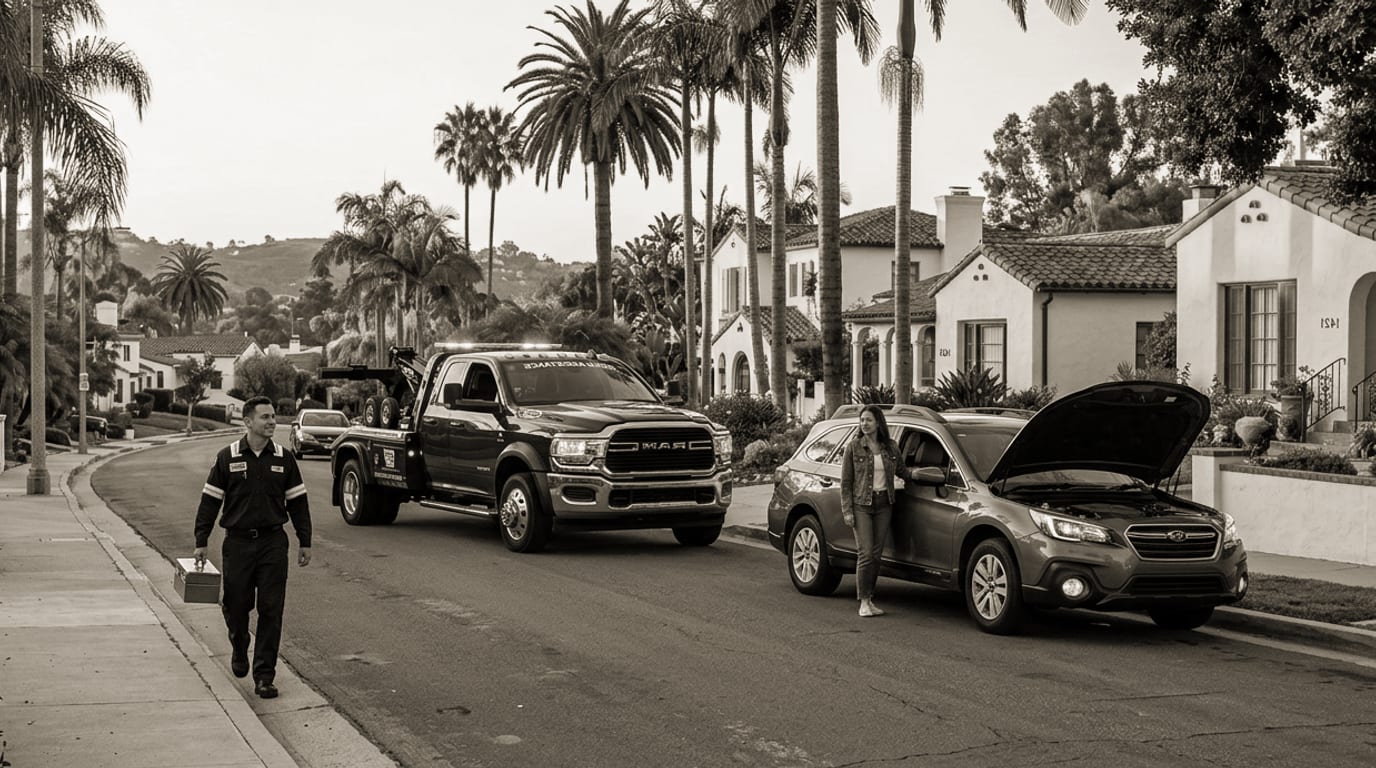
You can’t have a car towed off the public street in front of your house on your own, but an El Paso police officer can remove a car that’s blocking your driveway entrance. Call EPPD’s non-emergency line at (915) 212-4000, document everything first, and save 911 for actual emergencies. A parking facility owner cannot have a vehicle removed except as Chapter 2308 allows, a complying city ordinance, or at the direction of a peace officer or the vehicle’s owner.
Quick Tow EP is a referral service. We connect drivers with independent local tow operators. The driver hires and pays the operator directly, and the operator quotes the price. Quick Tow EP does no towing, roadside work or storage itself.
Start with notes and photos
Before you call anyone, build a record. It takes two minutes and it’s the difference between a smooth removal and a dead end.
- Photograph the car from multiple angles, including one shot that shows the plate and one that shows how it sits across your driveway. Turn on your phone’s timestamp if it has one.
- Write down the plate, make, model, color and the exact location, including cross streets. “Across my apron on Album Avenue near Chelsea” beats “in front of my house.”
- Note hazards: leaks or fluids under the car, whether anyone is inside, and whether the car blocks a hydrant or emergency access.
- Note whether the car sits on the public street or on your private driveway or lot. This single detail decides your whole path.
- Log the date and time you first saw it. If an abandonment period ends up applying, you’ll want that record.
Keep all of it. Photos and notes matter if there’s ever a hearing or a dispute.
If the car is on the public street
This is the most common version of the problem in El Paso, and it’s also the one where people waste the most time calling tow companies.
Under Occupations Code Section 2308.354, a parking facility owner or towing company may not remove a vehicle from a public roadway except under that chapter, a complying city ordinance, or at the direction of a peace officer, an authorized city employee, or the vehicle’s owner. In plain terms: a homeowner cannot hire a tow off the street in front of their house. A tow operator who shows up for that call is putting themselves in a bad spot, and so are you.
What you can do is call EPPD’s non-emergency line at (915) 212-4000 and report it. Parking in front of a public or private driveway is prohibited under Transportation Code Section 545.302, except momentarily to pick up or drop off a passenger. And under Section 545.305, a peace officer may remove, or make the driver move, a vehicle from a highway if it’s unlawfully parked and blocking the entrance to a private driveway. The owner is liable for reasonable towing and storage fees.
So the sequence is: document, try the neighbors, call non-emergency, and let the officer decide. Only call 911 if someone is hurt, there’s a crash, or the situation is genuinely an emergency.
What if the car is occupied right now?
Ask the person to move, politely, and leave it there if they do. If they refuse or the situation feels tense, don’t argue and don’t touch the car. Step back and call the non-emergency line.
What if the car has out-of-state plates?
It doesn’t change your steps. Plates from New Mexico or anywhere else don’t give a car special parking rights in El Paso. Report it the same way. If you believe the car was stolen, report it to EPPD. A peace officer may remove a reported stolen vehicle under Section 545.305.
Could it be stolen?
It’s possible, and it’s a good reason to call the non-emergency line rather than a tow company first.
If the car is on a private lot controlled by a parking facility owner
Different rules, and more options. A parking facility owner may have an unauthorized vehicle towed without the owner’s consent only under Occupations Code Sections 2308.251 and 2308.252, including when the car is in or obstructing a paved driveway, blocking an aisle, entry or exit, or a fire lane, or leaking hazardous fluid. In those cases, on request the owner must be told which tow company and vehicle storage facility will be used.
Signs matter for the general rule. A parking facility owner may tow without consent if compliant signs were posted at the time of towing and for the preceding 24 hours, or the driver got actual notice, or a windshield notice was posted and a certified-mail notice sent, with the car towable if not moved before the 15th day after the postmark. A towing company may make such a tow only with written verification from the parking facility owner that signs are posted or notice was given, per Section 2308.255. If you’re setting up ongoing enforcement for a lot, read our post on Texas tow-away sign rules before you post anything.
A parking facility owner also can’t have a vehicle removed except as the chapter allows, a complying city ordinance, or at the direction of a peace officer or the vehicle’s owner, per Section 2308.254. And a towing company may make the tow only with written verification from the parking facility owner that signs are posted or notice was given, only if insured for property damage, and only if the owner requested that specific tow or has a standing written agreement to enforce parking, per Section 2308.255.
If your situation is on a private lot, our private property tow referral page explains how the referral works.
What if I rent and don’t own the property?
Loop in your landlord or property manager first. They may be the parking facility owner for these purposes, and they’re the ones who can authorize a tow and confirm what signs are posted. If they’re unreachable and a car is blocking you in right now, call the non-emergency line and explain the situation. Don’t sign anything or authorize a tow on property you don’t control without checking. Tenants dealing with apartment lots can find more in our post on apartment towed guest car rules in Texas.
Do I need posted signs on my driveway to tow?
Removal requires the chapter’s authority, a complying city ordinance, or the direction of a peace officer or the vehicle’s owner. For a parking facility owner’s lot, the sign requirements are in Occupations Code Sections 2308.301 and 2308.302, and the tow also requires the Section 2308.255 written verification from the parking facility owner. If you’re unsure which applies to your property, check those sections and confirm the operator’s TDLR license before anything moves.
Who pays, and what it costs
Under Section 545.305, when an officer removes a vehicle blocking a private driveway, the owner is liable for reasonable towing and storage fees. That’s the car owner, not you. If your own car gets towed, expect to pay to get it back.
For vehicles towed by EPPD or the City of El Paso, the City of El Paso partners with UR Vehicle Management Solutions, which operates the City of El Paso Municipal Vehicle Storage Facility at 11615 Railroad Drive, El Paso, Texas 79934, phone (915) 212-0205. URVMS says the owner must bring a valid federal or state photo ID and one of registration, title or insurance, plus the balance owed. URVMS accepts cash and Discover, Mastercard and Visa, with a 1.98% government fee added for credit cards, per URVMS. Inside El Paso city limits, the City Code Section 12.54.020 caps govern nonconsent tows: $100 for a light duty tow, $350 for a medium duty tow and $450 for a heavy duty tow, plus a dolly fee of no more than $25, per EPPD and the city code. Separately, Section 12.54.060 adds a $20 fee on a police-ordered tow when the vehicle is released from a storage facility, and a $20 impoundment fee for a vehicle towed to a city-owned vehicle storage facility. For the wider picture, see our post on Texas towing fee limits.
If the car has been sitting a long time
A blocked driveway doesn’t require you to wait out an abandonment period before reporting it. But if the car has clearly been abandoned, Transportation Code Section 683.002 defines an abandoned vehicle in several ways, including one left illegally on public property more than 48 hours. A law enforcement agency may take an abandoned vehicle into custody on public or private property under Section 683.011. Our guide to reporting an abandoned car in El Paso walks through that process.
If it’s a junked vehicle visible from the street on your own property, that’s a code enforcement matter. El Paso Municipal Code 9.08.010 bars storing an uncovered junked vehicle visible from the street in a residential area, and reports go through 311, per the city. El Paso 311 is the city’s non-emergency service request line and web app, and “Junk Vehicles” is one of its request types, per the city. You can also read abandoned car on my property in El Paso.
Verify the operator before anything moves
If you do end up hiring a tow on a private lot, check the operator’s TDLR license in the License Search. Inside El Paso city limits the City Code Section 12.54.020 caps govern nonconsent tows, and outside city limits the TDLR statewide maximums apply unless a local rule sets lower ones. Never tow or move the blocking car yourself, and don’t damage it trying to get around it. Section 2308.404 liability runs against a tower, booting company or parking facility owner who violates the chapter.
If your own car was towed
If your car was towed from a parking lot, find it by calling the number on the no-parking sign. If it was booted, call the number on the window sticker and do not try to remove the boot or drive with it. For a car at the city facility, call (915) 212-0205 or search the URVMS online vehicle database, which lists all vehicles currently stored there and their charges.
Frequently asked questions
Someone’s parked across my driveway. Can I have it towed?
Not off the public street on your own. Under Section 2308.354, a private property owner can’t have a car towed off the public roadway in front of their house. Call EPPD’s non-emergency line at (915) 212-4000 and let an officer handle it under Section 545.305.
How long does a car have to sit before I can do something?
For a car blocking your driveway, you can report it right away. Abandonment periods like the more than 48 hours in Section 683.002 apply to abandoned vehicles, not to a car actively blocking your access. Log when you first saw it either way.
Do I need a sign posted for a tow to be legal?
It depends on the situation. For a parking facility owner’s lot, the sign requirements are in Occupations Code Sections 2308.301 and 2308.302, and the tow also requires the Section 2308.255 written verification from the parking facility owner. Removal requires the chapter’s authority, a complying city ordinance, or the direction of a peace officer or the vehicle’s owner.
Who pays for the tow and storage, me or the car owner?
When an officer removes a vehicle blocking a private driveway under Section 545.305, the owner is liable for reasonable towing and storage fees. If your own car is the one towed, you pay to recover it. URVMS quotes the amount due for vehicles at the city facility.
What do I do if someone is sitting inside the car?
Ask them to move, and let it go if they do. If they won’t, don’t touch the car or block them in. Call the non-emergency line and describe the situation, and call 911 only if it becomes an emergency.
What should I photograph before calling a tow company?
The plate, the make, model and color, the car’s position across your driveway, any leaks, and whether a hydrant or emergency access is blocked. Use a timestamp if your phone has one, and keep the photos with your written notes.
When to call for a tow
You need a tow operator when a parking facility owner has authorized a nonconsent tow of an unauthorized vehicle under Sections 2308.251 and 2308.252. For street parking, call EPPD first. Call (915) 320-5573 and Quick Tow EP will connect you with an independent local tow operator.