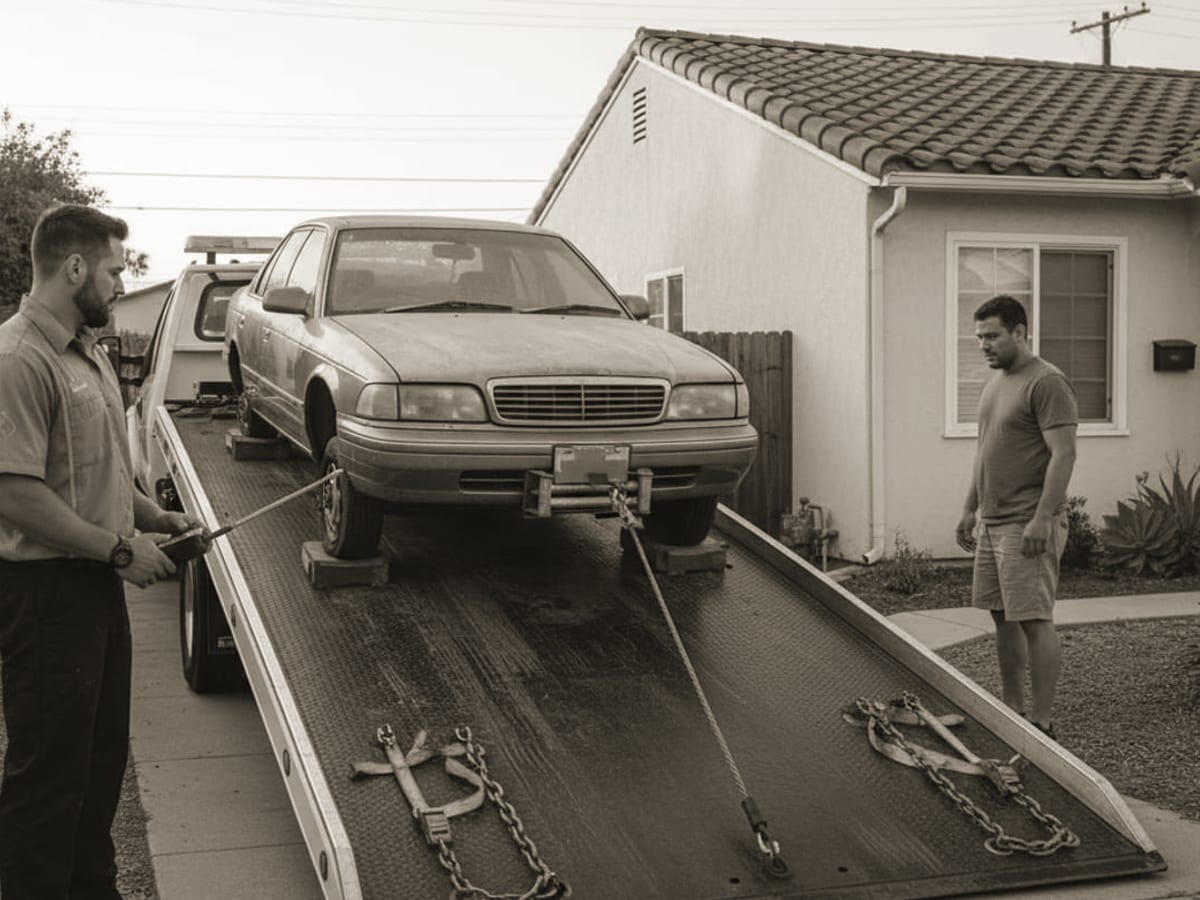
A car left on your private property without your consent may count as abandoned under Texas law after more than 48 hours, but that definition does not by itself authorize a private tow. The 48-hour definition under Section 683.002 governs abandonment, while a private property tow under Chapter 2308 requires compliant signs posted for the preceding 24 hours, actual notice, or windshield plus certified-mail notice with the 15-day window. From there you have two main routes: ask law enforcement to take it into custody, or hire a licensed tow company yourself once your signs or notices comply. You can’t sell it, junk it, or tow it off the public street in front of your house on your own. What you can do depends on where the car sits, how long it’s been there, and what paperwork you can show.
Quick Tow EP is a referral service. The site lists independent local tow operators, and the operator quotes the price, does the work, and gets paid directly by the driver. Quick Tow EP doesn’t tow, store, or handle vehicles itself.
First, confirm exactly where the car is sitting
Everything below turns on this one question. A vehicle on your driveway, your lot, or your yard is a private property problem. A vehicle on the street, the alley right-of-way, or the shoulder is a public property problem, and different rules apply. Walk out and look before you call anyone.
If the car straddles both, note which wheels are on which surface and photograph it. Then treat it as a public property matter first, because you have the least authority there.
When a car legally counts as abandoned in Texas
Transportation Code Section 683.002 defines an abandoned vehicle in several ways. The one that matters most to property owners: a motor vehicle that has remained on private property without the property owner’s consent for more than 48 hours. Public property has its own versions, including more than 48 hours unattended if the car is inoperable and more than five years old, or more than 48 hours parked illegally.
There’s a second, separate category worth knowing. A “junked vehicle” under Section 683.071 is self-propelled and wrecked, dismantled, partially dismantled, or discarded, or inoperable for more than 72 consecutive hours on public property or 30 consecutive days on private property, and it displays an expired plate or no plate. Section 683.072 declares a junked vehicle visible from a public place a public nuisance.
In El Paso, city code adds layers for residential areas. An uncovered junked vehicle or junk vehicle parts can’t be stored in a residential area where they’re visible from the street (El Paso Municipal Code 9.08.010), and vehicles can’t park in a front or side yard unless they’re on concrete, asphalt, or another comparable dust-free surface (El Paso Municipal Code 20.14.040). Reports go through 311, which is the city’s non-emergency service request line and web app, with “Junk Vehicles” as one request type. You can submit anonymously or with an account to get updates. 311 isn’t monitored around the clock, and emergencies transfer to 911. More on the city side is on the code enforcement page.
The police custody route
Sections 683.011 and 683.012 set out the police custody route. Section 683.011 lets a law enforcement agency take an abandoned vehicle into custody on public or private property. If the agency does, Section 683.012 requires it to send certified-mail notice to the last registered owner and any lienholders within 10 days. They then have until the 20th day after the notice to claim the vehicle by paying towing, preservation, and storage charges. If they don’t claim it, they waive their rights and consent to a public auction sale.
For a car on a public street, the police custody route under Sections 683.011 and 683.012 is one option. A vehicle blocking a private driveway can be removed by a peace officer under Section 545.305. For a car on your own lot, Section 683.011 still lets a law enforcement agency take it into custody on private property.
The private property tow route
This is where most El Paso property owners end up, and it has real requirements. Under Occupations Code Chapter 2308, a parking facility owner may have an unauthorized vehicle towed without the owner’s consent if compliant signs were posted at the time of towing and for the preceding 24 hours. There are alternatives: the driver got actual notice, or a windshield notice was posted and a certified-mail notice was sent, in which case the car may be towed if not moved before the 15th day after the postmark. Some conditions skip the waiting game entirely, including a car blocking an aisle, entry, or exit, a fire lane, a disabled space without a placard, leaking hazardous fluid, or sitting in or obstructing a paved driveway. On request, the owner must be told which tow company and vehicle storage facility will be used.
A few limits to keep in mind. Section 2308.254 says a parking facility owner can’t have a vehicle removed except as the chapter allows, a complying city ordinance, or at the direction of a peace officer or the vehicle’s owner. Section 2308.255 says a towing company may make the tow only with written verification from the parking facility owner that signs are posted or notice was given, only if insured for property damage, and only if the owner requested that specific tow or has a standing written agreement to enforce parking.
Signs, if you go the sign route
Sign rules are detailed, and getting them wrong undermines the whole tow. Section 2308.301 requires each sign to face and be conspicuously visible to drivers entering, be mounted on the right or left of each driveway or curb-cut entrance including from an alley, and for wide undefined entrances over 35 feet, be placed so no entrance point is more than 25 feet from a sign. Signs must be permanently mounted on a pole, post, wall, or barrier on the facility, with the bottom edge between five and eight feet above the ground.
Each sign must be weather-resistant, at least 18 inches wide and 24 inches tall, show the international towing symbol, say who may park and that all others are prohibited, carry words such as “Unauthorized Vehicles Will Be Towed at Owner’s or Operator’s Expense,” state the days and hours of enforcement, and give a phone number with area code answered 24 hours a day to locate a towed car. Section 2308.302 sets the color and lettering scheme in detail, starting with a bright red tow-truck symbol on white at least four inches tall. Under Section 2308.304, an otherwise unrestricted lot may restrict individual spaces with a compliant sign at the entrance to that group of spaces or at the end of each space, with the top no higher than seven feet.
Fire lanes not covered by another rule must have red-painted curbs marked “FIRE LANE—TOW AWAY ZONE” in white letters at least three inches tall at intervals of no more than 50 feet, per Section 2308.251. Our post on Texas tow-away sign rules walks through the layout.
What the tow company and storage facility must do
Within two hours of accepting a towed unauthorized vehicle, the storage facility must report it to the police department of the city it was towed from, or the county sheriff outside a city with a police department, with the description, plate, VIN, tow location, and the facility’s name and location (Section 2308.2565). If your lot posts compliant signs, the car’s owner must be able to find it by calling the number on the sign (Section 2308.303). The TDLR consumer page explains that side of the process for drivers.
What it can cost in El Paso
El Paso caps nonconsent tow fees in City Code Chapter 12.54. Section 12.54.020 sets the maximum at $100.00 for a light duty tow, $350.00 for a medium duty tow, and $450.00 for a heavy duty tow, including cleanup of debris, regardless of truck type, per the El Paso Police towing page. An additional fee of no more than $25 may be charged for dollies or go-jacks, and for a vehicle over 10,000 lbs, if the tow runs longer than two hours from arrival to completion, up to $55 per hour for each hour over two hours plus actual cost if cargo must be moved by hand. Under Section 12.54.020(D), if the owner or operator is at the scene and does not want the vehicle towed, there is no charge if it has not been hooked up, and if it has been hooked up but not yet towed from the scene, it is released on payment of one-half the regular tow fee.
These caps apply inside El Paso city limits. Places like Socorro, Horizon City, Anthony, Clint, San Elizario, Vinton, Fabens, Canutillo, and Tornillo aren’t covered by Chapter 12.54, so the TDLR statewide maximums apply there unless a local rule sets lower ones. Occupations Code Section 2308.202 lets a city set nonconsent fees below the state maximum.
The TxDMV disposal authority route
If you already have an abandoned car in your possession or on property you own, Section 683.051 lets the recorded owner, or a person who has the abandoned vehicle in their possession or on property they own, apply to TxDMV for authority to dispose of it to a motor vehicle demolisher. Section 683.056 requires the demolisher to get the title, a sales receipt, a transfer document, or a certificate of authority for disposal from whoever delivers the vehicle. This route suits a car that’s been sitting on your land long term and isn’t worth a tow-and-hold fight. Our junk car paperwork guide covers the documents.
What you must not do
- Don’t sell the car yourself. You don’t own it.
- Don’t junk it or scrap it without the TxDMV authority described above.
- Don’t tow it off a public street yourself. Section 2308.354 says a parking facility owner or towing company may not remove a vehicle from a public roadway except under the chapter, a complying city ordinance, or at the direction of a peace officer, an authorized city employee, or the vehicle’s owner. A private property owner can’t have a car towed off the public street in front of their house on their own.
- Leave the car where it is and document the location.
Your step-by-step process
- Confirm the exact location: public street, private lot, or straddling both. Photograph the position.
- Identify which legal ground applies and its waiting period, whether that’s more than 48 hours without consent, the junked vehicle thresholds, or a sign-based tow.
- Check that required signage is compliant before you authorize anything. Measure the height and read the lettering.
- Photograph the vehicle, its plate and VIN if visible, any notices you post, your signs, and the position on the lot.
- Issue any required notice and write down the date the clock starts.
- If the vehicle is inside El Paso city limits, call the El Paso Police non-emergency line at (915) 212-4000 to report it. If it is outside city limits, contact the law enforcement agency with jurisdiction over that location.
- Report to the correct authority if it’s on public property.
- Call a licensed operator once the waiting period has run.
- Confirm that the storage facility reports the towed vehicle to police within two hours under Section 2308.2565.
- Ask for the tow ticket itemizing each charge, and note that the tow company’s nonconsent fee schedule must be given to the storage facility and shown to the public on request.
- Keep copies of photos, plate, authorization, and tow time.
Documents to keep
- Photos of the car from several angles, with dates
- Photos of your signs and where they’re mounted
- The plate and VIN, if you can read them
- Copies of any notices you posted or mailed, with postmarks
- Your written authorization to the tow company
- The tow company’s written verification that signs were posted or notice was given
- The tow time, storage facility name, and cost total
- Any correspondence with the owner
Keep the file at least until the vehicle is disposed of, and keep any tow-hearing records for the 14-day request window under Section 2308.456.
Special situations to handle carefully
The owner shows up mid-process. Stop. Under Section 12.54.020(D), if the owner or operator is at the scene and does not want the vehicle towed, there is no charge if it has not been hooked up, and one-half the regular tow fee if it has been hooked up but not yet towed from the scene.
The owner disputes the tow or sues. Your photos, sign documentation, and written authorization are your defense. The owner or operator is entitled to a hearing on probable cause under Section 2308.452. If the court finds no probable cause, the tow company, storage facility, parking facility owner or agency that authorized the tow must pay or reimburse the towing and storage costs, and overcharges must be refunded.
The car has occupants or belongings inside. If there is a safety concern, call the El Paso Police non-emergency line at (915) 212-4000. For belongings, ask the storage facility about retrieval, and see our guide on getting belongings from a tow yard.
The car has a lien or no title. That’s exactly the situation Section 683.051 addresses. In the police custody route, Section 683.012 requires the agency to send certified-mail notice to the last registered owner and lienholders within 10 days.
The car still has resale value. You still can’t sell it. The lawful paths are the police custody route or the TxDMV disposal authority.
Recovering your costs. Under Section 545.305, the owner is liable for reasonable towing and storage fees when a vehicle is removed from a highway under that section. Otherwise, consult a lawyer.
A standing arrangement. Section 2308.255 allows a tow company to act under a standing written agreement to enforce parking. That’s worth setting up if you manage a lot.
Cars on the street in front of your house. Section 545.302 prohibits standing or parking in front of a public or private driveway except momentarily, within 15 feet of a fire hydrant, within 20 feet of a crosswalk at an intersection, or on a sidewalk. Section 545.305 lets a peace officer remove a vehicle unlawfully parked and blocking a private driveway entrance. Inside El Paso city limits, call (915) 212-4000. For the driveway-specific version, see car blocking my driveway.
New Mexico locations. Sunland Park, Santa Teresa, Chaparral, and Anthony NM are not in Texas. Texas rules don’t apply there. Contact the agency that handled it, and NMMVD for NM titles.
Frequently asked questions
How long does a car have to sit before it counts as abandoned?
On private property without your consent, more than 48 hours under Transportation Code Section 683.002. Public property has its own 48-hour rules, and a junked vehicle has separate thresholds of 72 consecutive hours on public property or 30 consecutive days on private property under Section 683.071. The 48-hour definition governs abandonment; it does not by itself authorize a private tow.
Can I have a car towed off my property without calling the police?
Yes, if you follow Chapter 2308: compliant signs posted at the time of towing and the preceding 24 hours, or actual notice, or a windshield notice plus certified mail with the 15-day window. The tow company also needs your written verification and must be insured for property damage.
Do I need to post signs before towing cars from my lot?
For the sign-based route, yes. Section 2308.301 sets the size, height, wording, and placement, and Section 2308.302 sets the colors and lettering. Some conditions, like a car blocking a fire lane or paved driveway, don’t depend on the sign route.
Who pays for towing an abandoned car off my property?
The operator quotes the price and the person who hires the operator pays directly. In El Paso, nonconsent tow maximums are $100.00 light duty, $350.00 medium duty, and $450.00 heavy duty under City Code Section 12.54.020. Under Section 545.305, the owner is liable for reasonable towing and storage fees when a vehicle is removed from a highway under that section.
What should I do if the abandoned car has no title or a lien?
Apply to TxDMV for authority to dispose of it to a motor vehicle demolisher under Section 683.051, or use the police custody route, which sends certified-mail notice to the last registered owner and lienholders within 10 days under Section 683.012.
What paperwork should I keep to protect myself if the owner disputes it?
Photos of the car, signs, and notices, your written authorization, the tow company’s written verification, the tow time, and the cost total. Keep the file at least until the vehicle is disposed of, and keep any tow-hearing records for the 14-day request window under Section 2308.456. The owner or operator is entitled to a hearing on probable cause under Section 2308.452, and if the court finds no probable cause, the tow company, storage facility, parking facility owner or agency that authorized the tow must pay or reimburse the towing and storage costs, and overcharges must be refunded.
When to call for a tow
Once your waiting period has run and your signs or notices are in order, a licensed operator does the actual removal, and you shouldn’t hook up a stranger’s car yourself. If the car is on private property in El Paso and you’ve documented everything, a private property tow is the next step. Call (915) 320-5573 and Quick Tow EP will connect you with an independent local tow operator.