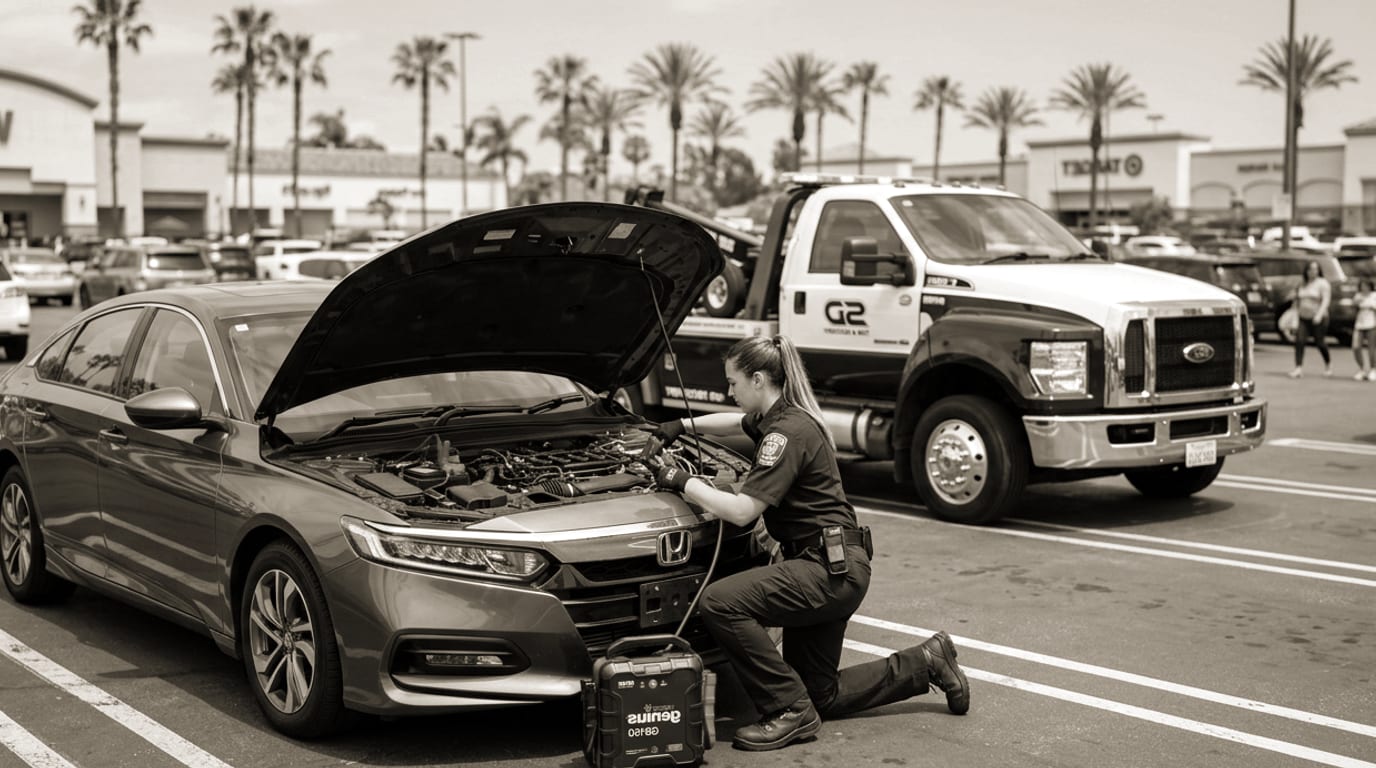
A dead battery on a weekend in El Paso usually means a jump start, a careful check under the hood, and a plan for getting the battery tested once shops reopen. If the car cranks slowly or clicks once and goes silent, a jump is worth trying; if you see damage, smoke, or a swollen battery case, stop and call for help instead. Check shop hours before you rely on one, and decide early whether you’re jumping it yourself or calling an operator.
Quick Tow EP is a referral service. We connect drivers with independent local tow operators. The driver hires and pays the operator directly, and the operator quotes the price. Quick Tow EP does no towing, roadside work, or storage itself.
First, get safe and figure out what you’re hearing
Before anything else, get yourself out of traffic. If the car will move, get it fully off the roadway to a safe location. If it cannot move, get out of the vehicle and to a safe location away from traffic when you can do so safely, and call 911 only for an emergency or if you are in immediate danger. Do not stand in traffic.
Then listen. Note what the car does when you turn the key, and write it down, because an operator will ask.
Check for anything that means stop: a battery case that looks swollen, liquid or corrosion crusted on top, a burning smell, smoke, or a battery that feels hot. If you see any of that, don’t attach cables. Move away from the vehicle and call for help.
Can you jump it yourself? Where do the cables go?
A self-jump is reasonable when you have a second vehicle, good cables, and a battery that looks intact. Check your owner’s manual first. Many newer cars hide the jump points under a plastic cover or route them to a remote positive terminal, and some have a designated ground point away from the battery. Follow the manual’s diagram rather than guessing.
The standard order, once you’ve confirmed the correct points:
- Park the working vehicle close but not touching, both engines off.
- Connect one end of the red cable to the dead battery’s positive terminal or jump point.
- Connect the other red end to the good battery’s positive terminal.
- Connect one black end to the good battery’s negative terminal.
- Connect the last black end to a bare metal ground on the dead car, away from the battery.
- Start the working vehicle, let it run a minute, then try the dead car.
- Once it starts, remove cables in reverse order.
Keep your face back from the battery while connecting, and don’t let cable clamps touch each other. If the dead car still won’t start after a couple of tries, stop. Repeated cranking drains what little charge is left, so stop and have the car tested.
When a jump won’t fix it
A jump may not help if the battery is old, cables are corroded, or the charging system or starter is at fault. Have it tested. Signs to stop and have the battery tested:
- The battery is old and has been slow to start for weeks.
- The case is swollen, cracked, or leaking.
- Terminals are heavily corroded or the cables feel loose.
- The car starts and then dies again quickly.
- You smell rotten eggs or burning near the battery, or you see smoke or swelling. These are safety stop signs: don’t attach cables, move away, and call for help.
Have the battery and connections checked, especially if the battery is several years old and has been slow to start. Plan on a test and possibly a replacement rather than nursing it along.
If you drive a hybrid or EV, check the owner’s manual before jumping anything. If the manual isn’t clear, call for help instead of experimenting. For EV-specific concerns, see our guide to towing an electric car on a flatbed.
Who to call on a Saturday, Sunday, or at night
If you’re stranded on I-10 from Transmountain Road to Horizon Boulevard, Loop 375 from I-10 West to Paisano, or US-54 from McCombs to Loop 375, TxDOT’s El Paso HERO program may be able to help. HERO crews provide battery jump starts at no cost, along with changing flat tires and adding air, gas, diesel and water, minor vehicle repairs, cell phone service, and drinking water for stranded motorists. Weekend hours are Saturday and Sunday from 9 a.m. to 9 p.m., and the number is 915-790-HERO (4376). In an emergency, call 911 first. HERO is a highway assistance program built around helping stranded motorists and keeping traffic moving, so if the car can’t be fixed on the spot, plan on a private tow. You can read more in our post on TxDOT HERO free roadside help in El Paso.
Off those highways, or outside HERO hours, you’re looking at a private operator. That’s where a referral service helps: you describe the situation, and Quick Tow EP connects you with an independent local operator who quotes the price and does the work. Ask the operator what services and hours they offer when you call.
If you’re nowhere near a highway, say so clearly. A battery dead in a garage, behind a gate, or in a lot with a low clearance entrance changes what equipment the operator needs. Mention blocked access, low ceilings, or a gate code up front.
What to tell the operator, and what it costs
Have this ready before you call:
- Your exact location, including direction of travel, nearest exit, and a landmark.
- Vehicle year, make, model, and fuel type (gas, hybrid, or EV).
- What the car does when you turn the key: clicks, slow crank, or nothing.
- Whether you see damage, corrosion, leaks, smoke, or smell anything.
- Whether the car is in a garage, behind a gate, or in a tight spot.
- Whether anyone is waiting with you and whether you’re in a safe spot.
Ask for the price before you agree to dispatch, and confirm what it covers: just the jump, or a service call plus the jump. Get the total in writing if you can, by text or email. Then check the operator. You can verify a tow operator’s license on the Texas Department of Licensing and Regulation license search before they arrive. It takes a minute and it’s worth it.
On cost: Quick Tow EP doesn’t set prices, and operators quote their own. If you carry towing and labor coverage on your auto policy, the Texas Department of Insurance says that coverage pays for labor to jump-start your battery, up to a dollar limit, and you pay anything above it (TDI). TDI also notes a company can refuse to renew that coverage after four towing and labor claims in 36 months. Our post on what roadside plans cover in El Paso walks through the insurance side.
After the jump: what to do next
Once it starts, don’t just kill the engine and park. Watch the dash on the drive: a battery or charging warning light, dimming headlights, or a car that stumbles and stalls are signs to stop and arrange a shop test rather than a diagnosis.
If it stalls or won’t restart, stop trying and arrange transport. Have the battery and charging system tested at a shop rather than relying on repeated jumps. A tow you call for yourself is a consent tow, priced by the operator you hire, with no TDLR maximum table applying to it.
Within a day or two, ask a shop to test the battery and charging system. That is the way to know whether you need a new battery or whether the charging system is the real culprit.
Frequently asked questions
My car won’t start on a Sunday. Who do I call?
If you’re on I-10, Loop 375, or US-54 within the HERO patrol area, call 915-790-HERO (4376) between 9 a.m. and 9 p.m. Saturday or Sunday. Otherwise, call a local tow operator or a referral service that can connect you with one. In an emergency, call 911 first.
How do I know if it’s the battery or the alternator?
Get a charging system test at a shop. It settles the question rather than leaving you to guess from symptoms.
Can I jump-start my car myself safely?
Yes, if the battery looks intact and you follow your owner’s manual for the correct jump points. Wear eye protection, keep the cables from touching each other, and stop if you see smoke, swelling, or smell burning. If anything looks wrong, call for help instead.
Where are the jump terminals on my car?
They’re usually at the battery, but many newer cars put the positive terminal under a red plastic cover or route it to a remote post, with a separate ground point nearby. Your owner’s manual shows the exact spots. Check the manual before jumping a hybrid or EV.
Will a jump start cost me anything?
That depends on who helps you. HERO provides jump starts at no cost on its patrol highways during its hours. A private operator sets its own price, so ask for the total before you agree, and check whether your towing and labor coverage reimburses part of it.
What should I do if the jump doesn’t work?
Stop cranking and arrange transport to a shop. Repeated attempts drain the battery further, so stop and have the car tested. Tell the operator the car won’t start and whether it’s in a garage, behind a gate, or in a tight spot so they bring the right equipment.
When to call for a tow
Call for a tow when the car won’t start after a reasonable jump attempt, when you see battery damage, smoke, or a burning smell, or when the car starts and dies again. A tow operator can move it to a shop for testing, and if you’re off the HERO highways or outside its hours, a private operator can move the car to a shop. Call (915) 320-5573 and Quick Tow EP will connect you with an independent local tow operator.